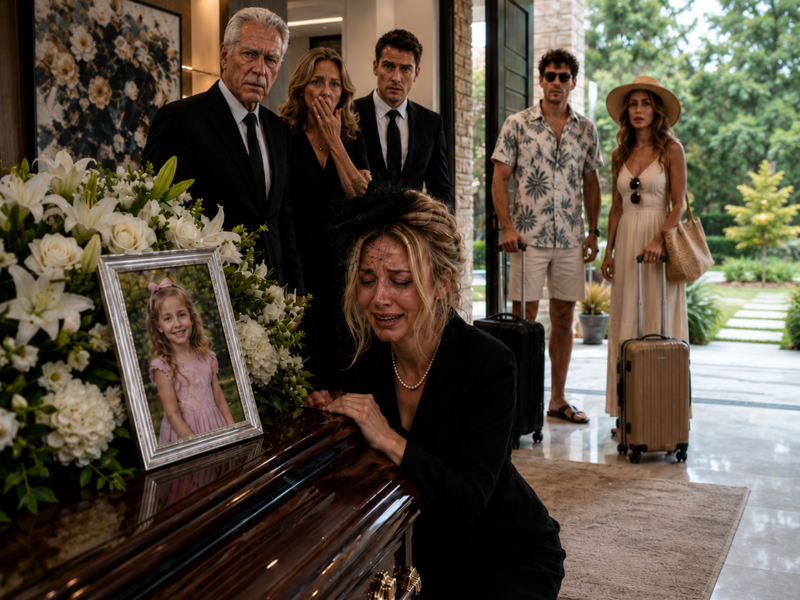
My husband went on a getaway with his personal secretary. Meanwhile, our daughter suddenly fell critically ill; I called him 107 times, but he never answered. When he returned a week later, he found our daughter’s funeral taking place. I will make him live the rest of his life in regret.
My husband went on a getaway with his personal secretary. Meanwhile, our daughter suddenly fell critically ill; I called him 107 times, but he never answered. When he returned a week later, he found our daughter’s funeral taking place. I will make him live the rest of his life in regret.
The first thing my husband said when he walked through the cemetery gates was, “Whose funeral is this?”
For one strange, suspended second, I thought the universe had finally developed a sense of humor.
Adrian stood twenty yards away from me in a cream linen shirt, sunglasses pushed into his hair, a small leather travel bag hanging from one hand. His skin was golden from the sun. There was a faint red mark near his collarbone, the kind left by too much heat or someone else’s mouth. Behind him, half hidden by the stone wall, stood Claire Bennett, his personal secretary, wearing the same white dress she had worn in the photographs I had received three days earlier.
Everyone turned to look at him.
My mother covered her mouth.
My brother Thomas lowered his eyes.
The priest stopped speaking.
And beside me, in a small white coffin covered with pink roses, lay our seven year old daughter.
Lily.
Adrian looked from the mourners to the flowers, then to me.
His expression changed slowly.
Confusion first.
Then irritation.
Then fear.
“What is this?” he asked.
My hands were clasped so tightly in front of me that my fingernails had cut crescents into my palms.
I had imagined this moment a thousand times during the previous forty eight hours.
I had imagined screaming.
I had imagined slapping him.
I had imagined throwing myself at him and beating my fists against his chest until he understood what every unanswered call had cost.
Instead, I heard my own voice come out strangely calm.
“This is Lily’s funeral.”
His bag slipped from his hand.
The sound it made against the gravel was small.
Almost ridiculous.
He stared at me.
“No.”
Nobody moved.
“No,” he repeated.
He took one step forward.
Then another.
“No, Evelyn.”
I watched the blood drain from his face.
“Where is she?”
I looked at the coffin.
His eyes followed mine.
And then my husband made a sound I had never heard from another human being.
It was not a cry.
It was not a scream.
It was the sound of something inside a person tearing beyond repair.
He stumbled forward, but Thomas stepped between us.
“Don’t,” my brother said quietly.
Adrian stared at him as if he had forgotten how language worked.
“That’s my daughter.”
Thomas’s jaw tightened.
“She was your daughter when Evelyn called you too.”
Adrian turned toward me again.
His face was gray.
“My phone…”
“One hundred and seven times,” I said.
He froze.
“I called you one hundred and seven times.”
Claire had begun to cry behind him.
I looked at her.
“Don’t.”
She stopped.
Not because I raised my voice.
Because she understood.
She had no right to cry in front of me.
Not yet.
Adrian reached for his pocket. His hands shook so badly that he dropped his phone once before managing to unlock it.
He stared at the screen.
I knew what he was seeing.
Missed calls.
Messages.
Voicemails.
Hospital alerts.
Calls from my brother.
Calls from my mother.
Calls from Lily’s school.
Calls from St. Catherine’s Children’s Hospital.
And at the bottom of it all, the notification that had been waiting for him while he drank champagne beside a turquoise sea.
Voicemail from Evelyn Hart.
Tuesday, 3:14 a.m.
“Adrian, they’re taking her into surgery. Please answer. She keeps asking for you.”
He sank to his knees on the cemetery path.
I turned away.
Because I had already buried my daughter once that week.
I refused to bury myself with him.
Seven years earlier, when Lily was born, Adrian had cried harder than I did.
He had held her against his chest and whispered that she was the most beautiful thing he had ever seen.
At the time, I believed him.
We had been married for four years then.
Young enough to still think love was something that happened naturally instead of something that had to be protected.
We met when I was twenty six and working as an architect for a small firm in Boston. Adrian was thirty, ambitious, funny, and so certain about the future that standing beside him made uncertainty seem impossible.
He had just started Hartwell Development with two college friends. They had one office, three employees, and enough debt to terrify any sensible adult.
I fell in love with him anyway.
Not because he had money.
He did not.
Not because he was powerful.
He was not.
I fell in love with the way he remembered details.
The fact that I hated raisins.
The fact that I always lost hair ties.
The fact that my favorite childhood book was The Secret Garden.
He once drove forty minutes through snow at midnight because I casually mentioned wanting cinnamon rolls.
That was Adrian then.
When we married, we rented a second floor apartment above a laundromat and slept through the sound of machines spinning below us.
We had one good pan.
Two mismatched mugs.
A mattress we bought on credit.
We were happy.
When Hartwell Development began to succeed, life changed gradually.
First came the larger apartment.
Then the townhouse.
Then the house in Brookline with twelve rooms, a garden, and windows I designed myself.
Adrian started traveling more.
Meetings in New York.
Conferences in Chicago.
Investors in London.
I reduced my hours after Lily was born.
Then, when she was three, I stopped working entirely because Adrian’s schedule had become so chaotic that someone had to make our family feel like a family.
He said it was temporary.
He said we were a team.
“You’re holding everything together while I build this,” he told me.
And for years I believed that counted as gratitude.
Maybe it did at first.
The problem with neglect is that it rarely arrives announcing itself.
It enters quietly.
Dinner at seven becomes dinner at nine.
Then dinner reheated alone.
A missed bedtime becomes three missed bedtimes.
A business trip gains an extra day.
A phone call becomes a text.
A text becomes a thumbs up emoji.
Eventually you find yourself sitting across from the person you married and realizing that you know more about the delivery driver’s week than your husband’s thoughts.
Claire entered our lives eighteen months before Lily died.
She was twenty nine, efficient, polished, and almost unnervingly competent.
Adrian hired her after his previous executive assistant retired.
“She’s incredible,” he told me after her first week.
At first, I was grateful.
Claire remembered school pickups Adrian forgot.
She reminded him about my birthday.
She sent flowers on our anniversary.
In hindsight, I should have found that last one insulting.
But when you are starved for attention, sometimes you thank the person carrying crumbs.
Claire was always around.
At company events.
At dinners.
At charity galas.
Sometimes at our house, laptop open at the kitchen table while Adrian took calls.
Lily adored her.
That part hurt most later.
Claire knew what stuffed animal Lily slept with.
She knew Lily hated mushrooms.
She knew our daughter wanted to be an astronaut, a veterinarian, and a bakery owner simultaneously.
Once, when Lily was sick with the flu, Claire brought her a book about planets.
“Miss Claire understands me,” Lily announced solemnly.
I smiled.
Adrian laughed.
There are memories that become knives only after the truth changes their meaning.
The first time I suspected something was wrong between Adrian and Claire was six months before Lily’s death.
I came downstairs after midnight for water and found Adrian sitting alone in the kitchen, smiling at his phone.
When he saw me, he turned the screen facedown.
“What?” I asked.
“Nothing.”
“Who was that?”
“Claire. Work.”
“At midnight?”
He sighed.
Not guilty.
Annoyed.
That hurt more.
“Evelyn, investors don’t stop having problems because you’re tired.”
Neither do wives, I thought.
But I said nothing.
I had become very good at saying nothing.
Three months later, I discovered a hotel receipt in his jacket pocket.
One room.
Two breakfasts.
Washington, D.C.
He had told me he stayed alone after a conference.
I confronted him.
He laughed.
Actually laughed.
“The hotel billed breakfast twice. You think I’m sleeping with someone because of eggs?”
I hated how foolish he made me feel.
I apologized.
That is another thing neglect does.
It teaches you to distrust your own pain.
Then came the getaway.
Adrian said he needed a week in the Caribbean to negotiate a private investment partnership.
He mentioned three executives who would supposedly be attending.
I asked whether Claire was going.
He hesitated for half a second.
“Yes. She’s coordinating everything.”
That half second followed me for days.
Two nights before he left, Lily climbed into our bed wearing purple pajamas covered in stars.
“Daddy, are you going to miss my science thing?”
Adrian looked up from his phone.
“What science thing?”
Her face fell.
“The planet presentation.”
I had reminded him four times.
“Friday,” I said.
He rubbed his forehead.
“I’ll be back Sunday.”
“It’s Friday,” Lily repeated.
“I know, sweetheart.”
She looked down.
“You said you would come.”
Adrian finally put his phone away.
He pulled her into his arms.
“I’ll video call you.”
“You always say that.”
The room went quiet.
Even at seven, children know exactly where to place the truth.
Adrian kissed her forehead.
“This time I promise.”
Lily studied his face.
Then she held out her little finger.
“Pinky promise.”
He hooked his finger around hers.
“Pinky promise.”
He left the following morning.
He did not call Friday.
Lily stood in front of twenty three classmates beneath a cardboard model of Saturn and kept looking toward the classroom door.
I watched her hope shrink every time footsteps passed in the hallway.
Afterward she smiled anyway.
“Daddy probably had a meeting.”
“Yes,” I said.
She took my hand.
“He’ll watch the video.”
“Yes.”
That evening, she said her stomach hurt.
I thought it was disappointment.
By midnight, she had a fever.
By Saturday morning, she could barely stand.
I drove her to urgent care.
They sent us immediately to the hospital.
At first the doctors thought it was appendicitis.
Then blood work showed signs of a severe infection.
By afternoon, her blood pressure was dropping.
Sepsis.
That word changed the temperature of the room.
Suddenly there were nurses everywhere.
Machines.
Monitors.
Doctors speaking in clipped sentences.
I called Adrian.
Once.
Twice.
Five times.
Ten.
No answer.
I texted him.
Lily is very sick. Call me now.
Nothing.
I called Claire.
Straight to voicemail.
I called Adrian’s business partner, Michael.
“Evelyn?” he said, surprised.
“Where is Adrian?”
“I thought he was with you.”
My blood turned cold.
“What?”
“He said he was taking personal time.”
I gripped the phone so hard my hand hurt.
“What investment meeting?”
There was silence.
“What meeting?”
“Evelyn, I don’t know what you’re talking about.”
That was the moment my marriage ended.
Not when I found photographs later.
Not when Claire confessed.
Not when Adrian walked into the cemetery.
It ended there.
In a hospital corridor that smelled like antiseptic and burnt coffee while my daughter fought for her life twenty feet away.
I hung up.
Then I called him again.
And again.
By Saturday night, I had called twenty eight times.
At 1:17 a.m., Lily opened her eyes.
“Mommy?”
I leaned over her.
“I’m here.”
“Daddy?”
The machines around her seemed unbearably loud.
“He’s coming.”
I lied because mothers are allowed to lie when the truth would break a sick child’s heart.
“When?”
“Soon.”
She closed her eyes.
“Tell him I did Saturn.”
“I will.”
“Mine was the best.”
“It was.”
She smiled faintly.
“I know.”
Sunday morning, the doctors told me the infection had damaged one of her heart valves.
There was a procedure they could attempt.
Risky.
Necessary.
I called Adrian forty six times by then.
I sent photographs.
I sent videos.
I sent one message entirely in capital letters.
YOUR DAUGHTER MAY DIE. ANSWER YOUR PHONE.
Nothing.
That afternoon, my brother tracked down the resort.
He called the front desk.
They refused to give guest information.
He called again pretending to be from Adrian’s company.
Eventually, someone confirmed that Mr. Hart had requested complete privacy and had specifically instructed staff not to put calls through to his villa.
His villa.
Not conference rooms.
Not meeting suites.
A private oceanfront villa.
Thomas booked the next available flight.
He would not arrive until Monday evening.
By then, Lily had deteriorated again.
The hospital chapel became the place where I learned what desperation does to dignity.
I prayed to a God I had ignored for twenty years.
I offered things no human being has the authority to offer.
My career.
My house.
My marriage.
My life.
Take anything.
Just not her.
Around 3:00 a.m. Monday, one of the nurses found me sitting on the chapel floor.
“Mrs. Hart?”
I stood so quickly I nearly fell.
“It’s Lily.”
I ran.
She was awake.
Barely.
But awake.
She looked tiny beneath the blankets.
Far too tiny for the machines surrounding her.
“Mommy.”
“I’m here.”
“Is Daddy here?”
My heart shattered again.
“No, sweetheart.”
She looked toward the door.
“He promised.”
“I know.”
“Maybe his phone broke.”
“Maybe.”
She was quiet for a long time.
Then she whispered, “Can I call him?”
I had already left dozens of messages.
But I unlocked my phone and opened Adrian’s contact.
Lily held it weakly in both hands.
The call rang.
And rang.
Voicemail.
She looked at me.
“Can I talk?”
I pressed record.
Her voice was so soft I had to hold the phone near her mouth.
“Hi, Daddy. It’s me.”
She paused to breathe.
“I’m in the hospital. Mommy says I’m being really brave.”
Another breath.
“I did Saturn at school. You can watch the video later.”
Her eyes closed for a second.
“I miss you.”
The monitor beeped.
Then she said the sentence that would follow Adrian for the rest of his life.
“You promised you always come if I really need you.”
She handed me the phone.
“Send it.”
I did.
At 3:14 a.m.
The voicemail Adrian saw for the first time beside our daughter’s coffin.
Monday afternoon, Thomas arrived at the resort.
He did not find Adrian in a meeting.
He found him on the beach.
With Claire.
A waiter later told my brother they had spent the afternoon drinking champagne.
Thomas took photographs.
Not because he was cruel.
Because he knew one day Adrian might lie.
Men like Adrian had learned to edit reality when reality became inconvenient.
Thomas walked directly toward them.
Adrian stood.
“What the hell are you doing here?”
Thomas hit him.
Once.
Hard enough to knock him backward into the sand.
Claire screamed.
“Your daughter is dying,” Thomas said.
Adrian stared up at him.
“What?”
“Your daughter is dying.”
Adrian grabbed for his phone from a nearby table.
It was not there.
Claire went pale.
That detail mattered later.
At the time, Thomas did not understand.
“Where is my phone?” Adrian demanded.
Claire said nothing.
“Where is it?”
She whispered, “Inside.”
Adrian ran toward the villa.
Thomas followed.
The phone had been locked in a bedroom safe.
Powered off.
Adrian opened it.
One hundred and two missed calls at that point.
He called me.
For the first time in almost three days, my phone showed his name.
I looked at it.
I could not answer.
Not because I wanted revenge.
Because the doctor was telling me Lily’s heart had stopped.
They revived her once.
Then again.
Adrian called seventeen more times while doctors worked on our daughter.
I did not hear them.
At 6:42 p.m., Lily died.
I was holding her hand.
The room did not become dramatic.
There was no thunder.
No scream from heaven.
A monitor flattened into one continuous tone.
A nurse began crying.
The doctor said, “Time of death, 6:42.”
And the universe continued.
Cars moved outside.
Elevators opened.
Somewhere, someone laughed.
I remember thinking how obscene it was that the world did not stop.
Adrian arrived at the airport too late for the last flight home.
He tried to charter a plane.
Weather grounded departures.
Then mechanical delays complicated connections the following morning.
The universe had finally decided to punish him with waiting.
But punishment was meaningless by then.
Lily was gone.
I did not tell him.
Not directly.
I sent one message.
Come home.
Then I turned off my phone.
For three days, I planned my daughter’s funeral.
I chose white flowers because she hated dark red roses.
I chose the blue dress she wore at my mother’s birthday.
I tucked her stuffed rabbit beside her.
I put a photograph of Saturn in the coffin.
And I listened to her final voicemail every night until I could no longer feel the shape of my own body.
I learned later that Adrian knew she had died before he reached the cemetery.
Thomas told him at the airport.
But denial is a strange mercy.
He kept telling himself there had been a mistake.
That perhaps we had misunderstood.
That maybe she had recovered.
He walked into the cemetery asking whose funeral it was because some part of him needed the world to lie.
The world did not.
After he collapsed, two men helped him to his feet.
He pushed them away and staggered toward the coffin.
I stepped in front of him.
“Evelyn.”
“No.”
“Please.”
“No.”
“I need to see her.”
The word need almost made me laugh.
“You needed a vacation.”
His face crumpled.
“Please don’t.”
“You needed privacy.”
“I didn’t know.”
“You needed the phone off.”
“I didn’t know.”
“One hundred and seven calls.”
“I didn’t know!”
His voice cracked across the cemetery.
I stared at him.
“That is exactly the point.”
Everyone became still.
“You did not know because you made sure nobody could reach you.”
He shook his head violently.
“No. I didn’t. Claire…”
Claire flinched.
I looked past him toward her.
For the first time, she met my eyes.
Something in her expression was wrong.
Not guilt.
Fear.
The distinction registered somewhere beneath my grief.
Adrian turned around.
“What?”
Claire said nothing.
“What did you do?”
Her lips trembled.
“Not here.”
“WHAT DID YOU DO?”
The priest stepped forward.
“Mr. Hart, please.”
Adrian looked at the coffin again.
Then he began sobbing.
I had known him for fourteen years.
I had seen him angry.
Drunk.
Proud.
Exhausted.
Terrified.
I had never seen him destroyed.
Part of me wanted that.
That is the truth.
There was a part of me, small and black and burning, that wanted him to crawl through every second I had survived.
I wanted him to wake at 3:14 a.m. for the rest of his life.
I wanted every little girl with brown curls to turn his blood to ice.
I wanted Saturn to haunt him.
I wanted him to hear Lily’s voice every time a phone rang.
I wanted regret to become the house he lived in.
And standing beside our daughter’s coffin, I made myself a promise.
I would not kill him.
I would not ruin him with lies.
I would not destroy him with anything except the truth.
The truth would be enough.
After the funeral, Adrian came home.
I told him he had thirty minutes to pack.
He stood in the foyer, still wearing the clothes from the cemetery.
“This is my house.”
I looked at him.
“Our daughter died three days ago.”
He closed his eyes.
“Evelyn…”
“Choose another sentence.”
“I’m sorry.”
“Not that one.”
“What do you want me to say?”
“Nothing.”
“I can’t leave you like this.”
A laugh escaped me.
“You already did.”
He sat on the bottom stair.
I walked past him.
He caught my wrist.
I looked down at his hand.
He released me immediately.
“Where am I supposed to go?”
“I don’t care.”
“Please.”
“You have twenty eight minutes.”
He packed a bag.
At the door he turned around.
“Can I have something of hers?”
“No.”
His face twisted.
“Evelyn.”
“No.”
“I’m her father.”
“You were.”
His shoulders dropped.
I hated myself a little for saying it.
But grief is not gentle.
He left.
Claire disappeared.
For forty eight hours, nobody knew where she was.
Then she appeared at my house at 11:30 on Thursday night.
I nearly called the police.
She stood beneath the porch light looking nothing like the woman from the cemetery.
No makeup.
Hair pulled back.
Eyes swollen.
She held a laptop bag against her chest.
“I need to talk to you.”
I stared at her through the partially opened door.
“If Adrian sent you…”
“He doesn’t know I’m here.”
“Leave.”
“Evelyn, please.”
“I buried my child four days ago.”
“I know.”
“You were on a beach with my husband.”
Her face collapsed.
“I know.”
I started closing the door.
“Adrian didn’t turn off his phone.”
I stopped.
The hallway behind me seemed to tilt.
“What?”
Claire looked at the ground.
“I did.”
I opened the door again.
The cold night air touched my face.
“You have ten seconds.”
She stepped inside.
We sat in the living room.
The room where Lily had built blanket castles.
The room where she danced to cartoon songs.
The room where three framed photographs showed a family that no longer existed.
Claire could not look at them.
“I need to tell you everything,” she said.
“You have one chance.”
She nodded.
“The trip wasn’t business.”
“I know.”
“Adrian and I had been having an affair for four months.”
I felt almost nothing.
The betrayal had become too small beside death.
“He planned to tell you?”
“No.”
The honesty surprised me.
“He kept saying he would end things with me. Then he would come back.”
“Romantic.”
Claire flinched.
“I deserve that.”
“You deserve much worse.”
“Yes.”
She rubbed her hands together.
“The first day at the resort, you called during dinner. Adrian saw your name.”
My breath stopped.
“What?”
“He saw your first call.”
Everything inside me went silent.
“He knew I called?”
“He saw one call.”
“And?”
“He said he didn’t want to deal with ‘home drama.’”
My stomach turned.
Claire continued.
“He put his phone facedown. You called again. He became irritated.”
I gripped the edge of the sofa.
“What happened?”
“I told him I would handle it.”
“Handle it.”
“I said I’d keep the phone in the room so we could have one uninterrupted day.”
“One day.”
“Yes.”
“You locked it in the safe.”
Her eyes filled.
“Yes.”
“Why?”
“I was jealous.”
The word was so pathetic that for a moment I could not understand it.
“Jealous.”
“He talked about Lily constantly.”
My mouth opened.
No sound came.
“I know how horrible that sounds.”
“No. You don’t.”
“I was jealous that even when he was with me, part of him belonged to his family. Every time you called, it reminded me that I was temporary.”
“So you locked his phone away.”
“Yes.”
“For three days.”
“I didn’t know Lily was sick.”
“You didn’t check?”
Claire started crying.
“No.”
“You never turned it on?”
“No.”
“Not once?”
“No.”
I stood.
She recoiled.
I walked to the window because if I stayed near her, I did not know what I might do.
Behind the glass, the garden was dark.
Lily’s yellow rain boots still sat near the back door.
“What about your phone?”
Claire wiped her face.
“I turned mine off too.”
“Why?”
“I wanted him to choose me.”
I turned around.
“My daughter died because you wanted a man to choose you?”
“No.”
She shook her head desperately.
“No, Evelyn. Lily died because she got sick. But I made it impossible for her father to know. I know that. I know.”
“You don’t get to separate those things.”
“I know.”
“No, you keep saying that, but you don’t know. Did you hold her while she asked for him?”
Claire covered her mouth.
“Did you tell her he was coming?”
She cried harder.
“Did you watch her stare at the door?”
“Stop.”
“Did you hear her say he promised?”
“Please.”
I crossed the room.
“Do not ask me for mercy.”
“I’m not.”
“Then why are you here?”
She looked at the laptop bag.
“Because Adrian is lying.”
A new kind of cold entered my body.
“About what?”
“Everything.”
She placed the laptop on the table.
“Yesterday, his attorney called me. They want me to sign a confidentiality agreement.”
“About the affair?”
“About the trip. The phone. Everything.”
I stared at her.
“Why?”
“His company is preparing for a major acquisition. If investors find out he abandoned his critically ill daughter while he was having an affair with an employee, the board may remove him.”
“So?”
“They offered me two million dollars.”
I laughed.
It sounded ugly.
“Congratulations.”
“I’m not taking it.”
“Then don’t.”
“There’s more.”
She opened the laptop.
“Adrian’s legal team is trying to erase the company travel records.”
I stared at the screen.
Emails.
Invoices.
Internal messages.
“They changed the trip in the system from personal leave to executive strategy retreat,” Claire said. “They’re backdating documents.”
“Who ordered that?”
“Adrian.”
For the first time since the hospital, I felt something stronger than grief.
Rage.
Not hot rage.
Cold rage.
Useful rage.
“He’s trying to pretend it never happened.”
“Yes.”
“And you have proof.”
“Yes.”
“How long before they delete it?”
“They already started.”
Claire swallowed.
“I copied everything before my access was revoked.”
I looked at her.
“Why?”
“Because I killed the last honest thing left in your marriage.”
“You didn’t kill it alone.”
“No.”
She closed her eyes.
“But I helped.”
I looked at the files on the screen.
There were photographs.
Messages.
Calendar changes.
Expense reports.
A hotel note.
PRIVATE GUESTS. DO NOT DISTURB.
Adrian’s signature.
There it was.
The weapon I had promised myself I would use.
Truth.
Claire looked at me.
“You can destroy him with this.”
“Yes.”
“If you send it to the board, he’ll lose the company.”
“Yes.”
“If it goes public, maybe everything.”
I looked at Lily’s photograph on the mantel.
Her front teeth were missing in that picture.
She was laughing.
I had spent days imagining Adrian suffering.
Now suffering sat on my coffee table in a black laptop.
One email.
One attachment.
One click.
I could take away the company he had chosen over us.
I could destroy his reputation.
His wealth.
His future.
He would wake every day knowing that one selfish week had cost him his daughter, his wife, and everything he had built.
I wanted to do it.
God help me, I wanted it more than I had wanted anything except Lily to live.
I asked Claire to leave the laptop.
She did.
For three days, I did not open it again.
Adrian called constantly.
Unlike me, he received answers.
From lawyers.
Not from me.
He sent letters.
I returned them unopened.
He sent flowers.
I donated them to the hospital.
He asked for Lily’s school drawings.
I refused.
Then, one week after Claire’s confession, he stood outside my front gate at 6:00 a.m. in the rain.
I watched him through the kitchen window.
He looked older.
His beard had grown.
His clothes hung differently on him.
He stood there for two hours.
Finally, I went outside.
“What do you want?”
“To talk.”
“No.”
“Five minutes.”
“You had seven years.”
“I know.”
“Stop saying you know.”
He nodded.
Rain ran down his face.
“I listened to her voicemail.”
My knees almost weakened.
I turned away.
“Every night.”
“Don’t.”
“She sounds scared.”
“Don’t.”
“She still thought I was coming.”
I spun around.
“You do not get to tell me what she sounded like.”
He stopped.
I stepped closer.
“You were not there.”
“I know.”
“You were drinking champagne.”
His eyes closed.
“I know.”
“You saw my call.”
His eyes opened.
Claire had told him she confessed.
“Yes.”
“You saw my call, Adrian.”
“Yes.”
“And you ignored it.”
“Yes.”
I slapped him.
The sound was sharp.
He did not move.
I slapped him again.
Then I hit his chest with both hands.
“You saw my call.”
“Yes.”
“You saw my call!”
“I’m sorry.”
“You promised her!”
“I know.”
“You promised her!”
“I know!”
His knees hit the wet pavement.
He covered his face.
“I know.”
I stood over the man I once loved while rain soaked both of us.
For one terrible instant, seeing him broken satisfied me.
Then I realized satisfaction lasted less than a second.
Lily was still dead.
Revenge could injure him.
It could not resurrect her.
That was the cruelty.
Nothing I did to Adrian could create a morning where Lily ran downstairs again.
Nothing.
I stepped back.
“Your lawyers are altering records.”
His hands fell from his face.
So Claire had not told him everything.
“What?”
“Do not lie.”
He stood slowly.
“Evelyn…”
“I have the files.”
His expression changed.
Fear.
“There are things you don’t understand.”
“Explain.”
“The company employs twelve hundred people.”
I laughed bitterly.
“Of course.”
“What does that mean?”
“It means somehow this becomes business.”
“If Hartwell collapses, families lose jobs.”
“My family already collapsed.”
“I’m trying to contain the damage.”
“The damage?”
“I didn’t mean Lily.”
“But you did.”
He looked sick.
“I meant the company.”
“There it is.”
“What?”
“The reason I lost you years before Lily died.”
He stared at me.
“You turn everything into an equation. Reputation. Risk. Profit. Damage.”
“That’s not fair.”
“No?”
“No. If the board removes me during the acquisition, financing can disappear. Projects freeze. People get laid off.”
“And therefore the world should believe you were on a strategy retreat?”
“No.”
“Then tell them the truth.”
He said nothing.
I nodded.
“Exactly.”
“Evelyn, please.”
“You are asking me to protect you.”
“I’m asking you to think about consequences.”
“I thought about consequences while signing permission for doctors to cut into our daughter’s chest.”
He looked away.
“Don’t.”
“I thought about consequences while deciding which dress to bury her in.”
“Please.”
“I thought about consequences when she asked why you had not come.”
He broke again.
I watched him fold inward.
And still, beneath the grief, I saw calculation.
He wanted forgiveness without exposure.
Regret without consequence.
Punishment in private.
He wanted to remain the respectable Adrian Hart to everyone except the people whose lives he had destroyed.
“No,” I said.
His face lifted.
“No what?”
“I will not help you erase her.”
“I’m not erasing Lily.”
“Yes, you are.”
“How?”
“By rewriting the week she died so you can survive it comfortably.”
“I will never survive it comfortably.”
“Then prove it.”
He stared at me.
“What do you want?”
There it was.
The question I had been waiting for.
What did I want?
His resignation?
His money?
His humiliation?
His suffering?
I had imagined answers.
But suddenly none of them felt large enough.
“I want you to tell the truth.”
“To whom?”
“Everyone.”
His face went still.
“The board?”
“The board.”
“My partners?”
“Yes.”
“Our families?”
“Yes.”
“Publicly?”
“Yes.”
His mouth tightened.
“That would destroy me.”
I stepped closer.
“Then now you understand.”
I turned toward the gate.
Behind me, he said, “And if I don’t?”
I stopped.
“If you don’t, I release everything.”
He looked toward the house.
“You’d burn down a company Lily would have inherited?”
“Do not use her name to protect your company.”
“I’m not.”
“You are.”
His voice rose.
“I am trying to save what I can!”
I turned back.
“You should have tried that a week earlier.”
He left.
The next morning, my lawyer called.
Adrian had filed an emergency petition regarding marital assets.
Not divorce.
Not yet.
An injunction.
He wanted to prevent dissemination of what his attorneys called proprietary corporate information.
The laptop.
The records.
The truth.
My lawyer, Rachel, explained the situation carefully.
“If you leak internal documents, they may argue breach, theft, interference, depending on how Claire obtained them.”
“They’re evidence.”
“Some are. Some are confidential business materials.”
“They’re falsifying records.”
“That changes things.”
“So we expose them.”
“We expose the right things, in the right way.”
I hated the patience in her voice.
Logic felt obscene when emotion was screaming.
“What if they delete everything first?”
“We preserve evidence.”
“What if Adrian wins the injunction?”
“We fight.”
“What if fighting takes months?”
“Then it takes months.”
“I want him to hurt now.”
Rachel went quiet.
Then she said, “Evelyn, do you want justice, or do you want him to suffer?”
The answer came instantly.
“Both.”
“That’s honest.”
“I’m not interested in being noble.”
“I’m not asking you to be.”
“Good.”
“But if you act only from rage, his lawyers will use that against you.”
I looked across the room at Lily’s stuffed rabbit.
“So what do I do?”
“You become more disciplined than he expects.”
That sentence saved me.
For the next month, I did nothing publicly.
Adrian’s attorneys expected a grieving wife to explode.
I did not.
They expected emotional emails.
I sent none.
They expected threats.
Rachel sent preservation notices.
We subpoenaed records legally.
Claire provided sworn testimony.
Michael, Adrian’s business partner, cooperated.
The resort produced documentation confirming there had been no corporate retreat.
The private villa reservation was Adrian’s.
The instruction to block communications was attached to the booking.
Then we found something worse.
On Friday afternoon, before Lily became critically ill, Adrian had sent Claire a message.
Take my phone tonight. Evelyn will probably call about Lily’s school thing and I don’t want another argument.
I stared at those words for nearly an hour.
Not because they proved he knew Lily was sick.
He did not.
But because they proved something almost equally painful.
He had knowingly chosen not to be a father before fate tested how expensive that choice would become.
I printed the message.
Then I placed it in a box with the hospital records.
Rachel asked what I planned to do.
“I don’t know.”
That was the truth.
In the meantime, Adrian changed.
At least outwardly.
He stopped going to the office.
He resigned temporarily as CEO pending a board review.
He moved into a small apartment near the hospital.
He began attending grief counseling.
I learned those things from other people.
I did not care.
Or I told myself I did not.
Then one afternoon, the hospital called.
The pediatric intensive care unit wanted permission to use a donation made in Lily’s name.
“What donation?”
There was silence.
“Mr. Hart donated five million dollars to establish a family emergency assistance fund.”
I nearly dropped the phone.
“He did what?”
“He requested anonymity, but because you’re Lily’s mother and the fund bears her name, we needed your approval.”
I hung up and called him for the first time since the funeral.
He answered before the first ring finished.
“Evelyn?”
“What did you do?”
Silence.
“The hospital.”
“Oh.”
“Five million dollars?”
“Yes.”
“You don’t get to buy forgiveness.”
“I know.”
“Stop saying that.”
“Sorry.”
“Why did you do it?”
He breathed slowly.
“There was a man outside the ICU.”
“What?”
“The night after the funeral, I went back.”
My chest tightened.
“You went to the hospital?”
“Yes.”
“Why?”
“I don’t know.”
I believed him.
“I sat in the corridor for six hours. There was a father sleeping in a chair. His son was in surgery. He told me he was going to lose his job because he had already missed too many shifts.”
I said nothing.
“He kept apologizing for being worried about money while his child was sick.”
Adrian’s voice broke.
“And I kept thinking I would have given everything I owned for one more hour with Lily.”
My eyes filled.
“So I thought maybe another parent shouldn’t have to choose.”
I closed my eyes.
“You should have asked me.”
“I know.”
“Adrian.”
“I won’t say it.”
The silence between us changed slightly.
Not softer.
Just less sharp.
“I’ll approve the fund,” I said.
“Thank you.”
“It changes nothing.”
“I understand.”
I hung up.
Three days later, I visited the hospital.
The fund had already helped two families.
A single mother whose daughter needed emergency surgery.
A father who could now stay beside his premature twins without losing his apartment.
I stood in the same corridor where I had begged Adrian to answer.
A nurse named Maria recognized me.
She had been with Lily on her final night.
She hugged me.
I cried for the first time in public since the funeral.
“I miss her,” I whispered.
“I know.”
“She was scared.”
Maria pulled back.
“No.”
I looked at her.
“She was brave.”
“That’s what people say when children are scared.”
“No. I mean she was brave while she was scared.”
I wiped my face.
Maria smiled sadly.
“She talked about you constantly.”
I almost laughed.
“She talked constantly in general.”
“That too.”
Then Maria hesitated.
“What?”
“There’s something I didn’t know whether I should tell you.”
My body went cold.
“What?”
“Lily gave me something.”
Maria walked to the nurses’ station.
She returned with a small envelope.
My name was written on the front in purple marker.
MOMMY.
I could not breathe.
“She wrote it the afternoon before surgery,” Maria said. “She told me to give it to you if she forgot.”
“If she forgot what?”
Maria’s eyes filled.
“To tell you.”
My hands shook as I opened the envelope.
Inside was one sheet of hospital notepaper.
The letters were uneven.
Mommy,
If I get better can we go see real Saturn? I know people cannot go there yet but maybe we can go somewhere with a big telescope. Daddy can come too if he is not busy. Please do not be mad at Daddy forever because sometimes people are dumb when they are busy. You say I have to forgive Nora when she takes my crayons. Daddy did worse than crayons but maybe he can have one more chance after he says sorry a million times.
I love you most in the universe.
Lily
At the bottom she had drawn three stick figures beneath a planet with rings.
One was me.
One was Lily.
One was Adrian.
I folded over in the hospital hallway.
Maria caught me.
For weeks, I had lived on anger because anger was easier than emptiness.
Anger gave me instructions.
Wake up.
Collect evidence.
Call lawyer.
Refuse flowers.
Punish Adrian.
Anger told me that if he suffered enough, perhaps the universe would balance.
Then my dead daughter handed me a letter and ruined the simplicity of hatred.
Daddy did worse than crayons.
I laughed and sobbed at the same time.
It sounded like Lily.
So painfully, perfectly Lily.
That evening, I sat on the floor of her bedroom.
Nothing had moved since she died.
Stars glowed faintly on the ceiling.
Her books were lined unevenly on the shelf.
A half finished drawing sat on her desk.
I read the letter again.
Please do not be mad at Daddy forever.
“I don’t know how,” I whispered.
Of course she did not answer.
But for the first time, I understood that making Adrian regret was not the same thing as making myself heal.
He deserved consequence.
But if my entire future became his punishment, then his failure would take the rest of my life too.
I could not let that happen.
Two weeks later, the Hartwell board scheduled a final hearing.
Adrian’s attorneys offered a settlement.
He would resign for eighteen months.
The company would pay a substantial charitable contribution.
The altered records would be corrected internally.
Claire would sign confidentiality documents.
I would agree not to release personal information.
In exchange, Adrian would transfer the house to me, give me full control over a trust established in Lily’s name, and settle the divorce generously.
Rachel slid the proposal across the table.
“It’s financially excellent.”
I stared at it.
“And morally?”
“That’s not my department.”
I smiled without humor.
“What would you do?”
“I’m your lawyer.”
“Pretend you’re not.”
Rachel leaned back.
“I’d ask what outcome lets you look at yourself ten years from now without shame.”
That night, Adrian came to the house.
He had requested one conversation.
I agreed.
We sat at the kitchen table.
The same table where we had celebrated Lily’s birthdays.
He looked thinner.
There was gray in his beard I had never noticed before.
“I’ll sign the settlement,” he said.
I looked at him.
“You will?”
“Yes.”
“Why?”
“I’m tired.”
“That’s not enough.”
“I’m tired of lawyers speaking for us.”
He placed something on the table.
His phone.
“I changed the password.”
I said nothing.
“It’s Lily’s birthday.”
My throat closed.
421.
April twenty first.
“You can look at everything.”
“I don’t want your phone.”
“I know.”
“Why are you here?”
He looked around the kitchen.
“Because this is probably the last time you’ll let me sit here.”
I had no answer.
He swallowed.
“I resigned.”
“Temporarily?”
“Permanently.”
I stared at him.
“The board doesn’t know yet.”
“Why?”
“Because you were right.”
I felt irritation rise.
“About what?”
“I kept trying to save what I could.”
He looked down at his hands.
“The company. My reputation. Money. Control.”
His voice became quieter.
“And none of it mattered.”
“That realization came late.”
“Yes.”
“You don’t get points for it.”
“I’m not asking for points.”
“Then what are you asking for?”
He looked at me.
“Permission to stop fighting you.”
The words landed strangely.
“I’m signing full ownership of the house to you. Half my shares go into Lily’s foundation. The rest I’ll sell over time.”
“What foundation?”
“The hospital fund.”
“That isn’t a foundation.”
“I want it to become one.”
I stared at him.
“A pediatric family support organization. Emergency expenses. Travel. Housing. Anything families need when their children are critically ill.”
My eyes burned.
“You decided this without me?”
“No. I’m asking.”
He pushed a folder toward me.
On the front was written:
THE LILY HART FOUNDATION
Underneath, smaller letters:
No Parent Should Have to Choose Between Being Present and Surviving.
I covered my mouth.
“I thought you might hate it.”
“I do.”
He nodded.
Then I whispered, “And I don’t.”
We sat in silence.
Finally, he said, “There’s something else.”
My body tightened.
“What?”
“I’m speaking to the board tomorrow.”
“You said you resigned.”
“I did.”
“What are you telling them?”
“Everything.”
I stared at him.
“The affair?”
“Yes.”
“The trip?”
“Yes.”
“The phone?”
“Yes.”
“The false records?”
“Yes.”
“Why?”
“Because you asked me to.”
“That was months ago.”
“I wasn’t ready.”
“And now?”
“I listened to Lily’s voicemail again last night.”
His face twisted.
“I realized she spent her last hours believing I was better than I was.”
I looked away.
“She said I always came when she really needed me.”
His voice cracked.
“I want to become the man she thought she had for a father, even if she never gets to see it.”
The kitchen blurred.
He reached into his jacket.
“I also brought this.”
He placed an envelope in front of me.
Inside were divorce papers.
Signed.
He had accepted every major term Rachel requested.
I looked up.
“You’re not contesting anything?”
“No.”
“Why?”
“Because I have already taken enough from you.”
For a moment, neither of us spoke.
Then he noticed the corner of Lily’s letter beneath a book.
“What is that?”
My hand moved over it instinctively.
“Nothing.”
He nodded.
He did not ask again.
That mattered.
The next afternoon, Adrian walked into a boardroom and destroyed his own reputation.
I know because the statement became public.
Not leaked.
Not exposed.
Released by Adrian himself.
He admitted the affair.
He admitted the vacation.
He admitted knowingly making himself unreachable for personal reasons.
He admitted that staff had later altered records under pressure from his legal advisors and said he had failed to stop it.
He accepted responsibility.
He resigned immediately.
His statement ended with six words:
My daughter deserved a better father.
The media exploded.
For two weeks, our tragedy became public property.
Headlines.
Television panels.
Photographs.
Strangers debating our marriage.
Some called Adrian a monster.
Some called him brave for confessing.
Some blamed Claire.
Some blamed me for not reaching him sooner through other channels, as though one hundred and seven calls were insufficient evidence of effort.
I learned quickly that grief becomes entertainment when enough people recognize your name.
I stopped reading.
Claire cooperated with investigators and returned the two million dollar offer without signing anything.
She sent me one letter.
I almost burned it.
Instead, I read it.
She did not ask forgiveness.
She wrote only that she was leaving the city, entering therapy, and volunteering with a crisis hotline because she needed to spend the rest of her life becoming someone who did not confuse being wanted with being valuable.
At the bottom she wrote:
I know there is no apology large enough for what I did. I am sorry anyway.
I never replied.
Forgiveness does not always require reunion.
Sometimes it simply means refusing to carry another person’s poison inside you.
The divorce became final eleven months after Lily died.
Adrian and I stood outside the courthouse in cold spring sunshine.
Neither of us knew what to say.
Finally, he asked, “Are you okay?”
“No.”
He nodded.
“Me neither.”
For some reason, that made me smile.
Very slightly.
He saw it.
His eyes filled.
“I haven’t seen you smile in almost a year.”
“Don’t make it important.”
“Too late.”
I shook my head.
He looked toward the street.
“The foundation application was approved.”
“I heard.”
“You could join the board.”
“No.”
“Okay.”
“Not yet.”
He looked back at me.
“Not yet?”
“I didn’t say yes.”
“I know.”
“But I didn’t say never.”
For the first time since the cemetery, something like hope crossed his face.
Not hope for us.
That mattered.
He finally understood there was no us to recover.
Some things die even when both people survive.
Our marriage was one of them.
But Lily’s memory did not have to die with it.
One year after her funeral, the Lily Hart Foundation officially opened.
I joined the board.
Not for Adrian.
For her.
The foundation purchased apartments near three children’s hospitals so families traveling for treatment could stay free.
It created emergency grants for parents missing work.
It funded transportation.
Meals.
Childcare for siblings.
Counseling after loss.
Adrian donated most of his remaining fortune.
People assumed it was a public relations strategy.
They did not know he refused every interview.
He did not attend fundraising galas.
He avoided cameras.
He worked from a small office in the back of the foundation headquarters and spent his days reviewing applications.
Sometimes he called families himself.
Once, I overheard him telling a father, “Go be with your son. We’ll handle the rent.”
His voice broke on the last word.
The father never knew why.
I did.
Regret had become Adrian’s permanent companion.
But over time, he stopped treating regret like punishment and started treating it like responsibility.
That difference changed everything.
On Lily’s second birthday after her death, Adrian asked if he could visit her grave at the same time as me.
My first instinct was no.
Then I remembered the letter.
Daddy can come too if he is not busy.
I said yes.
We met at the cemetery in the morning.
He brought pink tulips.
I brought sunflowers.
“She hated tulips,” I said.
He stared at them.
“No, she didn’t.”
“She absolutely did.”
“She said they looked elegant.”
“She told you that because you bought them.”
He blinked.
“What did she tell you?”
“That they looked like flowers trying too hard.”
Adrian laughed.
A real laugh.
Then immediately looked guilty.
I laughed too.
For ten seconds, we stood beside our daughter’s grave laughing about flowers.
Then we both cried.
Grief had taught me that opposite emotions can occupy the same body without canceling each other.
You can love someone and leave them.
You can forgive someone and never trust them again.
You can laugh beside a grave.
You can miss the person your husband used to be while knowing you would never marry him again.
Adrian crouched near the headstone.
“I’m sorry, bug.”
That had been his nickname for her.
“I’m sorry I didn’t come.”
He touched the stone.
“I think about that promise every day.”
My chest tightened.
He looked at me.
“I don’t expect you to forgive me.”
I was quiet.
“Lily did.”
His face changed.
“What?”
I took the folded letter from my coat.
I had carried it for almost a year.
He stared at it.
“She wrote this in the hospital.”
He did not reach for it.
“What does it say?”
“You can read it.”
His hands trembled as he accepted the page.
I watched his eyes move across Lily’s handwriting.
Halfway through, his knees gave out.
He sat in the grass.
Then he reached the line.
Daddy did worse than crayons but maybe he can have one more chance after he says sorry a million times.
A laugh broke through his sobbing.
“Oh, Lily.”
He pressed the paper against his mouth.
“Oh, baby.”
I sat beside him.
Not as his wife.
Not as his enemy.
As Lily’s mother sitting beside Lily’s father.
For a long time, we said nothing.
Then Adrian whispered, “She wanted us to forgive each other.”
“No.”
He looked at me.
“She wanted me not to be angry forever.”
“That’s different.”
He nodded.
“You’re right.”
I looked at the grave.
“I spent months trying to decide how to make you regret what you did.”
“You succeeded.”
“I know.”
“Every morning.”
“I know.”
“Every night.”
I turned toward him.
“That isn’t what I want anymore.”
He looked confused.
“What do you want?”
“I want you to remember.”
“I will.”
“No. Not just remember losing her.”
I pointed toward the foundation brochure visible inside my bag.
“Remember who she was.”
He looked down.
“She was funny.”
“Yes.”
“Bossy.”
“Extremely.”
“She cheated at Go Fish.”
“She called it strategy.”
“She hated tulips.”
“She did.”
He smiled through tears.
“I didn’t know that.”
“You know now.”
Three years passed.
My life slowly became mine again.
I returned to architecture.
At first part time.
Then fully.
I specialized in designing family spaces for hospitals.
Waiting rooms with natural light.
Sleeping areas for parents.
Play spaces for siblings.
Quiet rooms where terrible conversations could happen without fluorescent lights buzzing overhead.
The first pediatric center I designed included a rooftop garden with a small observatory.
Above the entrance was a bronze plaque.
THE LILY ROOM.
For Children Who Keep Looking at the Stars.
The night before it opened, I stood beneath the telescope and cried alone.
Then I heard footsteps.
Adrian.
I had invited him.
He stopped several feet away.
“This is beautiful.”
“She would have loved it.”
“She would have tried to touch everything.”
“She would have broken the telescope.”
“Definitely.”
We smiled.
Adrian had changed physically.
More gray.
Less polish.
He no longer looked like the man who once appeared on magazine covers celebrating young executives.
There was gentleness in him now.
Sadness too.
Permanent sadness.
I once thought that would satisfy me.
It did not.
I no longer needed his suffering.
I needed his goodness.
Not for me.
For the world Lily had left behind.
He looked through the telescope.
“What are we seeing?”
“Jupiter.”
“Not Saturn?”
“Wrong time of year.”
He smiled.
“Lily would complain.”
“She would demand a refund.”
We stood together beneath the dome.
After a while, he asked, “Are you seeing anyone?”
I looked at him.
“Adrian.”
“I’m not asking because…”
“Yes, you are.”
He smiled sadly.
“Maybe a little.”
I hesitated.
“Yes.”
Pain crossed his face.
He hid it quickly.
“Is he good to you?”
“Yes.”
“Does he answer his phone?”
The question was so unexpected that I almost became angry.
Then I saw his expression.
There was no self pity.
Only truth.
“Yes,” I said.
“Good.”
His eyes turned back toward the stars.
“I hope he always does.”
His name was Daniel.
We met through the hospital design project.
He was a pediatric surgeon.
For six months, I kept him at a distance.
He never pushed.
The first time I told him about Lily, he did not offer wisdom.
He did not tell me everything happened for a reason.
He simply listened.
When I finished, he said, “She sounds wonderful.”
That was when I began falling in love.
Not because he tried to repair my grief.
Because he respected it.
Daniel understood Adrian would always exist in my life.
The foundation.
Lily.
The grave.
Memories.
He never competed with a dead marriage.
That made room for something new.
Four years after Lily died, Daniel proposed.
Not in a restaurant.
Not beneath fireworks.
He proposed in my kitchen while I was making soup.
I laughed for almost a minute before saying yes.
At our wedding, there were only thirty people.
My mother.
Thomas.
Close friends.
Daniel’s family.
A small photograph of Lily sat beside my bouquet.
Adrian was not invited.
He did not expect to be.
But on the morning of the wedding, a package arrived.
Inside was a small silver necklace shaped like Saturn.
A note accompanied it.
For Evelyn.
Lily would insist on attending.
No signature.
None was necessary.
I wore it.
That evening, after Daniel and I danced beneath garden lights, I touched the necklace and looked at the stars.
I thought of the cemetery.
Of one hundred and seven calls.
Of the voicemail.
Of the man collapsing beside a white coffin.
I once believed my revenge would be Adrian’s regret.
I was wrong.
Regret was inevitable.
My real victory was that his failure did not become the final chapter of my life.
Five years after Lily’s death, the foundation had supported more than nine thousand families.
Adrian remained unmarried.
I never asked why.
I heard rumors occasionally.
A dinner with someone.
A brief relationship.
Nothing lasting.
Once, during a board meeting, I saw a young girl run toward him in the lobby.
Her mother followed.
“Mr. Hart!”
Adrian turned.
The girl wrapped her arms around his waist.
She was maybe eight.
Her hair was brown.
For one instant, his face broke.
Then he knelt.
“Hey, Mia.”
The mother was crying.
“My husband found work. We’re keeping the apartment.”
Adrian smiled.
“That’s great.”
“We would have lost everything without the foundation.”
He shook his head.
“You were with your daughter. That’s what mattered.”
The woman hugged him.
After they left, Adrian remained kneeling for several seconds.
I walked over.
“You okay?”
“No.”
I sat beside him on the lobby bench.
“She looked like Lily.”
“I know.”
He rubbed his eyes.
“Sometimes I think she’s going to walk around a corner.”
“So do I.”
“Does it ever stop?”
“No.”
He nodded.
Strangely, that seemed to comfort him.
After a moment, he said, “I used to think regret meant wanting to go back.”
“And now?”
“Now I think regret is knowing you can’t.”
I looked through the glass doors at families entering the building.
“So what do you do?”
“You go forward carrying the part you can’t change.”
That sounded like something grief had taught both of us.
Ten years after Lily died, the foundation opened its twentieth family residence.
We named it Lily House.
The building had twenty four apartments, a shared kitchen, playrooms, counseling offices, and a rooftop garden.
At the center of the garden stood a bronze sculpture of Saturn.
The dedication ceremony took place on a warm April evening.
Children ran through the grass.
Parents talked beneath strings of lights.
Music drifted from small speakers.
I stood beside Daniel, our hands linked.
Our son, Oliver, was eight.
Our daughter, Grace, was five.
They knew about Lily.
Not as a tragedy.
As their sister.
Her photograph was in our home.
Her Saturn model sat on Oliver’s bookshelf.
Grace occasionally spoke to Lily’s picture when she thought nobody was listening.
Adrian arrived quietly.
He had become Uncle Adrian to my children, though Daniel and I had discussed boundaries carefully.
It happened naturally.
Slowly.
He never tried to replace anything.
He simply showed up.
Birthdays.
School plays.
Hospital fundraisers.
Every phone call.
Every time.
Sometimes I wondered whether that was his lifelong penance.
Perhaps.
But penance can become love when practiced long enough.
That evening, Oliver ran toward him.
“Uncle Adrian!”
Adrian bent down as Oliver crashed into him.
“You came!”
“I said I would.”
“You always say that.”
Adrian froze.
So did I.
Oliver did not understand.
He continued excitedly, “And you always do!”
Adrian’s face changed.
His eyes filled.
He looked at me across the garden.
For a moment, the years disappeared.
I saw the young father holding newborn Lily.
The selfish executive ignoring his phone.
The broken man at the funeral.
The grieving father reading his daughter’s letter.
The man who spent ten years trying to become someone worthy of a promise he had once broken.
I gave him a small nod.
He hugged Oliver tightly.
“I always will,” he whispered.
Later, after the ceremony, the five of us climbed to the rooftop.
Daniel adjusted the telescope.
Grace complained she was cold.
Oliver asked seventeen questions about black holes.
Adrian stood near the Saturn sculpture.
I walked over.
“You’re quiet.”
He smiled.
“Just thinking.”
“Dangerous.”
“Very.”
Below us, windows glowed with warm light.
Families were cooking dinner inside Lily House.
Some children would recover.
Some would not.
But their parents would be there.
That mattered.
Adrian looked at the building.
“Do you think she’d like this?”
“Yes.”
“You’re sure?”
“She’d complain the Saturn sculpture isn’t scientifically accurate.”
He laughed.
“Then she’d like it.”
We stood in silence.
Finally, he said, “Thank you.”
“For what?”
“For not releasing everything that day.”
I looked at him.
“I did release the truth.”
“You let me release it myself.”
“Yes.”
“Why?”
I considered the question.
“Because there’s a difference between exposing someone and giving them one final chance to expose themselves.”
“I almost didn’t.”
“I know.”
“If I had refused?”
“I would have destroyed you.”
He smiled faintly.
“I know.”
“I meant it.”
“I know that too.”
“And part of me wanted to.”
“I deserved it.”
“Maybe.”
He looked surprised.
“Maybe?”
I turned toward him.
“For years, I thought your suffering was something you owed me.”
His eyes lowered.
“Then I realized the person you really owed was Lily.”
He looked toward Saturn.
“And I can never repay her.”
“No.”
The answer hurt him.
But truth sometimes does.
“You can only live differently because she existed.”
His eyes filled.
“I try.”
“I know.”
From across the rooftop, Grace shouted, “Mommy! Come look!”
I turned.
Daniel waved.
Oliver was bouncing beside the telescope.
I started walking toward them.
Then Adrian said, “Evelyn.”
I looked back.
“I am sorry.”
There had been a time when those words made me furious.
Now they sounded different.
Not because they had become enough.
They never would.
But because he had spent ten years putting actions behind them.
“I know,” I said.
He smiled.
And I finally understood why those two words no longer angered me.
Knowing is not the same as forgiving.
Forgiving is not the same as forgetting.
And forgetting is not required for peace.
I joined my family beside the telescope.
Grace climbed into my arms.
Daniel wrapped one arm around my waist.
Oliver shouted that he could see Saturn, though Daniel insisted he was looking at Jupiter.
Adrian came closer.
“Let me see.”
“No,” Oliver protested. “I’m first.”
“Respect your elders.”
“You’re not that old.”
Everyone laughed.
I looked around the rooftop.
Warm lights.
Children.
Stars.
A family that did not look anything like the one I once believed I needed.
And somehow, still, a family.
Different.
Complicated.
Scarred.
Alive.
I thought about the woman I had been beside Lily’s coffin.
She believed revenge would save her.
I wished I could reach back through time and hold her.
I would not tell her not to be angry.
She had earned every ounce of anger.
I would not tell her to forgive quickly.
Forgiveness demanded time, distance, consequence, and truth.
I would simply tell her that one day she would stand beneath the stars again and feel something other than pain.
One day she would hear children laughing without resenting the sound.
One day she would love again without betraying the daughter she lost.
One day the man she hated would become neither husband nor enemy, but simply another person who loved Lily and failed her and spent the rest of his life trying to honor her.
Adrian did live with regret.
He lived with it every day.
Whenever a phone rang late at night.
Whenever a child waited for a parent.
Whenever he saw Saturn.
Whenever April twenty first arrived.
Whenever he heard Lily’s voicemail, which he kept stored in three separate places because losing it terrified him.
But regret did not destroy him.
It changed him.
And that, I eventually realized, was a far greater consequence.
Destruction would have been easy.
Transformation required him to wake up every morning and remember exactly why he needed to be better.
Years later, when Adrian was sixty three, he suffered a mild heart attack during a foundation trip.
He recovered.
But the incident frightened all of us.
I visited him in the hospital.
When I entered the room, he looked at the clock.
“Twenty seven minutes.”
“What?”
“That’s how long it took you to come after Daniel called.”
I stared at him.
“You timed me?”
He smiled.
“I notice things now.”
“You’re impossible.”
“I learned.”
There was something on his bedside table.
A framed copy of Lily’s letter.
I had given him the original years earlier.
“You still carry that?”
“Everywhere.”
I sat beside him.
He looked older.
We both did.
“Evelyn.”
“Yes?”
“I’m scared.”
The honesty touched me.
“You’re going to be okay.”
“No. Not about this.”
“Then what?”
He looked at Lily’s letter.
“That when I die, if there’s something after this…”
His voice shook.
“What if she doesn’t want to see me?”
My heart broke for him in a way I never expected.
I reached across the bed and took his hand.
“She was seven.”
He laughed weakly.
“That isn’t an answer.”
“She wrote you one more chance.”
“A million apologies.”
“You’ve probably passed that.”
“Not even close.”
I squeezed his hand.
“If there’s something after this, Adrian, I don’t think Lily will be standing there with a calculator.”
He closed his eyes.
A tear slipped down his face.
“You think she’ll forgive me?”
I looked at the little drawing beneath her letter.
Three stick figures under Saturn.
“She already did.”
He cried quietly.
I sat with him.
Not because he was my husband.
He had not been for decades.
Not because I had forgotten.
I never forgot.
I sat with him because once, a little girl loved both of us more than anything in the universe.
That love had outlived the marriage.
It had outlived betrayal.
It had outlived rage.
In some strange way, it had even outlived death.
Adrian recovered.
He lived another eleven years.
When he died at seventy four, it happened quietly.
He had spent the afternoon at Lily House reading grant applications.
That evening, he went home, sat in his favorite chair, listened to Lily’s voicemail once, and fell asleep.
He never woke up.
I was seventy then.
Daniel stood beside me at the funeral.
Oliver and Grace were adults.
Hundreds of families attended.
People Adrian had helped.
Doctors.
Nurses.
Parents.
Children who were now adults because their families had received support at exactly the right moment.
There was no white coffin this time.
No stunned young wife.
No unanswered phone.
His coffin was surrounded by sunflowers.
I had chosen them.
After the service, I walked alone to Lily’s grave.
Adrian had purchased the plot beside hers decades earlier.
He never told me.
Rachel discovered it in his estate instructions.
The engraving on his stone was simple.
ADRIAN HART
FATHER
1959 TO 2033
Beneath it, one sentence.
I FINALLY LEARNED TO SHOW UP.
I laughed through tears.
“You dramatic idiot.”
Wind moved through the trees.
I sat between their graves.
Lily on one side.
Adrian on the other.
For the first time in decades, I played the voicemail from my own phone.
Lily’s tiny voice floated through the cemetery.
“Hi, Daddy. It’s me.”
I closed my eyes.
“I’m in the hospital. Mommy says I’m being really brave.”
The recording crackled softly.
“I did Saturn at school. You can watch the video later.”
Then the sentence.
The one that changed all of us.
“You promised you always come if I really need you.”
When the voicemail ended, I looked at Adrian’s grave.
“You came late.”
My voice trembled.
“Very late.”
I touched the grass above Lily.
“But I think she knew you eventually figured it out.”
The sun was setting.
Golden light passed through the branches.
Somewhere beyond the cemetery wall, children were laughing.
I stood slowly.
My knees complained.
I smiled.
Before leaving, I placed one sunflower on Lily’s grave.
Another on Adrian’s.
Then I walked toward Daniel waiting by the gate.
He held out his hand.
I took it.
Behind us were two people who had shaped my life.
One who taught me the size of love.
One who taught me the cost of taking love for granted.
Ahead of me was the life I had built after believing there could never be another life.
I looked once more toward the graves.
For years I had thought the story ended with one hundred and seven unanswered calls.
It did not.
That was only the moment everything broke.
What came afterward was harder.
Truth.
Consequence.
Grief.
Choice.
Forgiveness.
And the slow, stubborn work of building something warm from the ruins.
Daniel squeezed my hand.
“Ready?”
I looked toward the evening sky.
A bright point of light was appearing above the trees.
For one foolish, beautiful second, I imagined Saturn.
“Yes,” I said.
And this time, when I walked away, I did not feel as though I was leaving anyone behind.
𝐷𝑖𝑠𝑐𝑙𝑎𝑖𝑚𝑒𝑟: 𝑇ℎ𝑖𝑠 𝑐𝑜𝑛𝑡𝑒𝑛𝑡 𝑚𝑎𝑦 𝑏𝑒 𝑐𝑟𝑒𝑎𝑡𝑒𝑑 𝑏𝑦 𝐴𝑙 𝑓𝑜𝑟 𝑒𝑛𝑡𝑒𝑟𝑡𝑎𝑖𝑛𝑚𝑒𝑛𝑡 𝑢𝑟𝑝𝑜𝑠𝑒𝑠. 𝐴𝑛𝑦 𝑟𝑒𝑠𝑒𝑚𝑏𝑙𝑎𝑛𝑐𝑒 𝑡𝑜 𝑟𝑒𝑎𝑙 𝑝𝑒𝑟𝑠𝑜𝑛𝑠, 𝑒𝑣𝑒𝑛𝑡𝑠, 𝑜𝑟 𝑝𝑙𝑎𝑐𝑒𝑠 𝑖𝑠 𝑐𝑜𝑖𝑛𝑐𝑖𝑑𝑒𝑛𝑡𝑎𝑙.)