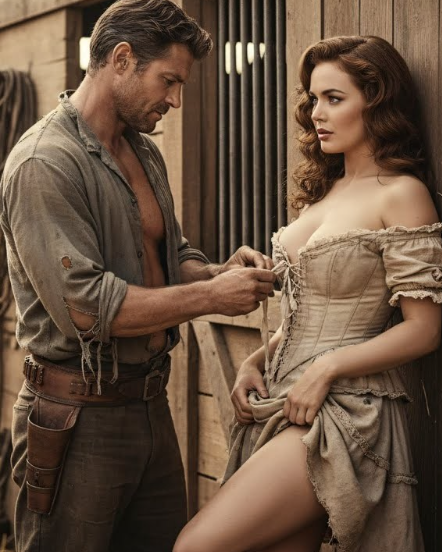
“Open It Up… Now ” — The Rancher Did It And Then… He Had A Wife
“Open It Up… Now ” — The Rancher Did It And Then… He Had A Wife
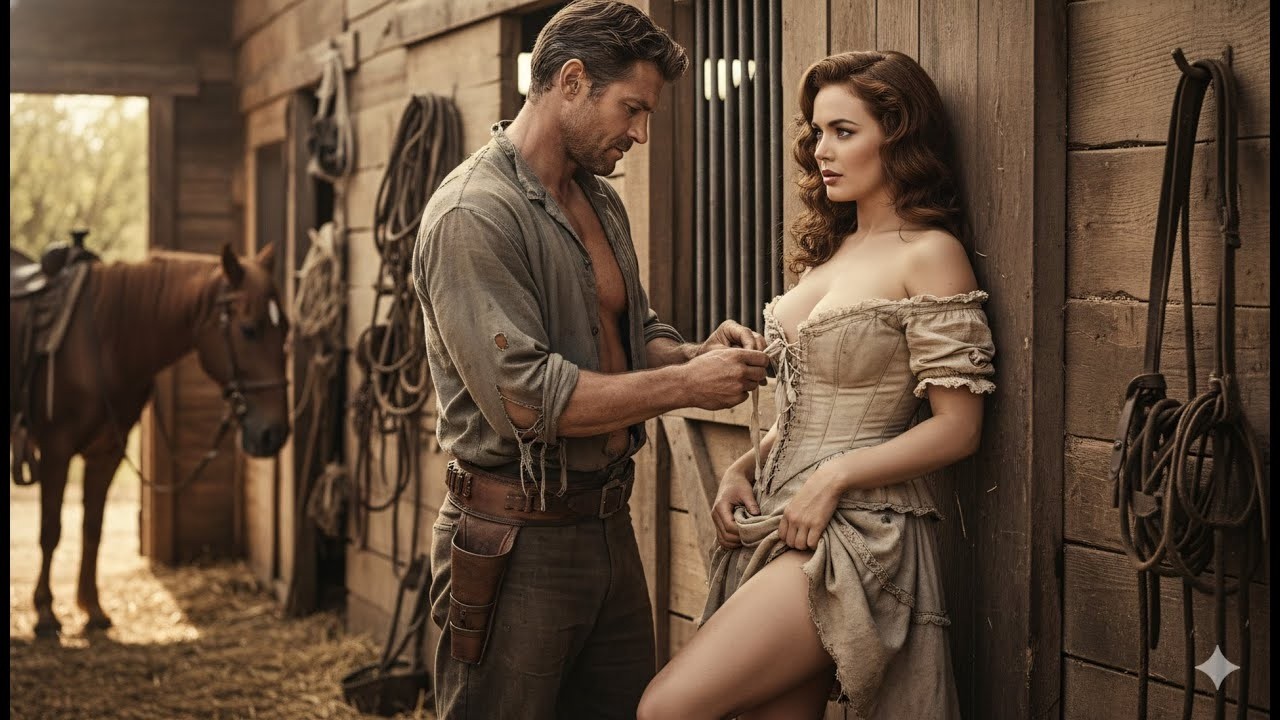
The wind on the high plains of Wyoming did not just blow. It hunted. It scoured the earth in the late 1880s, stripping the soil down to hardpan and turning the dried winter grass into brittle lances that rattled against boot leather.
It was a living, breathing malice that sought out any crack in a wall or gap in a coat collar.
Ethan Calloway stood in the center of this vast, gray expanse. A pair of fencing pliers heavy in his gloved hand.
He was a man seemingly carved from the same granite that jutted out of the foothills to the west.
His shoulders were broad, set with the permanent tension of a man who expects a blow, and his face was a map of weathered skin etched deep by 35 years of harsh seasons and harder memories.
He squinted against the biting cold, his eyes the color of flint, watching the horizon where the sky pressed down on the earth.
It felt too wide for one man. It always did. He gripped a loose strand of barbed wire, the metal biting into the thick leather of his glove, and pulled it taut against the cedar post.
The wood groaned, resisting him, but Ethan held it fast, driving a staple in with three sharp, violent strikes of his hammer.
The sound cracked like a pistol shot, swallowed instantly by the wind. This was his life.
The rhythm of it was as unyielding as the seasons. He woke before the sun, the air in his small log cabin cold enough to freeze water in the basin.
He broke the ice to wash his face, drank coffee that tasted like mud and iron, and went out to work until his fingers were numb and his back ached with a dull, familiar throb.
He moved cattle through patches of crusted snow, checking for calves too weak to stand, his horse stepping carefully over the treacherous ground.
Ethan worked alone. He ate alone. He slept alone. There had been a time when the silence of the ranch was peaceful, but lately it had curdled into something heavier.
It felt like a judgement. Inside the bunkhouse, which he used now only for storage since moving into the main cabin, dust motes danced in shafts of pale winter light.
In the main house, his evenings were spent mending tackle or reading by the light of a kerosene lamp.
On the rough-hewn mantelpiece sat a tin box. It contained the only conversation he had left, a stack of letters from his brother, Samuel.
Samuel, who had died 3 years ago not from a bullet or a horse, but from a fever that burned him up in 3 days.
Ethan still read the letters sometimes, tracing the ink with a callus-hardened thumb, trying to remember the sound of a voice that laughed.
The town of Bitter Creek lay 12 miles to the east, and Ethan avoided it when he could.
He was not welcome there, not truly. He was tolerated because his coin was silver and his credit was good, but he saw the way mothers pulled their children closer when he tied his horse to the hitching rail.
He heard the whispers that trailed behind him like smoke. “He killed a man.” It did not matter that it had happened two territories away, in a saloon in Deadwood that smelled of sawdust and stale whiskey.
It did not matter that the circuit judge had ruled it self-defense, noting that the other man had drawn first and with drunk murderous intent.
The people of Bitter Creek only knew that Ethan Callaway had taken a life, and that he lived alone on the edge of the badlands, and that there was a darkness in him that did not wash off.
He was the wolf at the edge of the campfire light, useful to keep the other predators away, perhaps, but never invited to sit and eat.
Ethan finished the section of fence and wiped a gloved hand across his nose. The sky to the north was bruising, turning a deep, unsettled slate.
A storm was coming, a bad one. The air held that metallic tang of snow, and the temperature was dropping fast.
He needed supplies if he was going to wait it out. He mounted his mare, a sturdy bay named Bess, and turned her head toward town.
She snorted, shaking her mane against the chill, and they set off at a trot, the hoofbeats muffled by the frozen earth.
Bitter Creek was a huddle of wooden buildings clinging to the prairie. Their false fronts bleached gray by the sun and wind.
The main street was a mess of frozen ruts and mud that had turned to stone.
Horses stood tethered with their heads low, tails flicking at the wind. Ethan rode in with his hat pulled low, the brim shadowing his eyes.
He could feel the gaze of the town on him. Two men loafing on the porch of the general store stopped talking as he passed, their eyes tracking him.
He ignored them, his spine stiff. He was used to the silence that fell when he entered a room.
He dismounted at the livery, paid a boy a nickel to watch Bess, and walked toward the freight office.
He needed flour, coffee, and lamp oil. He wanted to be in and out before the first flake fell.
The freight office was a cavernous building that smelled of dry pine, tobacco, and burlap.
Dust hung in the air. Behind the high counter stood Silas Higgins, the clerk. Silas was a thin man with watery eyes and a smile that never quite reached them.
He wiped his hands on a rag as Ethan approached. Afternoon, Calloway, Silas said, his voice pitching up slightly.
Ethan nodded once. Silas, I have a list. Silas took the scrap of paper, glancing at it, but his eyes darted back to Ethan with a strange, nervous energy.
I can get these, But you got something else here, something big. Ethan frowned. I did not order anything else.
Came in on the wagon yesterday from the rail head, Silas said, leaning over the counter.
Addressed to you. Ethan Calloway. Box four. Bitter Creek. His brand is on the manifest.
Ethan felt a prickle of unease at the base of his neck. He had ordered nothing.
He had no family left to send him gifts. Where is it? Silas gestured toward the back of the room where the shadows were deepest.
Two local loafers, men Ethan recognized as ranch hands from the Bar T, were leaning against a stack of barrels, watching with smirking interest.
Ethan walked around the counter, his spurs jingling softly. In the center of the floor sat a crate.
It was large, made of rough pine planks nailed shut tight. It was long enough to hold a piece of farm machinery, perhaps a new plow or a thresher part, but it looked odd.
There were no markings from a manufacturer, just his name scrawled in thick black grease pencil on the top, and a few holes bored into the sides near the top, as if for ventilation.
Ethan stared at it. This is a mistake. No mistake, Silas said, coming up behind him, clutching a clipboard.
Paperwork matches. You have to sign for it. I am not signing for what I do not know, Ethan said, his voice low and rough, like gravel sliding.
Silas chuckled, a nervous grating sound. Come on, Calloway. Maybe you ordered yourself some fancy Eastern goods and forgot.
A piano, or maybe a statue. One of the loafers by the wall laughed. Maybe it is a mail-order bride.
Calloway, one that does not talk back. The other man snickered. Too quiet for a bride.
Maybe it is just the Ethan felt a flash of anger, hot and sudden. He turned his cold stare on the men, and their laughter died in their throats.
They shifted their feet, suddenly interested in the floor. Silas cleared his throat, thrusting the clipboard forward.
“Look, storm is coming. I want to close up. If it is really yours, open it up.
Now, then you can see it is no mistake.” Ethan looked at the crate again.
It sat heavy and silent on the floorboards. A strange dread curled in his gut.
He did not want to open it. He wanted to walk away, get on his horse, and ride back to the silence of his ranch.
But the curiosity of the room was a physical weight. “Give me a bar,” Ethan said.
Silas handed him a heavy iron crowbar. Ethan weighed it in his hand, the cold metal biting into his palm.
He stepped up to the crate. He jammed the flat edge of the bar under the lid and shoved down.
The wood shrieked as the nails pulled free. It was a violent sound in the quiet room.
Ethan repositioned the bar and pried again, sweat breaking out on his forehead despite the cold.
He expected the gleam of oiled steel, the dull shape of iron tools. He wrenched the lid back, the wood splintering, and threw it aside.
The air in the room seemed to vanish. Inside the crate, nestled in a bed of filthy straw, was not a machine.
It was a woman. Ethan froze, his breath caught in a painful knot in his chest.
She was curled on her side, knees drawn up to her chest in a desperate attempt to preserve warmth.
She was wearing a dress that might have once been white, a wedding dress, laced and elaborate, but it was now gray with grime and torn at the hem.
Her feet were bare and blue with cold. A thin, scratchy blanket was tangled around her legs, and an empty ceramic water jug lay near her head.
She looked dead. Her skin was the color of old parchment, pale and waxy. Her dark hair was matted against her cheek.
Ethan dropped the crowbar. It hit the floor with a deafening clang that made Silas jump.
Sweet mother of God, Silas whispered, backing away. The noise seemed to reach the woman.
A tremor went through her. So faint, Ethan almost missed it. Her eyelids fluttered, struggling against a heavy weight.
They opened just a crack. Ethan found himself staring into eyes that were dark, glazed, and terrified.
She saw him, a looming, scarred figure in a heavy coat, and a small whimpering sound escaped her cracked lips.
Then her eyes rolled back, and she went limp again. The silence in the freight office shattered.
She is alive, one of the loafers shouted. What in the hell is this? Silas stammered, waving his hands as if to ward off the sight.
You ordered a woman, Calloway, like a side of beef. The accusation hung in the air, ugly and sharp.
Ethan looked up, his face darkening. I ordered nothing. Papers say she is yours, Silas shrilled, his fear turning to defensive anger.
Look at the manifest. One package delivered to E. Calloway. That is you. I ain’t responsible for this.
This is some sickness. The loafers were whispering now, their voices loud and crude. Look at that dress.
She is a [ __ ] Has to be. Who else gets shipped in a box?
Maybe Calloway finally found a woman who could not run away. The words hit Ethan like stones.
He looked down at the woman. She was so small. The bruises on her arms were shaped like fingerprints, man’s fingerprints.
There was a cut on her cheekbone, dried and angry. She had been packed in there like cargo, nailed into the dark, and shipped across the territory to a man she did not know.
The cruelty of it made Ethan’s vision blur. It reminded him of the saloon in Deadwood, the way men looked at things they thought they owned.
He did not think. He moved. He stripped off his heavy buffalo hide coat. The cold air bit at his flannel shirt, but he did not feel it.
He leaned into the crate, ignoring the smell of stale fear and sickness. “Do not touch her,” Silas warned.
“We should get the sheriff.” “Get out of my way,” Ethan snarled. The tone of his voice was not human.
It was pure animal warning. Silas and the loafers scrambled back, pressing themselves against the wall.
Ethan reached down and scooped the woman up. She was terrifyingly light, nothing but bone and fragile skin.
Her head lolled back against his shoulder, her neck exposed and vulnerable. He wrapped his coat around her, pulling the fur tight to shield her from the gawking eyes of the men.
He lifted her out of the box, holding her high against his chest. Her coldness seeped through his shirt, chilling his skin, but it only made him hold her tighter.
He felt a fierce protective surge rise in him, ancient and overwhelming. She was not a crate.
She was not a package. He turned and walked toward the door. “You can’t just take her,” Silas yelled, though he made no move to stop him.
“That is highly irregular.” Ethan paused at the door, turning his head. The look he gave Silas was cold enough to freeze the man’s blood.
“You said she is mine,” Ethan said. “I am taking her.” He kicked the door open and stepped out into the wind.
The street was emptying as the first stinging pellets of snow began to fall. A few people were rushing from the general store to their wagons.
They stopped, staring openly at the large scarred rancher carrying a bundle wrapped in a buffalo coat.
A woman’s limp hand dangled from the folds, the lace of a torn sleeve fluttering in the gale.
Ethan ignored them all. He did not look left or right. He marched to the livery stable, his boots crunching in the frozen mud.
“Get my wagon,” he ordered the stable boy. “Now.” The boy, wide-eyed, scrambled to hitch Bess to the buckboard.
Ethan stood in the shelter of the stable overhang, shielding the woman’s face from the wind with his own body.
She was breathing, but it was shallow. A ragged hitch in her chest. When the wagon was ready, Ethan laid her gently in the bed on top of the burlap sacks he kept there.
He climbed up, grabbed the reins, and drove the wagon back to the freight office.
He did not go inside. He jumped down, ran in, and grabbed the papers that Silas had left on the counter, along with a thick envelope he saw tucked into the straw of the crate.
“Hey!” Silas shouted. Ethan ignored him, climbed back into the wagon, and snapped the reins.
The drive back to the ranch was a race against the sky. The snow was falling in earnest now, hard little pellets that stung the face like buckshot.
The wind howled, trying to push the wagon off the rutted track. Bess lowered her head and pushed through, sensing Ethan’s urgency every time the wagon jostled over a frozen rut.
Ethan glanced back. The woman had not moved. She was a lump beneath his coat.
He worried she would freeze before they got there. He worried the jostling would kill her.
He worried about who she was and what kind of trouble followed a woman shipped in a box.
But mostly, he watched the fragile rise and fall of the coat, praying it would not stop.
The 10 miles felt like a hundred. The light was failing, the gray sky turning to a bruised purple and then to black.
The snow began to stick, turning the world into a featureless white void. Ethan navigated by instinct and by the line of fence posts that marked his land.
Finally, the dark shape of his cabin appeared through the swirling white. He pulled the wagon up to the porch, not bothering to take it to the barn yet.
He leaped down, his knees protesting the impact, and scooped the woman up again. She felt even colder now.
He kicked the cabin door open and carried her inside. The cabin was dim, the fire in the hearth having burned down to red embers, but it was out of the wind.
He carried her to his bunk, the only real bed in the place, and laid her down.
He moved quickly, his hands shaking slightly, not from cold, but from adrenaline. He built up the fire, feeding it kindling until the flames roared and light danced on the log walls.
He filled the kettle and swung it over the heat. He turned back to the bed.
He needed to get her warm. He needed to check for injuries. Ethan hesitated. He stood over her, his hands hovering.
He was a man who had lived without a woman for a decade. He was a man the town whispered about.
To touch her, to undress her enough to find injuries, felt like a violation, even if it was to save her life.
But looking at her blue lips, he knew he had no choice. “Forgive me, ma’am.”
He whispered to the unconscious woman. He peeled back the heavy buffalo coat. She lay there in the ruined wedding dress, the bodice tight and restrictive.
He could see the shallow movement of her ribs. He worked with awkward care. He unlaced the the boots from her feet, chafing her icy toes between his rough palms to bring blood back.
He found a clean wool blanket and tucked it around her. He wet a cloth with warm water and gently wiped the grime from her face.
As the firelight brightened the room, he saw her clearly for the first time. She was young, perhaps [clears throat] 25.
Her face was thin, her cheekbones sharp. There was a darkness under her eyes that spoke of long exhaustion.
The bruise on her jaw was blooming purple, an ugly mark against her pale skin.
Her lip was split. Ethan sat back on his heels, the wet cloth in his hand.
The wind shrieked outside, shaking the cabin door in its frame, a sound like a thousand screaming ghosts.
He looked at the woman in his bed, a stranger, a mystery. What kind of desperation forced a woman into a box?
What kind of men nailed the lid down? Ethan looked at his own hands. They were large, scarred, capable of violence and hard labor.
They were not hands made for holding something this broken. >> [clears throat] >> He stood up and walked to the window, staring out at the white chaos of the storm.
He was trapped here now, trapped with her. The snow would pile up deep tonight.
No one could get in and no one could get out. He turned back to look at her.
She made a small sound, a whimper of pain in her sleep, and shifted beneath the blankets.
Ethan Calloway, the man who wanted nothing more than to be left alone, walked back to the fire and added another log.
He pulled a chair close to the bed and sat down to keep watch. The revolver on his hip heavy and reassuring.
While the storm tried to tear the world apart outside, for 3 days, the world ceased to exist beyond the walls of the cabin.
The blizzard that descended on the high plains was not merely weather. It was a siege.
The wind struck the hewn logs with the force of a battering ram, shaking the chinking loose and driving fine, white powder through the smallest cracks.
Inside, the air grew heavy with the smell of wood smoke and damp wool. Ethan Callaway moved through the dim light like a ghost in his own home.
He did not sleep, or if he did, it was in snatching intervals. Sitting upright in the hard wooden chair by the hearth, his chin resting on his chest until the snap of a log woke him.
His focus was entirely on the woman in his bed. She burned with fever. It radiated off her like heat from a stove, turning her pale skin flushed and dry.
She tossed on the narrow mattress, tangling her legs in the heavy quilts, muttering words in a language of delirium that Ethan could not understand.
Sometimes she cried out sharp, terrified sounds that made Ethan flinch as if he had been struck.
He kept the fire roaring, feeding it from the stack of wood he had piled near the door before the snow sealed them in.
He melted buckets of snow on the iron stove, the water hissing as it hit the hot metal.
With hands that were scarred from branding irons and barbed wire, hands that had taken a life, he tended to her with a terrifying gentleness.
He dipped rags into the cool water and laid them across her forehead. He lifted her head to trickle water between her cracked lips.
He felt like a trespasser. Every time he touched her to adjust the blanket or check the heat of her skin, he felt the weight of his own roughness.
He was a man of the outside, of cattle and iron. She was fragile, bruised, and broken, and he was the only thing standing between her and the cold dark.
On the fourth morning, the wind finally died. The silence that followed was so absolute it made Ethan’s ears ring.
The gray light filtering through the frosted windowpanes grew stronger, shifting from the gloom of the storm to the bright, hard clarity of a winter morning.
Ethan was at the stove, scraping coffee grounds into a pot, when he heard the rustle of straw ticking.
He froze, the spoon suspended in the air. He turned slowly. The woman was awake.
She was pushed up against the headboard, the quilt pulled tight to her chin. Her eyes, the color of wet river stones, were wide and fixed on him.
There was no delirium in them now, only a stark, animal terror. She looked at the door, then back to him, her breathing coming in shallow, ragged gasps.
Ethan set the spoon down carefully. He held his hands up, palms open, showing he held no weapon.
“Easy,” he said. His voice was rough from days of silence, and he cleared his throat to soften it.
“You are safe.” She did not answer. She pressed herself further back against the logs, her gaze darting to the window, then to the heavy revolver hanging from the peg by the door.
“My name is Ethan Callaway,” he said, keeping his voice low and plain. “You are on my ranch, about 12 miles west of Bitter Creek.”
“Where?” Her voice cracked, a dry rasp. She swallowed and tried again. “Where is the box?”
Ethan felt a chill that had nothing to do with the temperature of the room.
“The box, not the wagon, not the train, the box.” “It is in the barn,” he said.
“I burned the straw.” She squeezed her eyes shut, a shudder running through her small frame.
She looked down at herself, realizing she was not wearing the dress she had arrived in, but was wrapped in a spare flannel shirt and buried under blankets.
Her hand flew to her throat. “I found you in town,” Ethan said quickly, seeing the panic rising in her.
“At the freight office, the clerk there was a crate addressed to me. I opened it.
You were inside. He watched her process this. She looked at his face, searching for the lie, but found only the flat, exhausted truth written there.
“You took me out?” She whispered. “I did.” “Why?” The question hung in the air, simple and devastating.
Why would a man take a broken thing out of a box unless he intended to use it?
“Because you were dying,” Ethan said. “And because I do not hold with shipping people like cattle.”
She stared at him for a long time. The terror did not leave her eyes, but the edge of it dulled slightly, replaced by a wary confusion.
She looked at his hands, then at his face, studying the scars and the lines of fatigue.
“I am Clara.” She said. Ethan nodded. “Hello, Clara. Do you have a last name?”
She hesitated. Her mouth opened, then closed. She looked down at her hands, which were gripping the quilt so hard her knuckles were white.
“I do not know if I do anymore.” She said softly. Ethan turned back to the stove, giving her a moment of privacy.
He poured a cup of coffee, the steam rising in the cold air, and brought it to her.
She took it with trembling hands, the ceramic clinking against her teeth as she took a sip.
Over the next 2 days, as the snow settled and the sun tried to warm the frozen earth, Clara recovered her strength.
She was still weak, her legs unsteady when she tried to walk across the cabin, but the fever had burned itself out.
They moved around each other like two stray dogs in a small alley, wary, circling, careful not to make sudden movements.
Ethan slept on a pallet of blankets near the hearth, leaving her the bed. He cooked simple meals of beans and salt pork, which she ate with a hunger of someone who had been starved.
Bit by bit, the story came out. It did not come in a flood, but in jagged fragments dropped into the silence of the long evenings.
She told him of a town in Nebraska, of a stepfather who saw her not as a daughter, but as a ledger entry.
He had debts, gambling debts mostly, and he had made an arrangement with a storekeeper in a mining camp three territories away.
A contract, a marriage in exchange for a cleared slate. “I was 18,” Clara said, staring into the fire.
“I thought I thought marriage might be a way out. The storekeeper was old, they said, but kind.
But the storekeeper had died of a heart attack 2 days before she arrived. She’d stepped off the stagecoach into a town of mud and strangers with no money and nowhere to go.
The contract,” she said, her voice dropping to a whisper, “my stepfather had signed a contract.
It said I was to be delivered. Since the storekeeper was dead, the debt reverted to his creditors.”
Ethan felt a muscle jump in his jaw. “Creditors?” “Men who ran a house.” Clara said, “a house where women are, where they are rented.
They said I was property, part of the estate. I tried to run. They caught me.
They said if I wanted to run, they would ship me to someone who would know how to break me.
They put me in the box. They said She stopped, her breath hitching. “They said it was cheaper than a ticket.
And that by the time I was opened, I would be too weak to fight.”
Ethan stood up. He could not sit still. He paced the length of the small cabin, his [clears throat] boots heavy on the floorboards.
A cold, slow anger was uncoiling in his chest, a venomous snake waking up. It was familiar.
It tasted like copper and ash. It reminded him of deadwood, of the saloon girl barely 16, and the minor who had been beating her with the buckle of his belt because she had spilled his whiskey.
Ethan had not meant to kill the man. He had only meant to stop him, but the rage had taken over.
The blind red fury at the sight of strong hands hurting something weak. The man had drawn a knife.
Ethan had drawn his Colt. It was self-defense. The law said, but Ethan knew the truth.
He had wanted the man dead before the knife ever appeared. He looked at Clara.
She was watching him, shrinking back into the chair, seeing the violence in his walk.
“I am sorry,” Ethan said, forcing himself to stop. He leaned his hands on the back of his own chair, his knuckles white.
“That is There is no word for what that is.” “They are looking for me,” Clara said.
“The men who shipped me, they expect a return on their investment.” “They will not find you here,” Ethan said.
“You do not know them.” “And” Clara looked at the door, at the vast emptiness outside.
The town They saw you take me. “They saw me save you. They saw a man take a woman out of a crate,” Clara said, her voice bitter.
“Do you know what they are saying? They are saying you bought me. They are saying I am your [ __ ] If I go back there, if I am found here, I am ruined.
Ethan, in the eyes of the law, I might even be theirs.” Ethan wanted to argue, but the words died in his throat.
He knew the world. He knew how it looked at women who had fallen through the cracks, and how it looked at men like him.
When the snow melted enough to open the door without shoveling, Ethan went to the barn.
He found the crate where he had left it, smashed in the corner. He retrieved the thick envelope he had taken from the straw and brought it back to the cabin.
He laid the papers on the table. Clara sat opposite him. She [clears throat] did not want to touch them.
Ethan opened the envelope. Inside were freight bills of lading marking the contents as household goods, fragile.
Beneath that was a handwritten contract, crude but legally phrased, transferring custody and service of one Clara Vance to the bearer of the document.
And there was a note. It was written on scented paper that smelled cloying and sweet, like rotting flowers.
To the recipient, the note read in a flowing, feminine hand, “The girl is difficult, but paid for.
Whoever holds the crate holds the girl. In these parts, possession is 9/10 of the law, and a signed receipt is as good as a marriage license if you find the right judge.
Enjoy.” It was signed simply, “The Madam.” Ethan felt bile rise in his throat. He looked at Clara.
She was reading the note, her face draining of blood until she looked as dead as she had in the box.
“Possession.” She whispered. “This paper is worth nothing.” Ethan said, though he sounded unsure. “It is slavery that was abolished.
It is debt.” Clara said, “And out here, debt is stronger than law. If the sheriff sees this, if he sees I was signed over, he might send me back just to avoid trouble, or worse.”
She looked up at him, her eyes brimming with tears. “I cannot go back. I will die first.
I will walk out into the snow and lie down before I let them touch me again.”
Ethan believed her. He looked at the contract, then at the gun on the wall, then at the woman trembling at his table.
He realized then that simply feeding her and warming her was not enough. If he took her to town and put her on a stagecoach, the men would track her.
If he kept her here without legal standing, the sheriff could come and take her as a vagrant or a runaway.
He needed a shield. A shield made of iron and paper. There is a way, Ethan said.
Clara wiped her eyes. What way? Ethan took a breath. He looked at his hands, scarred and rough.
He was a man who had accepted his solitude as a penance. What he was about to suggest felt like a different kind of sin, but it was the only wall he could build around her.
Marriage, he said. Clara recoiled. She pushed her chair back, the wood screeching against the floor.
“No, listen to me,” Ethan said, keeping his voice steady. “Not not like that. Not a real marriage.
A marriage of convenience, of law.” “No,” Clara said, shaking her head violently. “I will not be sold again.
I will not trade one owner for another. I’m not looking to own you, Clara.”
“Then why?” “Because a wife cannot be property of a brothel,” Ethan said. “Because if you are Mrs.
Callaway, the law protects you. If those men come, I have the right to stand between you and them.
If the sheriff comes, he cannot separate a man from his wife without cause.” Clara stood up, wrapping her arms around herself.
She walked to the window, staring out at the blinding white snow. “And what do you get out of it?”
She asked, her voice sharp with suspicion. “Men do not do things for nothing. Do you want a cook, a washerwoman, or” She did not finish the sentence, but the implication hung heavy in the room.
Ethan looked at her back. He could lie. He could say he wanted someone to mend his shirts, but she deserved the truth.
“I get silence,” he said. She turned to look at him. “I live alone because I choose to,” Ethan said, “but the town, they talk.
They fear me. A man alone is dangerous. A man with a wife is respectable.
If I marry you, they might stop looking at me like a wolf waiting to bite.”
He paused, then added, “and I get to sleep at night knowing I did not send a woman back to hell.”
The fire popped, a loud crack in the quiet room. The wind whispered at the eaves, a lonely, hollow sound.
Ethan watched her. He saw the war in her face, the fear of him, the fear of the men hunting her, the desperate need for safety clashing with the terror of being trapped.
“Sit down,” Ethan said gently. “Please.” She sat. That evening, as the sun went down and the cabin filled with shadows, they spoke the rest of the truth.
Ethan told her about the silence. He told her about the brother he had buried on the hill and the letters in the tin box.
He told her about the fight in Deadwood, not sparing himself the ugly details. “I am not a gentleman, Clara,” he said, his voice low.
“I have done things that keep me awake, but I have never hurt a woman, and I never will.”
Clara listened, her eyes searching his face. Then she spoke of her own shame. She told him how it felt to be looked at like cattle.
She told him about the fear that lived in her gut, a cold knot that never went away.
“I do not want to be touched,” she said, her voice trembling. “I do not know if I can ever be a wife in that way.”
“I am not asking for that,” Ethan said. “Name only?” She asked. “Name only,” Ethan promised.
“You keep your name inside this house. Outside, you take mine. You sleep in the bed.
I take the the or the floor. You cook if you want, or I will.
We work the land. We survive. And if the day comes that you are safe and you want to leave, then you leave.
And the debt? She asked. I will take the debt, Ethan said. Let them come to me for it.
They sat in silence for a long time. The fire burned down to embers. Finally, Clara looked at the contract on the table, then at Ethan.
I will do it, she said, but on one condition. Name it. If you ever If you ever try to make it real without my saying so, I will kill you, Ethan.
I will take that gun off the wall and I will kill you. Ethan looked at her.
He saw the steel in her spine, the desperate courage of a cornered animal. He respected it.
Agreed, he said. The next morning, the sky was a hard, pale blue. The temperature was well below freezing, but the road was passable.
Ethan hitched Bess to the wagon. Clara came out wearing her ruined dress, which she had tried to clean, covered by his heavy coat.
She looked like a child playing dress-up, except for the haunted look in her eyes.
They rode into town in silence. The air was so cold it burned the lungs.
When they rode down the main street of Bitter Creek, heads turned. The blacksmith stopped his hammer.
A woman shaking a rug on a porch froze. They all watched the rancher and the woman from the crate.
Ethan stared straight ahead, his jaw set like granite. Clara sat beside him, her chin high, though Ethan could see her hands trembling in her lap.
They stopped at the small white church at the end of town. Reverend Reed was inside polishing the brass candlesticks.
He was a thin, nervous man who smelled of chalk and old paper. When Ethan told him what they wanted, the reverend dropped his polishing cloth.
Now, Ethan, he stammered, looking from the scarred rancher to the bruised woman. This is sudden and highly irregular.
The circumstances of this young lady’s arrival are none of your concern. Reverend, Ethan said, his voice flat.
She is a free woman. I’m a free man. We wish to be married. The reverend looked at Clara.
Miss, are you Are you being coerced? Clara looked the holy man in the eye.
No, reverend. I’m choosing this. The ceremony was brief. There were no flowers, no music, just the smell of dust and the droning voice of the reverend reading from the Book of Common Prayer.
Ethan held his hat in his hands. When the time came, he placed a plain gold band on Clara’s finger, his mother’s ring, which he had kept in the tin box for years.
It was loose on her finger. I now pronounce you man and wife, the reverend said, sounding like he was pronouncing a sentence rather than a blessing.
They walked out into the sunlight. A small crowd had gathered by the wagon. Silas, the freight clerk, was there, along with the loafers.
They stared. Someone whispered, loud enough to be heard, “Open the box and got himself a wife.
Did not even have to pay for shipping.” Ethan stopped. He turned slowly to face the crowd.
He did not speak. He just looked at them. His hand resting casually near the hip where his revolver sat.
The whispers died out. The crowd shifted, people suddenly finding reasons to look at their boots or the sky.
Ethan helped Clara into the wagon. He did not touch her waist. He offered his hand, and she took it.
Her grip was cold and dry. They rode back to the ranch as the sun began to dip toward the mountains, painting the snow in shades of violet and blood orange.
They were married, bound by law and God, and yet the distance between them on the wagon seat felt wider than the prairie itself.
That night, the cabin felt different. The air was charged with a strange tension. They were no longer two survivors waiting out a storm.
They were husband and wife. Ethan cooked a stew of dried beef and potatoes. They ate at the small table.
The scraping of forks on tin plates the only sound. More? Ethan asked. No, thank you.
Clara said. It was good. It was barely edible, and they both knew it. When the meal was done, Clara cleared the plates.
She moved to the bed, standing uncertainly by the post. Ethan stood up. He walked to the corner and grabbed a pile of buffalo robes and blankets.
I will take the floor, he said. Near the fire. It is warmer there anyway.
Clara nodded, not looking at him. Thank you. He blew out the lamp, plunging the cabin into darkness save for the orange glow of the dying fire.
Ethan laid his blankets out on the rough wooden planks. He lay down, staring up at the shadowed ceiling beams.
He was used to hard ground. He had slept on rocks, on mud, on snow.
But tonight, the floor felt harder than usual. Across the room, he heard the rustle of the mattress ticking as Clara lay down.
He heard her shift, trying to get comfortable. He heard the soft, rhythmic sound of her breathing.
>> [clears throat] >> She was 10 ft away. His wife, a stranger with a bruised face and a past that was haunting her.
Ethan closed his eyes, but sleep did not come. He was acutely aware of her presence, of the heat of another living body in his house.
He felt a strange, terrifying mix of protectiveness and danger. He had built a wall to keep the world out, but now he had brought something precious and volatile inside.
“Good night, Clara.” He said into the dark. There was a long pause. “Good night, Ethan.”
The use of his name sounded strange on her tongue. Outside, the wind began to pick up again, scratching at the door like a dog wanting to be let in.
Ethan put his hand on the revolver lying next to his head and listened to the woman breathing in the dark.
Spring arrived on the high plains not with a gentle bloom, but with a violent, muddy upheaval.
The snow that had buried the ranch for weeks began to rot from the bottom up, turning the earth into a sucking gray quagmire that pulled at boots and wagon wheels alike.
The wind did not stop. It merely changed its tune, shifting from the high shriek of winter to a wet, heavy bluster that smelled of thawing soil and distant rain.
For Clara Callaway, this season of mud was a season of awakening. The fever had left her thin and pale, like a stalk of grass that had spent too long under a stone.
But, the steel in her spine that had kept her alive in the crate began to straighten.
>> [clears throat] >> She was no longer content to sit by the fire while Ethan worked himself into the ground.
She started small. The first time she walked to the well, the bucket felt as heavy as an anvil.
The mud tried to steal her shoes with every step, the cold seeping through the leather to bite at her toes.
But, she set her jaw, a line of stubborn determination that Ethan watched from the barn door, and hauled the water back to the cabin without spilling a drop.
Inside the rough log walls, she waged war on the dust and grime that had accumulated during Ethan’s years of solitude.
She swept the floorboards until her hands were blistered. She took the thin supplies in the pantry, sacks of weevil-prone flour, a jar of solidified lard, a tin of dried apples, and learned to coax bread out of the wood stove that did not taste like ash.
Ethan watched her transformation with a quiet, guarded fascination. He had expected her to break.
He had expected the harshness of the land, the isolation, and the memory of the box to crush her spirit.
Instead, she seemed to be rooting herself in the hard ground, like the sagebrush that refused to die.
One morning, when the sky was the color of a bruised plum, Ethan found her standing on the porch, watching him saddle Bess.
“I want to help,” she said. Ethan tightened the cinch, the leather creaking. “You are barely strong enough to lift a skillet.
Clara, I am stronger than I look,” she said. “And I’m going mad staring at these four walls.
Give me something to do. Outside.” Ethan looked at her. She was wearing one of his old flannel shirts, the sleeves rolled up to her elbows, and a skirt she had patched with thread from his sewing kit.
Her hair was pulled back, revealing the sharp line of her jaw. There was a fire in her eyes that had not been there before.
He nodded slowly. “Put your boots on.” He [clears throat] started her with the chickens.
It was humble work, but necessary. The hens were ill-tempered and broody, pecking at any hand that dared invade their nests.
Ethan showed her how to distract them with a handful of grain, how to slide her hand under their warm, feathered bellies to find the eggs.
He watched her from the corner of his eye as he mended a bridle. He saw her flinch when a beak struck her hand, but she did not pull back.
She murmured to the birds, a soft, nonsensical stream of sound that seemed to calm them.
When she mastered the coop, he took her to the horses. Bess was gentle, but the other horse, a gelding named Rony, was skittish and prone to biting.
Ethan stood close as Clara picked up the stiff-bristled brush. “Let him smell you first,” Ethan said, his voice low.
Clara held out her hand. Rony blew air through his nostrils, his ears flicking back.
Clara did not waver. She stood her ground, small and slight against the thousand pounds of muscle.
“He is just scared,” she said softly. “He expects a hit.” Ethan felt a pang in his chest.
“Like you,” he thought. He watched her work the brush over the horse’s flank, her movements growing more rhythmic and confident.
She had to stand on her toes to reach the high curve of the back.
The exertion brought a flush to her cheeks, a color that made her look less like a ghost and more like a woman of flesh and blood.
Ethan found himself staring at the curve of her neck, exposed by her pinned-up hair.
He watched the way her shoulder blades moved beneath the oversized shirt. A sudden, sharp heat flared in his gut, a hunger he had not allowed himself to feel in years.
It was not just desire, it was a complex, tangled knot of want, respect, and a heavy, crushing guilt.
She was his wife by law, but she was a survivor under his protection. To want her felt like a betrayal of the promise he had made.
He turned away abruptly, grabbing a pitchfork and attacking a bale of hay with unnecessary force.
“Good,” he said, his voice gruff. “That is enough for today. Do not wear yourself out.”
Clara paused, the brush mid-stroke, sensing the shift in the air but not understanding the source.
She looked at his broad back, sensing the wall he had just thrown up, and quietly went back to brushing.
As the weeks bled into one another, the silence in the cabin began to change.
It was no longer the empty hollow silence of two strangers trying to avoid collision.
It was a silence filled with small domestic currents. They developed a rhythm in the gray light of dawn before the sun crested the eastern ridges.
They sat at the small table drinking coffee. The steam rose between them curling in the cold air.
“The roof is leaking near the chimney.” Clara said one morning cradling her cup. “I will patch it.”
Ethan answered. “Once the rain stops.” “I mended your blue shirt.” She said, “The tear at the shoulder.”
Ethan looked down at his cup. “Thank you.” It was sparse conversation stripped [clears throat] of adornment yet it felt intimate.
It was the language of shared survival. One evening as they were clearing the table Clara passed him a plate.
Her fingers brushed against his. It was a fleeting contact lasting no longer than a heartbeat but the shock of it traveled up Ethan’s arm like a jolt of static from a wool blanket.
He almost dropped the plate. He looked up and for a second their eyes locked.
He saw the same shock mirrored in her gaze. A widening of the pupils, a sudden intake of breath.
The air in the cabin seemed to thicken charged with the unspoken reality of a man and a woman living in a single room lying in the dark listening to each other breathe.
Clara pulled her hand back quickly clutching it to her apron. “I will I will wash up.”
She stammered. Ethan turned to the fire staring into the flames until his eyes burned willing his heart to slow its heavy treacherous beating.
Late in March the supplies ran low again. The flour barrel was scraping bottom and they were out of coffee.
A trip to town could no longer be avoided. “Get your coat.” Ethan said. Clara hesitated.
Since the wedding she had not left the ranch. The world outside the fence line felt like a mouth waiting to swallow her.
“I can stay here,” she said. “No,” Ethan said. “I will not leave you alone.
Not with the roads clearing, anyone could ride up.” The drive to Bitter Creek was tense.
The mud had hardened into deep, unforgiving ruts that tossed the wagon from side to side.
The sky was a vast, indifferent blue, the sun offering light but little warmth against the lingering chill.
When they rolled onto the main street, the town seemed to pause. It was a Saturday, and the boardwalks were busy.
Ranchers were in for supplies. Women were moving between the dry goods store and the milliner.
And men were lounging outside the saloon. As the wagon creaked past, heads turned. Conversations stopped mid-sentence.
Ethan felt the weight of the stares physically, like a press of heavy hands on his shoulders.
He kept his eyes forward, his expression carved from stone. But he was acutely aware of Clara beside him.
She sat rigid, her hands clasped so tightly in her lap that the knuckles were white.
He pulled the wagon up to the general store and tied the horses. He walked around to help Clara down.
When she took his hand, her palm was damp with sweat despite the cold. “Stay close,” he murmured.
They walked onto the boardwalk. A group of women stood near the door of the mercantile.
As Clara approached, they fell silent. One of them, the banker’s wife, wearing a hat with a stiff feather, looked Clara up and down with a gaze that stripped her bare.
It was a look of pure, distilled judgment. It saw the mended dress, the worn boots, and the shadow of the crate.
“Well,” the woman said to her companion, loud enough to carry, “I suppose standards have fallen in Bitter Creek.
Used to be we knew where people came from. Her companion sniffed. Some things are better left in the freight yard.
Clara flinched as if she had been slapped. She lowered her head, her face burning with a humiliation that was hot and suffocating.
She tried to step around them, to shrink until she was invisible. Someone from the group of men near the saloon chuckled.
A low, gritty voice muttered, There goes the crate wife. Wonder if he kept the receipt.
Ethan stopped. The air around him seemed to drop 10°. He turned slowly toward the men.
His [clears throat] hand did not go to his gun, but it rested on his belt, close enough to be a promise.
He fixed his gray eyes on the man who had spoken, a drifter with a stained beard.
You have something to say, say it to me, Ethan said. His voice was not loud, but it cut through the street noise like a whip crack.
The drifter looked at Ethan’s scars, at the width of his shoulders, and at the cold, dead look in his eyes.
He swallowed, looked away, and spat tobacco juice into the mud. Just talking about the weather, Callaway.
Ethan held the stare for a second longer, letting the threat hang there, heavy and suffocating.
Then he turned back to Clara. He did not just walk beside her. He moved his hand to the small of her back.
It was a firm, solid pressure. It was not a caress, but a claim. He was placing himself between her and the world.
He was telling the town, without speaking a word, This is mine. You touch her, you bleed.
Clara felt the heat of his hand through the layers of her coat and dress.
It burned against her spine. It was terrifying. That touch, it reminded her of ownership, of men taking what they wanted, but it also felt like a shield.
For the first time in her life, a man was using his strength not to take from her, but to hold back the wolves.
A confusing warmth spread through her chest, a mixture of gratitude and a sharp sudden longing to lean back into that hand, to let him carry the weight.
She was afraid of how much she wanted it. They entered the store. The shopkeeper, Mr.
Henderson, was behind the counter. He was a man who usually greeted Ethan with a nod and a fair price.
Today, he would not look Clara in the eye. He took Ethan’s list and began gathering items, slamming cans of peaches and sacks of beans onto the counter with unnecessary force.
His wife, who usually offered customers a piece of hard candy, was sweeping the back corner.
Her back turned resolutely toward them. While Ethan was counting out coins, a man walked in.
It was Deputy Miller, a man with a shiny badge and pockets that were always empty until poker night.
He leaned against the doorframe, picking his teeth with a splinter of wood. Heard some interesting news from the wire.
Calloway, Miller said. Ethan did not look up from his counting. Is that so? Yeah, seems some businessmen from over near Laramie are asking about a missing investment.
A girl. Clara froze. The tin of coffee in her hand felt suddenly slippery. Seems they think she was stolen, Miller continued.
His eyes sliding over Clara with a greasy familiarity. They say she has debts, big debts, and that whoever took her might be liable for theft.
I have a bill of sale, Ethan said, sliding a silver dollar across the counter, and a marriage license.
Miller laughed, a dry, rattling sound. Paper burns, Calloway. These men, they do not care much for paper.
They are saying you owe them, and they are saying they are coming to collect.
Ethan picked up the sack of flour. He turned to Miller. “Let them come,” Ethan said, “but tell them the road to my ranch is long, and the ground is hard.
It is a bad place to dig graves.” He took Clara’s elbow, guiding her out of the store, past the staring eyes, and back to the wagon.
The ride home was silent. The silence was not the comfortable quiet of the morning.
It was heavy, thick with fear. Clara stared at the horizon, where the clouds were gathering in dark, bruised knots.
She could feel her past riding toward her. It was not a nightmare anymore. It was men on horses, bringing chains and ledgers.
Back at the ranch, the evening settled in with a brooding darkness. Ethan unhitched the horses and tended to them while Clara went inside to start the fire.
Her hands shook so badly she dropped the match twice. When Ethan came in, he stomped the mud from his boots and washed his hands in the basin.
The water turned gray. He dried them on a rough towel and looked at Clara.
She was sitting in the rocking chair, her body curled in on itself, her face buried in her hands.
She was making no sound, but her shoulders were shaking. Ethan walked over to the hearth.
He put a log on the fire, watching the sparks fly up the chimney. “They will not take you,” he said.
“You do not know them,” Clara whispered into her palms. “I know their kind.” “No,” Clara said.
She dropped her hands and looked at him. Her face was ravaged by fear, her eyes red-rimmed.
“You do not know. You think this is just about money, about a contract. It is about power,” Ethan said.
“It is about shame,” Clara said, her voice rising. She stood up, unable to contain the tremors that were racking her body.
She began to pace, the words spilling out of her like blood from a reopened wound.
She told him things she had kept locked in the darkest corners of her mind.
She told him about the night her stepfather sat at the kitchen table with the broker, drinking whiskey.
She told him about the way her stepfather’s hand had felt on the back of her neck, heavy, sweaty, squeezing until she could not breathe while he signed the paper that sold her.
“He looked at me like I was a brood mare he was tired of feeding,” Clara said, tears streaming down her face.
“He took the money and he counted it right in front of me.” She told him about the room they had locked her in while waiting for the train, about the men who came to the door to look through the slide, their eyes wet and hungry, assessing her value.
“And there was a boy,” she choked out, “before all of it. In Nebraska, his name was Thomas.
We were going to run away. He went west to find work, to save money for us.
He wrote for 3 months, then nothing.” She stopped, leaning against the table for support.
“I waited. I waited while my stepfather drank up the farm. I waited while the debts piled up.
I found out later Thomas died in a mine collapse. He died owing the company store.
So, I was left with nothing, no name but debt. That is all I am, Ethan.
I am a ledger of what men owe and what men own.” She looked at him, her eyes wild.
“Even you. You look at me and you see a problem to be solved, a thing to be protected, but underneath, you must see it.
I am tainted. I have been handled and traded and shipped in a box. That does not wash off.”
Ethan listened to every word. He sat on the bench by the fire, his His on his knees, his hands clasped so tightly that the knuckles were white ridges.
His face was in shadow, but the firelight caught the hard line of his jaw.
He felt a rage so pure and hot it almost blinded him. He wanted to burn the world down.
He wanted to find every man who had ever looked at her with greed and tear them apart.
But looking at her, shaking, broken, believing she was dirt, he knew that rage was not what she needed.
He stood up. He crossed the small space between them. Clara flinched, expecting anger, expecting disgust.
Ethan knelt. The movement was so unexpected that Clara stopped crying. He went down on one knee in front of her, ignoring the hardness of the floor, lowering his height so he had to look up at her.
He reached out, but he did not touch her. He held his hands open, palms up.
“You are not a debt,” he said. His voice was soft, rough with emotion. He took a breath, fighting to keep his voice steady.
“You are not a box. You are not a thing. You are Clara.” “Ethan,” she whispered.
“I do not see taint,” he said, and his voice cracked, a fissure in the stone of his composure.
“I see a woman who survived hell and walked out on her own two feet.
I see the woman who mends my shirts and talks to my horses.” He looked her in the eye, his gaze fierce and open.
“You are the only clean thing in this house, Clara. I am the one with blood on my hands.
I am the one the town fears. If anyone is ruined, it is me.” The silence that followed was absolute.
The wind outside ceased to exist. The fire ceased to pop. There was only the sound of two hearts beating in the dim light.
Clara looked down at his hands, scarred, calloused, large enough to crush her, yet held open in offering.
She looked at his face, stripped of its usual mask, revealing a raw, aching honesty.
Impulsively, without thinking, she reached out. She placed her small, trembling hand into his large, rough one.
The contact was electric. It was not the accidental brush of fingers over a plate.
It was a choice. Ethan’s hand closed around hers, not to trap, but to hold.
His grip was warm and solid. He looked at their joined hands for a long moment.
Then, slowly, with the reverence of a man approaching an altar, he leaned forward. He pressed his lips to her knuckles.
It was not a kiss of hunger. It was not the wet, grasping kiss of the men she feared.
It was dry, warm, and infinitely gentle. It was a vow spoken against her skin.
A tremor went through Clara, starting at her hand and shuddering through her entire body.
It was a shock of feeling so intense it frightened her. It was the feeling of being cherished.
Ethan stayed there for a moment, his eyes closed, breathing in the scent of lye soap and skin.
Then he pulled back, looking up at her. The air between them hummed. [clears throat] It was thick with a new kind of tension, not fear, not awkwardness, but a profound, terrifying pull.
He stood up slowly, never letting go of her hand until he was fully upright.
They stood close, inches apart. Clara had to crane her neck to look at him.
She could feel the heat of his body. She could see the pulse beating in the hollow of his throat.
She wanted to step forward. She wanted to press herself against that solid chest and forget the world.
She saw the same want in his eyes, a darkening of the gray, a pupil-blown intensity that made her knees weak.
But the shadow of the past was still too long. The men were coming. The fear was not gone, only held it Ethan seemed to realize it, too.
He squeezed her hand once, hard, then let it go. “Get some sleep,” he said, his voice strained.
“You are safe here.” He turned and walked to his pile of blankets on the floor, moving like a man walking through deep water.
That night was an agony of silence. Ethan lay on the floor, staring into the dying embers.
His body ached. It was a physical pain, a deep, resonant thrumming in his blood.
He could smell her scent in the room. He could hear the rustle of the mattress as she turned.
He wanted her. God help him. He wanted her. Not just to protect her, not just to save her.
He wanted the woman who had stood up to him in the barn. He wanted the woman who had looked the banker’s wife in the eye, but the fear of his own nature held him down.
He was a killer. He was a rough beast of the plains. If he touched her now, if he took what he wanted, would he be any different than the men who had signed the contract?
He had promised her safety. He had promised her he would not claim her. In the bed, Clara lay with her eyes wide open.
She touched the knuckles of her hand, tracing the spot where his lips had rested.
The skin still tingled. She imagined him standing up. She imagined him crossing the room.
She imagined him pulling the quilt back and sliding into the bed beside her. The thought did not make her sick with terror as it would have a month ago.
It made her heart hammer a frantic, heavy rhythm against her ribs. She wanted to be held.
She wanted to know what it felt like to be touched by a man who asked instead of took.
But the shame was a heavy blanket. “I am tainted,” the voice in her head whispered.
“He is just being kind. He is doing a duty.” The unspoken longing filled the cabin, thicker than the smoke, heavier than the timber logs.
Spring on the plains was a violent affair. Two days later, the sky turned a bruised greenish black.
Thunder rolled down from the mountains, sounding like artillery fire. Sheets of rain swept across the land, turning the world into a blur of gray water.
Ethan was in the barn checking the roof for leaks when he saw them. He was looking out the loft door, squinting through the downpour.
In the distance, coming over the rise of the hill that marked the edge of his property, were three riders.
They were not cowboys looking for strays. They rode with a purpose, hunching against the rain, their horses moving in a tight formation.
They wore long duster coats that flapped in the wind. Ethan felt a cold knot tighten in his stomach.
He raised a pair of field glasses to his eyes. The rain obscured the faces, but he saw enough.
He saw the way the lead rider sat in the saddle, arrogant, heavy. He saw the rifle scabbard on the saddle, and he recognized the horse, a flashy piebald that he had seen tied outside the freight office the day he found the crate.
It belonged to one of the men who had been laughing in the corner, or perhaps one of the men Silas had been talking to, or perhaps it was one of the men from the documents, the men from the business.
The danger was no longer a rumor in town. It was no longer a piece of paper on a table.
It was here. It was riding through the mud, coming for the woman in his cabin.
Ethan lowered the glasses. He did not feel fear. He felt a terrible icy clarity.
He climbed down the ladder, his boots hitting the floor with a heavy thud. He checked the load in his revolver.
He grabbed his Winchester rifle from the tack room. He walked out into the rain, heading for the house where Clara was baking bread, unaware that the wolves were at the door, the sky that afternoon was the color of a healing bruise, purple and sullen at the edges, thickening into a charcoal gray directly overhead.
The wind had dropped to a whisper, a deceptive stillness that usually heralded hail or thunder.
Ethan Calloway was in the yard, splitting firewood with a rhythmic, violent efficiency. The ax head gleaming as it rose and fell.
He stopped mid-swing, the hair on the back of his neck standing up. It was an instinct honed by years of living where the law was thin and help was nonexistent.
He lowered the ax slowly and looked toward the rise of the East Road. Three riders crested the hill.
They did not ride like neighbors coming to borrow sugar. They rode abreast, taking up the width of the track, their horses stepping high and skittish.
They wore long canvas dusters that were stained with the yellow mud of the territory roads, and their hats were pulled low even from this distance.
Ethan could see the glint of rifle scabbards and the heavy drag of side arms on their hips.
Ethan set the ax down. He did not run, but he walked with long, purposeful strides to the porch where his Winchester leaned against the doorframe.
He picked it up, levered a round into the chamber, and stood in front of the heavy oak door.
Inside the cabin, Clara had seen them, too. She stood at the window, her body pressed against the wall so she could peer out through the edge of the glass.
Her fingers gripped the rough sill until the tips turned white. She knew those coats.
She knew the way those men sat in their saddles, heavy, arrogant, owning the space around them.
The past had arrived, riding horseflesh. The riders slowed as they entered the yard, spreading out in a semicircle to flank the porch.
The lead man was thick-necked with a face that looked like it had been punched out of raw dough and left to harden.
He had small, dark eyes that flicked over the cabin, the barn, and finally settled on Ethan with a look of bored amusement.
“Afternoon,” the man said. His voice was like gravel grinding in a sluice box. Ethan did not nod.
“State your business.” The man smiled, revealing teeth stained with tobacco. “Name is Vance. No relation to the little lady inside.
I assume I represent the Gilded Lily establishment over in Laramie. These are my associates.”
He gestured vaguely to the two men flanking him, hard-eyed, silent types who looked like they would shoot a dog for barking too loud.
“We are here on company business,” Vance continued, reaching into his duster. He pulled out a folded sheaf of papers.
“We have documentation here regarding a piece of property that was unlawfully removed from the freight office in Bitter Creek, a shipment that belongs to us.”
Ethan held his ground, the rifle resting easily in the crook of his arm, the barrel pointed at the dirt, but ready to rise.
“There is no property here, only my wife.” Vance laughed, a short, barking sound. “Your wife?
Yes, we heard you played house with the delivery, but see, friend, putting a ring on stolen goods does not make them yours.
The girl has debts. Her contract was sold to us. She belongs in Laramie, working off what she owes.”
“Clara.” Listening through the thin glass, Clara felt a wave of nausea roll through her.
Stolen goods? Working off what she owes? The words stripped her of her humanity, reducing her to a column of figures in a ledger.
“She is a free woman,” Ethan said, his voice dropping an octave, becoming the low rumble of earth before a slide.
“She is legally married. That contract is void.” Vance sighed, shaking his head as if dealing with a slow child.
Look, Calloway, we are reasonable men. We know you are out of pocket for the freight charges.
We are willing to reimburse you. Vance reached into his saddlebag and pulled out a heavy leather pouch.
He jiggled it, the unmistakable clink of gold coins cutting through the heavy air. We will buy out your interest, Vance said.
$500. That buys you a lot of cattle and it saves you a lot of bleeding.
Send her out. We will put her on a horse and we will ride away.
Ethan stared at the bag of money. It was more than he made in two good years.
It was the price of a life. Inside the cabin, >> [clears throat] >> Clara stopped breathing.
She watched Ethan’s back. She saw his hand tighten on the stock of the rifle.
She saw the tension coil in his shoulders, the way his weight shifted slightly to the balls of his feet.
She remembered the story of the man in the saloon. She remembered that Ethan Calloway had killed for less than this.
For a second, the silence stretched so tight it sang. The wind picked up, tugging at the hem of Ethan’s coat.
Put the money away, Ethan said, before I decide to bury it with you. Vance’s smile vanished.
He dropped the pouch back into his bag and let his hand drift toward the Colt on his hip.
The two men beside him tensed, their eyes locking on Ethan. You are making a mistake, Vance said softly.
You are a rancher, Calloway. You have stock. You have a barn. You have a life out here alone.
Accidents happen. Are you threatening me? Ethan asked. I’m telling you the law, Vance said.
We have papers. The sheriff in Bitter Creek knows we are here. If you do not hand over the stolen property, we will go get the badge.
And if the law does not work, well, the plains are a big place. People disappear.
Ethan leveled the rifle. The barrel came up smooth and fast, centering on Vance’s chest.
“Get off my land.” Ethan said. Vance looked at the rifle, then at Ethan’s eyes.
He saw something there that made him pause. A reckless, absolute willingness to pull the trigger.
He raised his hand slightly, backing his horse away. “All right.” Vance said. “All right.
We will do this the official way. We will go see Sheriff Brady.” He turned his horse, signaling his men to follow.
But before he spurred the animal, he leaned forward in the saddle, looking past Ethan to the window where Clara stood.
He could not see her clearly, but he knew she was there. “You hear me, girl?”
He shouted. “You are coming with us, either in our rooms or in the ground.
Makes no difference to the ledger.” He spurred his horse, and the three men thundered out of the yard, leaving a cloud of dust that hung in the humid air like poison.
Ethan stood on the porch until they were out of sight. Only then did he lower the rifle.
His hands were shaking, not from fear, but from the adrenaline of a violence barely contained.
He turned and entered the cabin. Clara was standing by the table, her face ashen.
She looked at him with wide, terrified eyes. “They will come back.” She whispered. Ethan nodded grimly.
“Get your shawl. We’re going to town.” “Why?” “Because I am not going to wait for them to turn the law against us.
We need to talk to Brady before they buy him.” The ride to town was a race against the storm.
Thunder rumbled in the west, low and guttural. By the time they hitched the wagon in front of the sheriff’s office, the first heavy drops of rain were pitting the dust of the street.
Sheriff Brady was a man of comfortable corruption. He sat behind his desk, a half-eaten sandwich on a tin plate, polishing his spectacles.
He was thick around the middle and had eyes that avoided direct contact. When Ethan and Clara walked in, Brady sighed as if their presence was a personal inconvenience.
“I was wondering when you would show up.” “Ethan.” Brady said, not standing up. “You spoke to them.”
“Ethan said, just left.” “Brady said, showed me some interesting papers. Ethan, very official. Seems the young lady has a binding contract with a business in Laramie.
Seems she was legally transferred.” “She is my wife.” Ethan said, slamming his hand on the desk.
The sound made Brady jump. “So you say.” Brady said, putting his glasses back on.
“But Vance tells me you picked her out of a crate like a side of bacon.
He says the marriage is a sham to cover up theft of services.” Clara stepped forward.
“Sheriff, those men are traffickers. They deal in women. I was sold against my will.”
Brady looked at her, his gaze sliding over her dress, her face, her hands. There was no sympathy in his look, only a dull, judgmental appraisal.
“Now, Mrs. Callaway, if that is who you are, a woman does not end up in a crate by accident.”
Brady said. “Usually, where there is smoke, there is fire. These men run a legitimate business.
They have rights to their investment.” “Legitimate?” Ethan snarled. “They threatened to kill us.” Brady shrugged.
“They are passionate about their property. Look, Ethan, I like you. You keep to yourself, but this this is messy.
If that contract holds up, you are harboring a fugitive. I might have to annul this marriage and send her back.
For her own good, of course. Maybe you knew what you were getting all along.
Maybe you just wanted a cut of the merchandise. Ethan’s vision went red. The insinuation that he was no better than the flesh peddlers snapped the last thread of his patience.
He lunged across the desk grabbing Brady by the lapels of his vest. “You take that back.”
Ethan roared shaking the heavy man. “You take that back or I will put you through that wall.”
Brady scrambled for his gun, his face turning purple. “Ethan, let go. That is assault.
Ethan.” Clara screamed. She grabbed Ethan’s arm pulling with all her strength. “Ethan, stop. Please.
They want you to do this.” Ethan froze. He looked at Brady’s terrified, hateful face.
He looked at Clara who was pleading with him, her eyes full of fear not for herself, but for him.
He shoved Brady back into his chair. The sheriff gasped adjusting his vest, his hand trembling as it hovered near his holster.
“Get out.” Brady wheezed. “Get out of my office. I will look into the law, but do not think you can bully me.”
“Calloway, you watch your step. One wrong move and I lock you up and hand her over myself.”
Ethan glared at him, his chest heaving. “Come on, Clara.” They walked out into the rain.
The street was emptier now, but there were still people under the awnings. As they passed the general store, a group of women stopped talking.
They watched Clara with hard, unforgiving eyes. “I she was a saloon girl.” One whispered loudly.
“No, worse.” Another replied. “She was ordered like cattle. A man does not pull a gun on the sheriff for a decent woman.
There is something sinful in that house.” The words hit Clara like stones. She kept her head high, but inside she was crumbling.
The moral condemnation of the town cut deeper than Vance’s threats. Vance just wanted her body.
These women wanted to destroy her soul. They saw her as a contamination, a stain on their decent frontier life.
Back at the ranch, the storm broke in earnest. Thunder shook the cabin walls, rattling the tin plates on the shelf.
The rain lashed against the roof, finding every gap in the shingles. Ethan paced the floor, wet and furious.
Clara stood by the hearth, shivering though the room was warm. >> [clears throat] >> “We need a lawyer,” Ethan said, running a hand through his damp hair.
“There is a judge in Cheyenne. I will ride out tomorrow. I will sell the herd if I have to.
I will fight them in every court in the territory.” “Why?” Clara asked. Her voice was quiet, brittle.
Ethan stopped pacing and looked at her. “What? Why are you doing this?” Clara asked, turning to face him.
Her face was pale, streaked with rain and tears. “Look at you, Ethan. You almost went to jail today.
You have men threatening to kill you. The whole town thinks you are filth because of me.
They are fools,” Ethan said. “They are right!” Clara cried out. “I am trouble, Ethan.
That is all I am. I am a debt that keeps growing. I bring violence and shame to everything I touch.
You should have let them take me. You should have taken the money.” “Stop it,” Ethan said.
“No!” Clara shouted, her voice breaking. “Why are you risking your life for trash? That is what they called me.
That is what I am, a thing in a box. You are a good man, Ethan.
You have a ranch. You have a name. I am ruining it. I am dragging you down into the mud with me.”
She was sobbing now, fierce, ugly sobs that tore at her throat. She hated herself in that moment, hated her past, hated her weakness, hated that she had brought this darkness to the only man who had ever shown her kindness.
Ethan crossed the room in two strides. He grabbed her by the shoulders, his grip hard, shaking her slightly.
“Listen to me,” he shouted over the thunder. “I do not care about the town.
I do not care about the ranch. I care about you.” The confession hung in the air, raw and terrified.
“I lived like a ghost for 10 years,” Ethan said, his voice dropping to a desperate rasp.
“I walked these fields alone. I ate alone. I was dead. Clara, until I opened that lid.”
He stared down at her, his eyes searching hers. “I would rather die standing beside you than live 100 years knowing I handed you back to them.
I would rather be ruined with you than respectable without you. You are not trash.
You are the only thing in this world that is real to me.” Clara stared at him.
The self-hatred that had been eating her alive paused, stunned by the ferocity of his words.
Suddenly, a crack of thunder exploded directly overhead. A flash of lightning blinded them, and the oil lamp on the table sputtered and died, plunged the room into a flickering gray darkness, illuminated only by the dying fire and the flashes from the window.
In that half-light, the distance between them vanished. “Ethan,” Clara breathed. She stepped into him.
It was not a conscious decision. It was gravity. She buried her face in his chest, grabbing the lapels of his coat, pulling him down to her.
She needed to feel that he was real, that he was solid, that he was not going to send her away.
Ethan’s arms went around her, crushing her to him. He held her like she was the only anchor in a hurricane.
He buried his face in her hair, breathing in the scent of rain and smoke and fear.
Clara looked up, seeking him in the dark. Their mouths met. It was not gentle kiss.
It was a collision. It was weeks of fear, months of loneliness, and the sharp edge of death pressing against them.
It was a kiss that tasted of salt and desperation. Clara opened to him, her hands tangling in his wet hair, pulling him closer, wanting to merge with him, to hide inside his strength.
Ethan groaned, a low sound in his throat. The desire he had been holding back, the dam he had built out of honor and guilt, broke.
He pressed her back against the rough logs of the wall, his hands moving over her, memorizing the curve of her waist, the heat of her skin through the damp fabric of her dress.
For a moment, the world outside, the men, the sheriff, the judgment, ceased to exist.
There was only the fire in the blood, the frantic need to claim life in the face of destruction.
Then, Ethan’s hand brushed the bruise on her shoulder, a mark from where she had hit the side of the crate weeks ago.
He froze. He pulled back, gasping for air, his forehead resting against hers. His heart was hammering against his ribs like a trapped bird.
“No,” he whispered, “not like this.” Clara clung to him, her breath ragged. “Ethan, please.
I want I want to choose.” “I know,” Ethan said, his voice trembling. “And I want you.
God, Clara, I want you more than my next breath, but not while you are afraid.
Not while they are out there hunting you.” He took her face in his hands, his thumbs tracing her cheekbones.
“If we do this,” he said softly, “it will be because we are safe, because you are free, not because we are scared of dying tonight.
I will not be another man taking something from you in the dark.” Clara looked at him in the flashes of lightning.
She saw the hunger in his eyes, but she also saw the iron restraint. He was denying himself to protect her dignity.
He was giving her the one thing she had never had. The right to be courted.
Not consumed. She felt a pang of disappointment. Her body was humming, aching for him, but beneath it, a profound, overwhelming gratitude.
“Thank you.” She whispered. Ethan kissed her forehead. A lingering seal of protection. “Go to bed, Clara.
Try to sleep.” They separated. Clara lay in the bed. Her body awake and throbbing.
Listening to the rain hammer the roof. Ethan lay on the floor. Staring into the dark.
His hand on his gun. >> [clears throat] >> His soul divided between the terror of the coming fight and the fierce hope of what might come after.
The morning dawned gray and wet. The air thick with fog. Ethan was up before light.
He packed a saddlebag with jerky and ammunition. “I am going to ride to the telegraph office at the railhead.”
He told Clara as he checked the cinch on Bess. “It is a long ride, but I can wire a lawyer in Cheyenne from there.
I will be back by midnight.” “Do not go.” Clara said, gripping the porch railing.
“I have to.” Ethan said. “We need the law on our side.” “The real law.”
“Not Brady.” “Keep the door barred. Keep the rifle loaded.” “If anyone comes you shoot.
You do not ask questions.” He swung into the saddle. Looked at her one last time with a gaze that said everything he could not speak.
And rode out into the mist. The day passed in an agonizing slow motion. Clara did her chores with the rifle propped against the wall.
Every sound, the wind in the eaves, the creak of a settling log made her jump.
Night fell heavy and absolute. The clouds had returned, blotting out the moon. Clara barred the door and sat by the fire, the Winchester across her lap.
She must have dozed off. She woke to the smell of smoke. It was not the comforting smell of the hearth.
It was the acrid, choking stench of burning pitch and dry hay. Clara scrambled to her feet.
She ran to the window. The world outside was glowing orange. The barn! No! She screamed.
She unbarred the door and ran out onto the porch. The barn was fully engulfed.
Flames licked up the sides of the structure, roaring into the night sky, defying the dampness of the recent rain.
The heat hit her face from 50 yards away. From inside the inferno, she heard a high, terrifying scream.
“Ronnie! The gelding!” Ethan had taken Bess, but Ronnie was stalled in the back. “Oh god!”
Clara cried. She grabbed two metal buckets from the porch and ran toward the well.
Her hands fumbled with the rope, panic making her clumsy. She hauled up water, splashing it over her dress, and ran toward the fire.
It was a hopeless, pathetic gesture. The fire was a monster. It consumed the dry timber of the barn with a voracious roar.
Clara threw the water, the steam hissing instantly, but it did nothing. She ran back to the well, sobbing, her burning with smoke.
“Please!” She screamed at the empty night. “Stop!” She heard the horse scream one last time, a sound of pure terror that was suddenly cut short by the crash of the collapsing roof.
Clara dropped the buckets. She fell to her knees in the mud, covering her ears, rocking back and forth.
The heat seared her skin, singing her eyebrows and the hem of her dress. Ash rained down on her like gray snow.
She saw something on the stable door, the only part of the structure not yet consumed, hanging by one hinge.
There was a knife stuck into the wood, and carved into the charred plank, crude and deep, were words illuminated by the firelight.
Payment due. They had been here. They had watched her sleep. They had lit the fire and ridden away, leaving her with the ashes.
Ethan rode into the yard 2 hours later. He saw the glow from miles away.
He had ridden Bess into a lather, his heart in his throat. He pulled up near the smoking ruins.
The barn was gone. It was just a skeleton of black timbers and glowing coals.
The smell of roasted flesh hung in the air, sickening and heavy. He found Clara in the yard.
She was collapsed in the mud, her face streaked with soot and tears, staring blankly at the ruin.
Clara! He leaped from the horse and ran to her. He fell to his knees, pulling her into his arms.
She was shaking violently. “I could not stop it.” She choked out, her voice a raw whisper.
“I tried. I tried. Ethan, Roney, he was inside.” Ethan looked at the devastation. Years of work, the winter feed, the tack, his horse, all gone in the night.
He looked at the knife still sticking out of the burning remnant of the door.
He held Clara tight, feeling her fragile weight against him. He did not feel despair.
He felt the cold, hard settlement of a man who has run out of options.
The law was too slow. The sheriff was bought. The town was against them. And now, the enemy had brought fire to his home.
There was no more dodging. There was no more hoping they would go away. Ethan stood up, pulling Clara with him.
He wiped the soot from her cheek with his thumb. “Go inside.” He said. His voice was terrifyingly calm.
“What are we going to do?” Clara asked, trembling. Ethan looked at the ashes of his life and then at the woman who had fought the fire for him.
“We are done talking,” he said. He looked out into the dark toward where the tracks of three horses led away from the ranch.
“Get the guns, Clara. Clean them. Tomorrow we are not going to town. We are going to war.”
The morning sun rose over a blackened scar on the earth. The air still held the acrid, choking stench of wet ash and roasted timber, a smell that clung to the back of the throat and refused to be swallowed.
Where the barn had stood there was now only a skeleton of charred beams collapsing into a heap of ruin.
The iron hinges of the doors twisted by the heat like softened tallow. Ethan Callaway stood in the yard looking at the destruction.
He wore his good dark coat, though it was brushed with soot at the hem.
His face was shaved. His jaw set in a line as hard and unforgiving as the granite ridges to the west.
He was not looking at the ashes with despair. He was looking at them with the cold, deadly clarity of a man who has decided that the time for retreating is over.
Clara emerged from the cabin. She wore the gray dress she had mended a dozen times, but she had washed the soot from her face and pulled her hair back severely.
She looked pale. Her eyes dark, grimmed from a sleepless night of listening to the wind and fearing it was footsteps.
But she did not look like a victim. She walked to the wagon where Ethan was hitching Bess, the only horse left to them.
“Get in,” Ethan said. His voice was low, stripped of any inflection. Clara climbed onto the seat.
She did not ask where they were going. She saw the Winchester rifle resting at Ethan’s feet and the heavy Colt revolver on his She knew they were going to finish it.
They rode out of the yard, leaving the smell of the fire behind them, but carrying the anger of it in their blood.
They did not take the back trails or the dry creek beds to hide their movement.
Ethan drove the wagon straight down the main road, the wheels grinding loudly against the stone and hard-packed dirt.
“Ethan,” >> [clears throat] >> Clara said after a mile of silence, “if we go to the sheriff, he will only turn us away again, or worse.”
“We are not going to the sheriff,” Ethan said, his eyes fixed on the horizon.
“Judge Holloway’s in town. He rides the circuit once a month. He arrived yesterday. I saw his carriage at the hotel when I was seeking the lawyer.”
“But the sheriff The sheriff answers to the judge.” “Ethan said, and the judge answers to the law.
We are done whispering, Clara. We’re going to scream this in the middle of the street.”
When they rolled into Bitter Creek, the town seemed to hold its breath. The news of the fire had traveled fast, carried by the morning wind and the milk wagons.
People stopped on the boardwalks to watch them pass. They saw the soot stains on the wagon.
They saw the grim set of Ethan’s shoulders and the woman sitting straight-backed beside him.
They did not look like a rancher and his mail-order bride. They looked like people marching to a gallows or a war.
Ethan pulled the wagon up in front of the small brick courthouse that sat adjacent to the jail.
He tied Bess to the rail and helped Clara down. He did not let go of her arm.
He tucked it through his, a gesture that was less about support and more about presenting a united front to the gathering eyes.
Inside, the courtroom was stifling. It smelled of stale tobacco smoke, unwashed bodies, and the dry dust of old paper.
It was already half full. The town had scented drama and they had come to watch the show.
At the front of the room, behind a high oak bench, sat Judge Jeremiah Holloway.
He was a man carved from old leather with white mutton chops and eyes that had seen every variation of human sin the territory had to offer.
He looked tired. Sheriff Brady stood near the bench looking nervous. And there, sitting in the front row with their boots crossed and an air of casual ownership, were Vance and his men.
Vance turned as Ethan and Clara entered. He smiled, a slow, predatory stretching of his lips.
He nudged the man next to him, whispering [clears throat] something that made the other man snicker.
Ethan ignored them. He walked straight to the aisle, his spurs chiming on the floorboards.
“Judge Holloway,” Ethan said, his voice booming in the small space. The judge looked up over his spectacles.
“Ethan Callaway, I heard you had some trouble at your place last night. A fire?
Arson?” “Judge,” Ethan said, “and attempted murder.” Vance stood up lazily. “Now, [clears throat] Judge, that is a heavy accusation without proof.
We were miles away playing cards at the hotel. Half the town saw us.” “Sit down, Mr.
[clears throat] Vance,” the judge snapped. “I will hear you when I address you.” Ethan stepped forward, bringing Clara with him.
“I am not here to argue about the fire. Judge, I am here to settle the cause of it.
These men claim to own my wife. They claim a debt contract gives them the right to drag her back to a brothel in Laramie.
They have threatened us. They have burned my barn and they have killed my stock.
I want it ended.” The courtroom buzzed with whispers. The word brothel hung in the air, heavy and scandalous.
The women in the back rows leaned forward, eyes wide. Judge Holloway looked at Clara.
He studied her for a long moment, looking past the worn dress to the trembling hands she had clasped in front of her.
“Is this the woman in question?” The judge asked. “She is my wife.” Ethan said.
Vance laughed. “She is a runaway. Judge, we have the papers right here, signed by her legal guardian.
Transfer of services. She is property of the Gilded Lily until her debt is paid.
Callaway there stole her from the freight office before we could collect.” The judge extended a hand.
“Let me see.” Vance walked forward and slapped the papers onto the bench with a confident smirk.
“It is all there, legal and binding.” The judge put on his spectacles and read.
The room was silent. Save for the buzzing of a fly against the windowpane. Ethan felt Clara shaking against his side.
He squeezed her arm, a silent promise. The judge finished reading. He looked up at Vance, then at Ethan, >> [clears throat] >> and finally at Clara.
“Step forward, madam.” The judge said. Clara froze. Her throat felt like it was packed with sand.
She looked at Ethan. He nodded once, a sharp downward motion. She took two steps forward.
“State your name.” The judge said. “Clara Callaway.” She whispered. “Louder.” The judge said. “Clara Callaway.”
She said, her voice cracking but audible. “And before that?” “Clara Vance.” Vance chuckled from his seat.
“See, kept the family name.” “Silence.” The judge roared, slamming his gavel. He turned back to Clara.
“Tell me about this contract. Did you sign it?” “No, sir.” Clara said. Her knees were shaking so badly she thought she might fall.
“My stepfather signed it.” “And did you agree to the terms?” “No, sir. I was told I was going to be married to a storekeeper.”
“When he died?” Clara took a breath, fighting the shame that threatened to choke her.
When he died, my stepfather sold the contract to these men. He told me I was going to pay off his debts.
Go on, the judge said, his face unreadable. They locked me in a room, Clara said.
Her voice grew stronger, fueled by the memory of the injustice. They told me I was not a person anymore.
They said I was an investment. When I tried to run, they put me in a crate.
They nailed it shut. They shipped me on a train and then a wagon for 3 days.
The whispers in the room grew louder. Shocked gasps rippled through the crowd. They gave me a blanket and a jug of water, Clara continued.
The words spilling out now. They addressed me to whoever would take delivery, like I was a sack of grain.
When Mr. Calloway opened the box, I was half dead. She looked at Vance, her eyes burning.
They told me that if I did not work for them, they would kill me.
They told me I belonged to them in the dark or in the ground. Vance stood up, his face red.
She is a liar. She is a [ __ ] who knows how to spin a sob story.
Look at her. She has been living with a killer in a shack. At the word [ __ ] Ethan moved.
It was not a conscious decision. It was a reflex born of a month of suppressed rage.
He surged forward, his hands curling into fists, his eyes locked on Vance’s throat. The violence that lived inside him, the violence he had kept chained since Deadwood, broke free.
Ethan! Clara’s voice cut through the red haze. She reached out and grabbed his hand.
It was a small gesture, her fingers wrapped around his scarred knuckles, squeezing with all her strength.
She did not pull him back. She could not have overpowered him. She simply held on.
Ethan stopped. He was trembling, his breath coming in ragged gasps. He looked down at her hand on his.
He felt the warmth of her skin. He remembered the promise he had made. I will not be another man taking something from you.
He took a deep breath, forcing the animal back into its cage. He did not let go of her hand.
He stood there, chest heaving, glaring at Vance, grounded by the woman he was ready to kill for.
The room was deadly silent. The sight of the scarred rancher, known for his solitude and his violence, being held in check by the small woman beside him, was more powerful than any blow.
Judge Holloway cleared his throat. He looked at the papers on his desk. Then, with a slow, deliberate movement, he tore them in half.
Vance gaped. Judge, that is legally binding. It is trash, Holloway said, his voice like iron.
He stood up, looking down at the court. There is no law in this territory or in this nation that recognizes a human being as transferable property, the judge declared.
Slavery was abolished in 1865. You cannot sell a woman for debt. You cannot ship a woman in a box.
And you certainly cannot claim ownership of a woman who is legally married. He pointed a finger at Ethan.
Mr. Calloway, the judge said sternly, if you draw that weapon on these men without direct provocation, I will hang you.
Do you understand? Yes, sir, Ethan said, his voice raspy. And you, Mr. Vance, the judge said, turning his glare on the brothel man.
If you or your associates go near the Calloway ranch again, if you threaten this woman again, I will have you arrested for kidnapping, extortion, and arson.
I am voiding this contract. Get out of my court. Vance stared at the judge.
He looked at the torn papers fluttering to the floor. His face went a mottled shade of violet.
He looked at Ethan and then at Clara. His eyes were flat and dead promising things that no law could prevent.
“This is not over, Calloway.” Vance hissed. He turned and marched out of the courtroom, his spurs jingling, his men trailing behind him like angry dogs.
The judge sat back down, looking suddenly exhausted. “Case dismissed. Clear the court.” Ethan and Clara walked out into the sunlight.
They were free. The law had spoken. But as they stood on the steps, watching Vance and his men mount their horses and ride south toward the rocky pass, Ethan felt no victory.
He felt the hair on his arms standing up. “They are not going to Laramie.”
Ethan said quietly. Clara looked at him. “What do you mean?” “They are going to the cut.”
Ethan said. “They are going to wait for us.” He looked at the sun, which was already beginning its descent toward the western peaks.
“We have to go back.” Clara said. “The cattle.” “What is left of them?” “We [clears throat] go back.”
Ethan said. “But we keep the rifle across our knees.” The ride back was tense.
The sun began to bleed out over the open land, painting the sky in violent streaks of orange and red.
The shadows stretched long and thin, hiding the ruts in the road. Six miles out of town, the [clears throat] road narrowed.
It passed through a featureless expanse of sagebrush before entering a jagged cut between two rocky hills known as Devil’s Gap.
The walls of the cut were steep, littered with boulders and scrub oak. It was a natural choke point.
Ethan slowed the wagon as they approached the entrance to the gap. The air was still, too still.
There were no birds singing. “Get down.” Ethan said softly. “What?” “Get on the floorboards.
Ethan commanded. Now! Clara slid off the seat, curling herself into the small space beneath the dashboard.
Ethan wrapped the reins around his hand and pulled the Winchester from beneath the seat.
He snapped the reins. Yah! Bess lunged forward. The wagon surged into the gap. The wheels clattering loudly against the echoing stone walls.
The first shot sounded like a crack of thunder. A bullet slammed into the wood of the wagon seat, inches from Ethan’s hip, sending a shower of splinters into the air.
Ethan did not hesitate. He raised the rifle and fired blindly at the rocks to the left, where a puff of smoke had appeared.
He slapped the reins, urging the horse into a gallop. More gunfire erupted from the right side of the canyon.
Bullets sparked off the iron rims of the wheels. One whizzed past Clara’s ear, snapping like an angry insect.
Ethan saw a shape rise from behind a boulder. A man in a duster. It was one of Vance’s men.
Ethan levered the rifle and fired. The man spun backward, clutching his shoulder, and disappeared behind the rock.
Got one! Ethan shouted. But as he turned to aim at the other side, a heavy impact slammed into his left shoulder.
It felt like being kicked by a mule. The force of the bullet spun him around on the seat.
The rifle flew from his numb fingers, clattering onto the road. Ethan grunted. A sharp, wet sound of pain.
And slumped sideways. Ethan! Clara screamed. She scrambled up from the floorboards. Ethan was half hanging off the seat, his face gray, blood spreading rapidly across the shoulder of his coat.
He was trying to lift himself, but his arm was useless. The wagon was slowing down as Bess panicked, dancing in the traces.
From the shadows of the rocks, Vance emerged. He was on foot, holding a revolver, walking calmly toward the wagon.
He was smiling. “I told you, Calloway.” Vance shouted, “In the ground.” Ethan groaned, reaching for the Colt on his hip with his good hand, but he was dizzy, his movement sluggish.
He could not get the gun clear of the holster. Vance raised his pistol, aiming at Ethan’s chest.
Clara looked at the rifle lying in the dust behind them. Too far. She looked at Ethan, bleeding and helpless.
She looked at the man walking toward them to execute her husband. She did not think.
She did not weigh the moral cost. She simply acted. She lunged across Ethan’s body.
Her small hands grabbed the handle of his heavy Colt Peacemaker. She struggled with the weight of it, pulling it from the leather holster.
Vance saw her and laughed. “Put it down. Girl, you will only hurt yourself.” Clara remembered the lessons in the pasture.
Hold it with two hands. Do not jerk the trigger. Squeeze. She lifted the gun.
It shook violently in her grip. Vance was 20 yd away, closing the distance. She stepped down from the wagon, placing herself between Ethan and the gunman.
Her dress [clears throat] dragged in the dust. She planted her feet. “No closer.” She screamed.
Vance stopped, amused. “Or what? You will shoot me? Go ahead, darling.” He took another step, raising his gun to fire at her.
Clara squeezed. The recoil nearly broke her wrists. The gun roared, a flash of fire in the twilight.
The bullet went wide, kicking up dirt 5 ft to Vance’s left. Vance laughed. “Try again.”
Clara cocked the hammer. Her terror was gone, replaced by a cold, white-hot fury. She aimed lower.
She did not aim for the heart. She aimed for the mass of him. >> [clears throat] >> She fired again.
This time Vance’s leg buckled. He screamed, dropping his gun, clutching his thigh where a bloom of red appeared on his duster.
He fell to the ground, thrashing. The third man, seeing his boss go down and the rancher’s wife standing there like an avenging angel with a smoking gun, decided the money was not worth it.
He scrambled up the rocks, mounted a hidden horse, and rode hard into the night.
Silence crashed back into the canyon. Clara stood there, the heavy gun drooping in her hand, her ears rang.
She stared at Vance, who was groaning in the dirt, cursing her. She turned to the wagon.
Ethan was watching her. He was pale, sweating profusely, his eyes wide with shock. Clara, he rasped.
Clara dropped the gun. It hit the dirt with a thud. She ran to him, climbing back onto the seat.
She tore the hem of her petticoat, her hands shaking so hard she could barely rip the fabric.
She pressed the cloth against his shoulder. “Hold this,” she ordered, her voice trembling. Ethan pressed his hand over hers.
He looked at her face, smudged with gunsmoke and fear. “You shot him,” he whispered.
“He was going to kill you,” Clara said, tears finally spilling over. She grabbed the reins.
She snapped them hard. “Get up, Bess.” The wagon lurched forward, leaving the wounded man in the road and the dead one in the rocks.
They drove into the deepening night, toward the ranch that was no longer just a shelter, but a fortress they had held together.
By the time they reached the ranch, Ethan was drifting in and out of consciousness.
The blood loss was significant. Clara helped him down, half carrying, half dragging him into the cabin.
She got him onto the bed. She cut away his coat and shirt. The bullet had passed through the fleshy part of the shoulder, missing the bone and the lung, but the wound was ugly and bleeding freely.
Clara worked with a focus she did not know she possessed. She boiled water. She cleaned the wound with whiskey, ignoring Ethan’s hiss of pain.
She stitched the skin with a needle and thread sterilized in the fire. Her hands steady now that the violence was over and the saving had begun.
An hour later, there was the sound of horses in the yard. Clara grabbed the rifle and stood by the door.
“It’s Sheriff Brady,” a voice called out. “And Doc Miller.” Clara opened the door. The sheriff stood there, looking sheepish, along with the town doctor and two neighboring ranchers.
“We found Vance on the road,” Brady said, looking at the floor. “He told us what happened.
Said you Said you ambushed him.” “He is a liar,” Clara said coldly. “They were waiting for us in the cut.
My husband is shot.” The doctor rushed past her to tend to Ethan. Brady stood in the doorway, twisting his hat.
“I saw the tracks, Mrs. Callaway. It looks like you are telling the truth. I I arrested Vance.
He needs a doctor for that leg, but he is in a cell.” Clara looked at him.
“And the contract?” Brady cleared his throat. “Judge Holloway made it clear. You are a free woman.
And after tonight, well, I do not think anyone is going to argue with you.”
One of the neighboring ranchers, a man named Henderson, who had snubbed them in town, looked at Clara with a strange expression.
It was not friendliness, exactly, but it was respect. “You shot him?” Henderson [clears throat] asked.
“With a Colt .45?” “I did what I had to do,” Clara said. The story would spread by morning.
The crate bride who had faced down three gunmen, the woman who had put a bullet in a brothel owner to save her husband.
The whispers would change. She was no longer the ruined woman. She was a woman of the West.
Forged in the same iron as the land itself. When the men left, the cabin was quiet.
The doctor had bandaged Ethan and given him laudanum for the pain, saying he would recover if the fever stayed down.
>> [clears throat] >> Clara sat in the chair by the bed. The firelight cast long shadows on the walls.
She watched Ethan sleep. She looked at his face, relaxed now in the grip of the medicine.
The lines of pain smoothed out. She felt a strange sensation in her chest. It was not the fear that had lived there for months.
It was a deep, aching fullness. She had killed a man, or tried to. She had stood in the road and pulled a trigger.
It should have horrified her. It should have reminded her of the violence she had run from, but instead, she felt clean.
She had not fought for a debt. She had not fought because she was told to.
She had fought for him. Hours later, Ethan stirred. He groaned, shifting on the mattress.
His eyes fluttered open. “Clara.” He croaked. “I am here.” She said, leaning forward to wipe his forehead with a cool cloth.
He blinked, focusing on her face. “You stayed.” “Of course I stayed.” Ethan tried to sit up, but she pushed him gently back down.
Ethan looked at her hand resting on his chest. He took it in his good hand.
His grip was weak, but his skin was warm. “I remember.” He whispered. “In the cut, you stepped in front of me.”
“You were hurt.” Clara said. “You could have run.” Ethan said. “You could have let him kill me and ridden away.
You [snorts] would have been free.” Clara shook her head, tears pricking her eyes. “I would not have been free.
I would have been alone.” Ethan looked at her for a long time. The silence between them changed.
It was no longer the silence of strangers, or partners, or even friends. It was the silence of two people who had looked into the abyss together and pulled each other back.
“I do not want this anymore.” Ethan said suddenly. Clara’s heart stopped. “You You do not want me?
No.” Ethan said, his voice gaining strength. “I do not want the deal. I do not want the separate beds.
I do not want the convenience.” He squeezed her hand. “I want you, Clara, not to cook my food, not to keep the town quiet.
I want you because when that bullet hit me, the only thing I was scared of was that I would never see your face again.”
He took a breath, wincing. “I love you, Clara. I think I have loved you since the moment I pulled you out of that box, but I was too scared to say it.
I was scared I was just another man trying to own you.” Clara let out a sob, a sound of pure relief.
She leaned down, resting her forehead against his chest, careful of the bandage. “You never owned me.”
She whispered. “You saved me.” “No.” Ethan said, “You saved me. Tonight and every day before that.”
Clara lifted her head. She looked into his gray eyes, clear and honest in the firelight.
“I do not want the deal, either.” She said, “I want to be your wife, real and true.”
She brushed a lock of hair from his forehead. “I realized something.” She said softly.
“When I held that gun, I was not fighting for a protector. Ethan, I was fighting for my home.
You are my home.” The words hung in the air, simple and absolute. Ethan smiled, a weak, tired, beautiful smile that transformed his scarred face.
“Come here,” he whispered. Clara kicked off her boots. She climbed onto the bed, careful not to jostle him.
She lay down beside him, fitting her body against his uninjured side. She rested her head on his shoulder, her arm draped across his chest.
He held her close. There was no thunder tonight, no gunfire, just the steady beat of his heart under her ear, and the sound of the wind outside, blowing over the ashes of the barn and the green grass waiting to grow beneath them.
They fell asleep like that, tangled together in the dark, armed against the world, and finally, completely at peace.
The ashes of the barn did not leave easily. For weeks, the smell of charred wood hung over the ranch, trapped in the damp earth of the early spring thaw.
It was a black scar on the greening plains, a reminder of the violence that had come to their door.
But Ethan and Clara did not let it stand as a monument to their fear.
They treated it as a foundation. Rebuilding was slow, grinding work. Ethan’s shoulder was stiff, the muscle knitting back together with a stubborn, aching slowness that frustrated him.
The doctor had warned him against heavy lifting, which meant the burden of the labor fell on Clara.
She took to it with a ferocity that surprised them both. She wore Ethan’s old work gloves, which swallowed her hands, and hauled blackened timbers to the burn pile.
She mixed mortar for the new stone foundation, her arms coated in gray dust, sweat tracking through the soot on her forehead.
The land, as if testing their resolve, threw its worst at them. >> [clears throat] >> Late frosts killed the early wildflowers.
Sudden, violent hail battered the roof of the cabin, sounding like a thousand hammers trying to break in.
Through it all, Ethan sat on the porch or stood by the fence, his arm in a sling, directing her.
At first, he hated it. He was a man defined by his strength, by his ability to bend the world to his will with his hands.
To sit and watch his wife, small, pale Clara, struggle with a crossbeam made his jaw ache with tension.
“Lift with your legs, not your back,” he would call out, his voice sharp with worry.
“I am lifting,” Clara would grit out, her teeth clenched as she heaved the wood into place.
“Stop mothering me, Ethan. I am not made of glass.” “I know you are not,” Ethan retorted, a dry smile touching his lips.
“Glass does not argue this much. It was a new sound between them.” Banter. It was light, teasing, a way to bridge the gap of pain and exhaustion.
In the evenings, when the sun dipped below the peaks and turned the sky to a bruised purple, they would sit on the porch steps, too tired to move.
“You missed a spot with the saw,” Ethan said one evening, pointing with his good hand at a fencepost she had trimmed.
“It is crooked. It is rustic,” Clara replied, wiping her brow with her sleeve. “It adds character.
Besides, the cows do not care about geometry.” “The cows might not, but I do,” Ethan said, though his eyes were warm.
“You are a terrible carpenter, Mrs. Calloway.” “And you are a terrible supervisor, Mr. Calloway,” she shot back, leaning her head against his good shoulder.
The sharp edges of their pasts, the guilt, the shame, the fear of the crate, were being smoothed down day by hard day, like rough wood under a plane.
They were no longer two strangers trapping themselves in a cabin for protection. They were partners, sweating and bleeding into the same soil.
One evening in late May, the air turned suddenly warm, carrying the scent of sage and heated earth.
They had spent the day hauling fresh lumber from the wagon, stacking [clears throat] it for the framing of the new barn.
Clara’s muscles burned with a deep, satisfying ache. They ate a simple meal of cornbread and beans by the light of the kerosene lamp.
The cabin was quiet, but it was a comfortable silence, filled with the ticking of the clock and the settling of the logs.
Ethan shifted in his chair, wincing. His hand went to his shoulder. “Is it hurting?”
Clara asked, setting down her fork. “It is stiff,” Ethan admitted. “The dampness gets in.”
“Let me look at it,” Clara said. She stood up and walked around the table.
Ethan did not protest. He let her help him stand, let her unbutton his shirt.
Her fingers were deft and gentle, moving over the fabric with a familiarity that made his breath catch.
She peeled the shirt back, exposing the angry red pucker of the bullet wound and the constellation of older white scars that mapped his history of violence and survival.
Clara inspected the wound. “It is healing well,” she said softly. “The redness is gone.”
She did not pull away. Her hand lingered on his skin, her fingertips tracing the line of his collarbone, then drifting down to the heavy muscle of his chest.
It was not a nurse’s touch. It was a woman’s touch. Ethan looked up at her.
Her face was illuminated by the golden lamplight, her eyes dark and unreadable. He felt a sudden, thundering pulse in his throat.
“Clara,” he warned, his voice rough. She did not stop. She moved her hand to his neck, her thumb brushing the pulse point.
“I am not afraid, Ethan,” she whispered. Ethan closed his eyes. I am, he said.
What are you afraid of? He opened his eyes, looking straight into hers. I am afraid of breaking you.
I’m afraid that if I touch you, if I really touch you, I will be just like them.
Another man taking what he wants. Clara stepped closer until her skirts brushed against his legs.
She took his face in her hands. You are not them, she said fiercely. They took You waited.
You waited until I was ready. You waited until I was strong. She leaned down, pressing her forehead against his.
I am strong now. Ethan. And I’m not a thing to be broken. I am your wife.
The air in the room seemed to vanish, replaced by a thick, humming heat. The desire that had been simmering between them for months, through the storms, the gunfights, the long nights of lying in separate beds, boiled over.
But it was not a frantic, desperate thing. It was slow. It was heavy. Ethan stood up.
He wrapped his good arm around her waist, pulling her flush against him. He kissed her.
It was a question. A slow exploration of her mouth, tasting the cornbread and the sweetness of her breath.
Clara answered him, opening to him, her hands tangling in his hair. They moved to the bed.
It was not the narrow cot of a stranger anymore. It was their marriage bed.
Ethan undressed her with shaking hands. He paused at every layer, giving her the chance to stop him, to pull away.
But Clara did not pull away. She stepped out of the dress, the petticoats, until she stood before him in the dim light, pale and scarred and beautiful.
She reached for his belt. When they finally lay together, skin against skin, the world outside ceased to exist.
There was no wind, no fire, no town gossip. There was only the heat of their bodies and the frantic beating of their hearts.
Ethan moved over her, supporting his weight on his good arm, careful not to crush her.
He watched her face, searching for any sign of fear. “Clara,” he whispered, his voice sounding like a prayer.
She looked up at him, her eyes shining with tears. “I am here,” she said.
“I am choosing this.” When he entered her, she gasped, not in pain, but in a sudden, sharp intake of realization.
This was not being used. This was being known. It was acclaiming, yes, but it was mutual.
She wrapped her legs around him, pulling him deeper, demanding as much as she gave.
They moved together in a rhythm that was ancient and new. It was a conversation without words, a shedding of the armor they had both worn for so long.
Ethan’s roughness was tempered by an overwhelming tenderness. Clara’s hesitation was burned away by a fierce, rising hunger.
It was an act of defiance against the death that had stalked them. It was life, stubborn and hot, asserting itself in the face of the void.
Afterward, the silence in the cabin was profound. The fire had died down to embers, casting a deep red glow on the ceiling beams.
Outside, the wind whispered through the new grass, and a coyote howled in the distance, a lonely, wild sound that no longer felt like a threat, but like a song.
They lay tangled together, limbs heavy and loose. Clara rested her head on Ethan’s chest, listening to the steady, strong thud of his heart.
It was a sound she realized she wanted to hear for the rest of her life.
Ethan stroked her hair, his hand large and calloused against the silk of her strands.
“You are awake.” He murmured. “I am.” She said. “I do not want to sleep.
I do not want to miss this.” Ethan kissed the top of her head. “I am not going anywhere.
Clara, not tonight. Not ever.” She closed her eyes, letting the tears she had held back finally fall.
They were not tears of sorrow. They were tears of a woman who had finally put down a heavy load.
In the weeks that followed, the world began to open up. It happened slowly, in small, uneven shifts that were almost imperceptible at first.
Ethan and Clara rode into town for supplies. They sat together on the wagon seat, their shoulders touching.
When they walked into the general store, the silence was still there, but the quality of it had changed.
It was no longer sharp with judgment. It was heavy with curiosity and a grudging respect.
Mrs. Higgins, the banker’s wife who had once sneered at Clara, nodded stiffly as they passed in the aisle.
It was not a smile, but it was an acknowledgement. Clara nodded back, her head high.
While Ethan was loading sacks of grain, a man approached him. It was Henderson, the rancher who had been part of the posse that night.
“Calloway.” Henderson said, tipping his hat. “Henderson.” Ethan replied, pausing with a sack on his shoulder.
“Heard you are raising the barn.” Henderson said, looking at his boots. “Started last week.”
Ethan said. Henderson cleared his throat. “I have got some boys who are idle, and a stack of seasoned pine I am not using.
We could we could ride over on Tuesday. Give you a hand with the frame.”
Ethan looked at the man. He knew what this was. It was an apology. It was the West’s way of saying, “You stood your ground and we see you.”
“I would appreciate that.” Ethan said. “I will have coffee on.” Henderson nodded. “And bring the missus, my wife.
She sends her regards. Says she has a recipe for dried apple pie she thought your wife might like.”
Ethan smiled, a small, genuine thing. “I will tell her.” Bit by bit, the ice thawed.
They were not embraced. Ethan would always be the man who killed in a saloon and Clara would always be the woman from the box, but they were no longer outcasts.
They had carved a space for themselves in the hard rock of the community. They were the Callaways.
And in this territory, surviving was the only currency that truly mattered. Summer arrived with a blast of heat that turned the plains to gold.
The work did not stop, but the urgency had faded. The barn was framed, the roof going on.
The cattle were fat on the summer grass. Clara noticed the change in her body before she admitted it to herself.
She was late. Her monthly bleeding, usually as regular as the moon, had not come.
At first, she told herself it was the stress, the hard work, the lingering effects of the winter.
But as the days turned into weeks, a different kind of awareness settled in her gut.
Fear spiked first, sharp and cold. A child. She remembered her own mother, worn down by children and poverty.
She remembered the trap of biology that kept women tethered to men who did not want them.
She looked at her flat stomach in the mirror of the washstand and felt a wave of panic.
Was this another chain? But then she looked out the window. Ethan was in the yard repairing a section of the corral fence.
He had his sleeves rolled up, revealing his forearms corded with muscle. He was sweating, his hat pushed back on his head.
He He working not for himself, but for them. For the future. He stopped, wiping his face with a bandana, and looked toward the house.
He saw her in the window. He did not look away. He raised his hand in a wave, his face softening into that look of quiet, absolute adoration that still stole her breath.
The fear in Clara’s chest uncoiled, replaced by a swelling warmth that felt like sunrise.
This was not a trap. This was a seed planted in good soil. She waited until evening.
They were sitting on the porch, watching the fireflies dance in the tall grass. The air was thick with the sound of crickets.
“Ethan,” she said [clears throat] softly. He was whittling a piece of cedar, but he stopped immediately.
“What is it? You sound serious.” “I need to tell you something,” Clara said. Her hands were trembling in her lap.
Ethan put the knife down. >> [clears throat] >> He turned on the bench to face her, his face instantly alert.
“Worried. Is it the men? Did you see something?” “No,” Clara said quickly. “No, nothing like that.”
She took a deep breath, looking out at the darkening mountains. “My time it has not come,” she said.
“I am late. Two months late.” Ethan stared at her. For a moment, he did not seem to understand.
He looked at her face, then down at her hands, then back to her eyes.
“Late?” He whispered. Clara nodded, tears prickling her eyes. “I think I think we are going to have a child.”
Ethan went completely still. He looked like a man who had been struck by lightning, but was still waiting for the thunder.
His mouth opened slightly, but no sound came out. “Ethan?” Clara asked, a flicker of worry returning.
“Are you He moved so fast she flinched. He slid off the bench and fell to his knees in front of her.
>> [snorts] >> He buried his face in her lap, wrapping his arms around her waist.
Ethan? She felt his shoulders shaking. She put her hands on his head, her fingers tangling in his rough hair.
He looked up. His face was wet with tears. The stoic, scarred rancher who had faced down gunmen without blinking was weeping.
A child. He choked out. A baby? Yes. Clara smiled, the tears spilling over her own cheeks now.
A baby. Ethan let out a laugh that was half sob. He pressed his ear against her stomach, listening to the silence of the life growing inside.
I thought I would die alone, >> [clears throat] >> he whispered against her dress.
I thought the name Calloway would end with me in a pine box. Not anymore, Clara said.
He looked up at her, his gray eyes shining with a fierce, blinding joy. I will build a cradle.
I will start tomorrow. Cherry wood. I have some seasoned cherry wood in the shed.
He kissed her hands, her stomach, her face. He treated her like she was made of spun glass and iron, precious and unbreakable all at once.
The joy in him blurred the lines of his scars. The broken man was gone, replaced by a father.
A week later, they rode to town. It was a Sunday. The church bell was ringing, a clear, high sound that drifted over the dusty roofs.
Clara wore a new dress. It was blue, the color of the summer sky, made from fabric Ethan had ordered from Cheyenne.
It was simple, but it fit her perfectly, showing the curve of her waist and the pride in her posture.
Ethan wore a clean white shirt, pressed and starched, his boots polished until they gleamed.
They walked into the church not as outcasts, but as congregants. Their heads turned, but this time Ethan [clears throat] did not glare.
He nodded. Clara smiled. They stood before Reverend Reed. The same pastor who had married them in a rushed, hushed ceremony months ago now stood with his Bible open looking at them with a mixture of surprise and pleasure.
“We want to do it right.” Ethan had told him. “No contracts, no protection, just a promise.”
The church was full. Silas, the freight clerk, was there looking uncomfortable in the back row.
Sheriff Brady was there looking respectful. Henderson and his wife were in the second pew.
When Ethan took Clara’s hands, his grip was steady. There was no trembling. “Do you, Ethan Callaway, take this woman” the reverend began.
“I do.” Ethan said. His voice rang out filling the rafters. “I choose her today and every day.
And do you, Clara, I do.” Clara said, her voice clear and strong. “I choose him.”
When they kissed, it was not the chaste peck of their first ceremony. It was a seal, a declaration.
It was a promise that whatever the West threw at them, drought, snow, fire, or men with guns, they would face it as one flesh.
They walked out of the church into the blinding sunshine shielding their eyes laughing as the townspeople, the same ones who had whispered about the crate, threw rice and offered congratulations.
The story closes on the porch of the ranch. It was late autumn. The air had turned crisp again.
The wind combing through the yellow grass with a restless energy. The mountains in the distance were capped with new snow standing like old sentries guarding the valley.
The new barn stood tall and proud. The wood smelling of pine and oil. The cattle were lowing in the lower pasture.
Ethan sat on the rocking chair, his long legs stretched out. Clara sat on the step between his knees, leaning back against him.
His arm was draped over her shoulder, his large hand resting protectively over the swell of her belly, which was now undeniable.
They watched the sunset. It painted the sky in violent, beautiful streaks of crimson and gold, colors that reminded Ethan of fire and blood, but also of glory.
“We should plant those trees next spring,” Ethan said quietly. “Cottonwoods, along the north side, to break the wind.”
Clara nodded, covering his hand with hers. “And an apple tree near the window, for the blooms.”
“An apple tree,” Ethan agreed. The stars began to come out, one by one, piercing the velvet dusk.
Ethan looked down at the top of Clara’s head. He smelled the soap she used, the scent of flower and wind that clung to her.
He thought back to that day in the freight office, the dust motes dancing in the air, the clerk’s sneering voice, “If it is really yours, open it up.
Now.” He remembered the pry bar in his hand, the screech of the nails, the terror of seeing a body in the straw.
He had opened a box of cruelty. He had stared into the face of human desperation.
And out of that darkness, out of the very worst that men could do to one another, had come this.
He looked at the woman leaning against him. He looked at the home they had built from ash.
He felt the kick of his child against his palm. He realized that he had been the one in the box.
He had been nailed shut by grief and guilt, shipped through a life he did not want to live.
Clara had been the one to pry him open. She had been the crowbar and the light.
Ethan leaned down and kissed her hair. “What are you thinking about?” Clara asked, sensing his shift in mood.
“I was thinking about the crate,” Ethan said softly. Clara stiffened slightly, then relaxed. “It is gone.
Ethan, it is ashes.” “I know,” he said, “but I am glad I opened it.”
Clara turned her head, looking up at him with a smile that outshone the first stars.
“So am I,” she whispered. The wind blew across the high plains, wild and free.
It rattled the dry leaves of the sagebrush and whispered through the cracks of the new barn, but inside the small circle of the porch, there was only warmth.
The rancher and his wife sat together in the dark, watching the night roll in, ready for whatever morning would bring.
Thank you for listening to this story of Ethan and Clara. It has been a long journey from the cold floor of a freight office to the warmth of a family porch, and I am grateful you rode along with us.
I would love to know where you are listening from today. Please leave a comment below and share your location.
If you enjoyed this tale of the American West, please consider subscribing to From Wild West for more stories of grit, survival, and love on the frontier.
I invite you to share your thoughts on the story in English. I read every comment and value your perspective on how these two broken souls found their way home.
Until next time, keep your eyes on the horizon.