Part 2:
Seven more children showing symptoms.
Brian Fitzgerald can barely stand, but insists on serving morning mass.
He doesn’t want to disappoint Manior Hail.
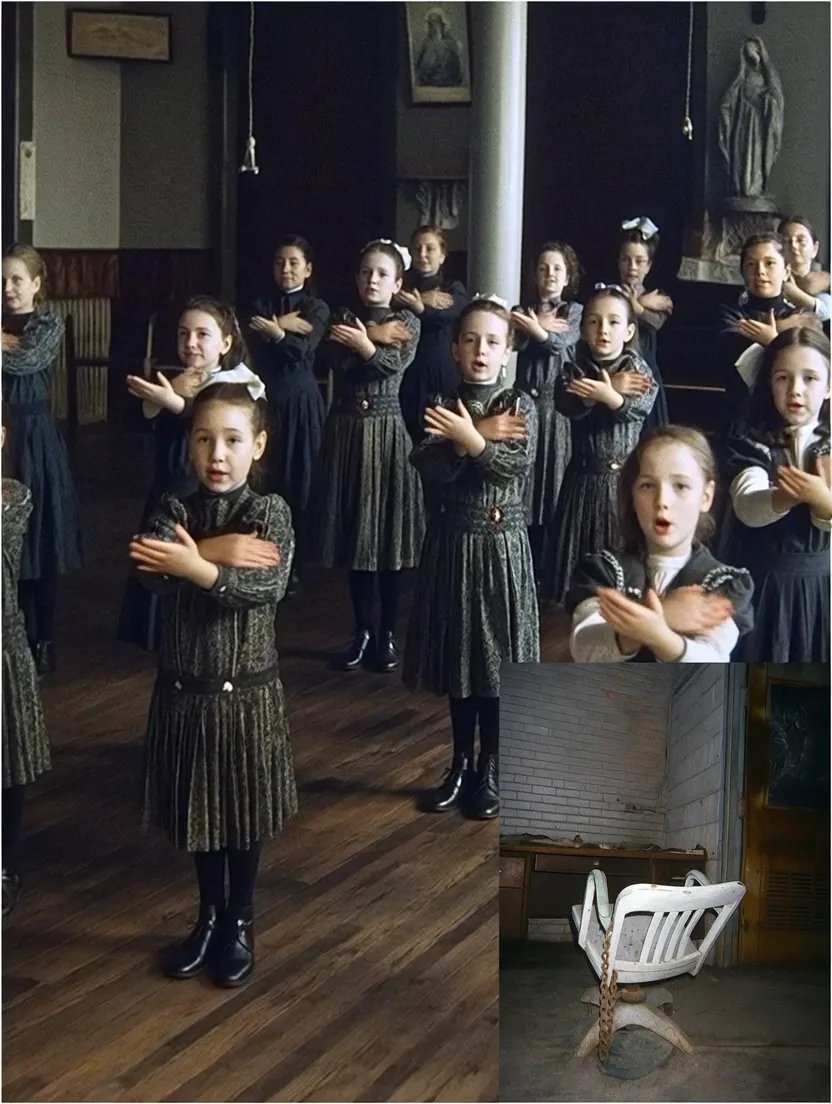
The child is 11 years old and burning with fever, but still worried about disappointing that man.
His brother Tommy walked him to school today.
Had to practically carry him.
I told Tommy that Brian was just tired.
The lies come so easily now.
March 10th, 1958.
Patricia asked me today if Lucy was sick.
Lucy hasn’t been in class for 2 days.
I told Patricia that Lucy’s family went to visit relatives, but Lucy is in the basement with the twins coughing blood onto her pillow.
She keeps asking for Patricia.
Wants to show her the story she’s been writing about two girls who become teachers together.
I promise to give it to Patricia.
Another lie.
Menior says no contact with the healthy children.
Michael pulled out his phone, Googled St.
Bartholomew School, Pennsylvania, 1958.
The first result made his throat close.
Historic mystery.
Entire Catholic school vanishes without trace.
But it was the second result that made him stand up so fast he hit his head on a beam.
Local woman, 67, still searching for childhood friend who disappeared with St.
Bartholomew’s school.
The photo showed an older woman with tired eyes standing in front of the abandoned school.
The caption read, “Patricia Donnelly never stopped wondering what happened to her best friend Lucy Morse when St.
Bartholomew mysteriously closed in 1958.
” He looked back at the journal, flipping to March the 16th, 1958.
Sister Agatha’s final entry.
They’re sealing them in tonight.
All of them.
43 children now sick, plus the staff who tried to help.
Mancinior Hail says it’s God’s will that the scandal of a tuberculosis outbreak would destroy the church’s mission in Pennsylvania.
He says they’re dying anyway, that this is mercy, but I was just in the basement.
Lucy Morris was awake, writing in her notebook by candle light.
She asked me to tell Patricia she was sorry she couldn’t finish their story.
Brian Fitzgerald was helping the younger children drink water.
his hands shaking with fever, but still trying to be helpful.
The Henley twins were singing softly to each other, some lullabi their mother used to sing.
They’re not dying.
They’re sick, but they’re not dying.
Not yet.
The construction workers arrive at midnight.
Manscior told them they’re sealing old storage tunnels.
They don’t know there are children behind those walls.
I should stop this.
I should scream until someone listens.
But I am a coward.
I am leaving tonight.
Transferred to Saint Mary’s in Harrisburg with sworn silence as my penance.
The children are still breathing.
God forgive me.
The children are still breathing.
Michael’s phone rang, making him jump.
His mother, did you finish up there? Dinner’s getting cold.
Mom.
His voice came out strangled.
Mom, what happened at St.
Bartholomew’s silence? Then come home now.
Mom.
Aunt Pat.
Your aunt Pat destroyed her life looking for answers that don’t exist.
Whatever you found, leave it there.
The line went dead.
Michael looked at the journal, then at his phone showing Pat’s face in that news article.
She’d been searching for 50 years for Lucy Morse, her best friend, who was writing a story about two girls who become teachers together.
He tucked the journal inside his jacket and headed for the attic stairs.
His mother stood at the bottom, her face pale.
“You don’t understand what you’re playing with,” she said.
138 people vanished.
Aunt Pat’s best friend is gone.
Has been gone for 50 years.
Some stones don’t need turning.
What if it was me? Michael asked.
What if I vanished and someone knew the truth but said nothing? His mother’s face crumpled.
Michael, please.
This family has suffered enough.
But Michael was already grabbing his car keys.
As he drove toward Milbrook toward Aunt Pat he barely knew.
He thought about Lucy Morse in a basement writing by candle light asking forgiveness for not finishing a story about Brian Fitzgerald 11 years old with fever still helping younger children drink water.
About the Henley twins singing lullabies to each other in the dark.
They hadn’t just been numbers.
They’d been children with friends, with stories, with songs, and for 50 years, everyone who knew the truth had chosen silence over justice.
Pat’s house was small, neat, with a garden ready for winter.
When she answered the door, her eyes went immediately to the journal visible in his jacket.
“You’re Robert’s son,” she said.
“Yes, and you’re looking for Lucy Morse.
” Pat’s legs gave out.
Michael caught her arm, helped her to a chair.
How do you know about Lucy? Michael handed her the journal.
Because Sister Agatha wrote about her, about how she was writing a story about two girls who become teachers together.
About how she asked for you at the end.
Pat opened the journal with shaking hands, found the entry about Lucy.
A so escaped her.
She was writing that story for my birthday, April 10th.
We were going to be teachers and write children’s books together and live next door to each other.
Pat’s finger traced the words.
I’ve been looking for her for 50 years.
Everyone said I was crazy, that she was just transferred to another school.
But I knew Lucy was shy.
She would have written to me.
She would have found a way to say goodbye.
She looked up at Michael, tears streaming down her face.
“Where is she?” “I think,” Michael said carefully.
She’s still at St.
Bartholomew’s in the basement where they sealed them in.
Pat’s living room was a shrine to one person.
Lucy Morse, not obsessive, not overwhelming, but clear in its focus.
A corkboard held yellowed newspaper clippings about the school closure, a map of Pennsylvania with pins marking Catholic schools she’d contacted, and in the center, a single photograph.
Two girls, maybe 10 years old, arms around each other, grinning at the camera.
That was 2 weeks before she disappeared, Pat said, following Michael’s gaze.
We just won the spelling bee together.
Lucy spelled necessary and I spelled rhythm.
We were going to go to the state championship.
She sat with the journal, reading each entry slowly, her finger underlining Lucy’s name whenever it appeared.
Sister Agatha was my favorite teacher, Pat said quietly.
She encouraged me to write, to ask questions.
After the school closed, I went to her, begged her to tell me where Lucy was.
She looked me in the eye and said she didn’t know.
Pat’s voice turned bitter.
She knew Lucy was dying in a basement and she looked me in the eye and lied.
Michael studied the map.
You checked all these schools? Every Catholic school in Pennsylvania, then New Jersey, New York, Ohio.
I was 13.
Calling churches from payoneses pretending to be my mother.
Some were kind, checked their records.
Others told me to stop bothering them.
She touched a pin near Philadelphia.
This one, St.
Catherine’s, the secretary said something strange.
She said, “Another saint, Bartholomew’s parent.
I’m sorry.
We have no records.
” Like other parents had called, too.
“Did you find them?” other parents.
Pat walked to a filing cabinet, pulled out a folder.
12 families in the first year, but people gave up, moved away, or she showed him an obituary.
Mrs.
Henley, the twin’s mother, died in 1971.
The death certificate says heart failure, but her older daughter, Catherine, told me she never stopped looking for Marie and Margaret.
She died of grief.
Michael read more of the journal while Pat made coffee with shaking hands.
The entries painted a picture of escalating horror.
March 11th, 1958.
Lucy’s fever broke today.
She was lucid for a few hours.
Asked if she could go back to class.
When I told her she needed to rest, she said, “But Pat and I are writing a play for Easter.
She can’t do all the dialogue herself.
I promised to help Patricia.
Another lie to add to my collection.
March 12th, 1958.
Brian Fitzgerald figured it out.
He’s too smart.
That boy asked me why the medicine isn’t making anyone better.
Why more children keep coming to the basement, but none leave.
Why his brother Tommy can’t visit.
I told him it was for Tommy’s safety.
He said, “Then why aren’t you worried about your safety, sister?” I had no answer.
“Brian Fitzgerald,” Pat said, returning with coffee.
“Tommy’s little brother.
Tommy still lives here in Milbrook.
Never left.
Never married.
Like he’s waiting for Brian to come home.
He’s been waiting 50 years.
We meet for coffee sometimes.
Two people who never got over it.
He told me once that the last time he saw Brian, Brian gave him his lucky penny, said, “Hold this for me until tomorrow.
There was no tomorrow.
” She pulled out a phone book, an actual phone book, and found Tommy’s number.
Her hand hesitated over the phone.
“I’ve never told him I was still actively looking,” she admitted.
“He seems so fragile, like hope might break him.
He deserves to know, Michael said.
Pat dialed.
The conversation was brief, her voice gentle.
Tommy, it’s Pat.
I need you to come over.
Yes, now it’s about Brian.
They waited in silence, Pat still reading the journal, occasionally gasping at entries.
March 14th, 1958.
The Henley twins died today within minutes of each other.
Marie went first and Margaret seemed to know instantly.
She just said, “Wait for me, Marie.
” And closed her eyes.
They were 9 years old.
Manscior Hail said a prayer over them.
I wanted to strike him.
20 minutes later, Tommy Fitzgerald arrived, 68 years old, weathered, wearing a janitor’s uniform from St.
Sebastian’s nursing home.
His eyes went immediately to the journal.
“That’s Sister Agatha’s handwriting,” he said.
“I’d know it anywhere.
” “She taught me fractions.
” Pat handed him the journal, open to an entry about Brian.
Tommy read, his hands beginning to shake.
March 15th, 1958.
Brian Fitzgerald helped me distribute water to the sicker children today.
His fever is 103, but he insisted.
He made each child smile, told them jokes, said his brother Tommy was going to bring comic books for everyone.
He doesn’t know Tommy isn’t allowed near the school anymore.
This child has more grace than any of us adults.
He was helping, Tommy whispered.
Even sick, he was helping others.
Tommy, Pat said gently.
There’s more.
The last entry.
March 16th.
Tommy read Sister Agatha’s final confession about the children being sealed in while still breathing.
His face went white, then red, then white again.
Alive, he said, the word barely audible.
They sealed him in alive.
We need to go to the school, Michael said.
The journal mentions the basement entrance near the kitchen.
If we can find where they sealed.
Tommy was already standing.
I know where it is.
I’ve been in that building hundreds of times over the years.
Looking, always looking.
But I never knew about walls being built.
It’s a crime scene now, Pat said.
If we find something, we need to involve police.
After, Tommy said, his voice stronger than Michael had heard it.
After we know for sure.
I’ve waited 50 years.
I’m not waiting for warrants and bureaucracy.
They drove in Pat’s car, Tommy giving directions he could probably recite in his sleep.
The school loomed on its hill, a darkness against stars.
They parked at the bottom of the overgrown drive.
I have bolt cutters in the trunk, Pat said, surprising Michael.
I’ve been prepared for this for decades.
They cut through the fence, walked up the crumbling drive.
The front door’s plywood had been torn away by previous trespassers.
Their flashlights cut through darkness that felt alive, waiting.
The main hallway stretched before them.
Checkerboard floor tiles broken like scattered teeth.
On the walls, children’s artwork still hung.
Faded construction paper butterflies.
A banner reading spring concert 1958 never performed.
Tommy moved like he knew every inch, leading them past empty classrooms where desks still sat in rows.
In one room, a chalkboard still showed the date.
March 14th, 1958.
Below it, in a child’s handwriting, weekend homework.
Write about what you want to be when you grow up.
Lucy’s classroom, Pat whispered.
She walked to a desk in the third row, touched it gently.
She sat here.
I sat right behind her so we could pass notes.
Tommy was already moving toward the kitchen, his flashlight steady.
The basement door should be here.
They found it painted the same institutional green as the walls.
The door was locked, but the wood around the lock was soft with rot.
Tommy put his shoulder to it and it gave way with a wet crack.
The stairs descended into black.
The smell hit them immediately.
Mold, decay, and something else.
Something sweet and wrong.
At the bottom, a normal basement stretched out.
Boiler room, storage areas, janitors supplies frozen in time.
But Tommy was moving with purpose now, past the boiler, toward what should have been a corridor.
He stopped so suddenly Pat ran into him.
There, he breathed, a wall that didn’t belong.
Newer concrete, different color, clearly added after the original construction.
And at the bottom, where the wall met the floor, scratch marks, deep gouges in the concrete, dozens of them at different heights, child heights.
Tommy fell to his knees, his hands touching the scratches.
They tried to get out.
They were alive, and they tried to get out.
Pat’s flashlight found something else.
Written on the wall in what looked like chalk, barely visible.
Lucy M was here.
She made a sound like she’d been punched.
She was here.
My Lucy was here.
Michael ran his hands along the wall, found seams where concrete blocks had been morted together.
We can break through this.
We need tools, but we can break through.
No, Tommy said standing.
We do this right.
We call the FBI.
We make sure nothing gets covered up this time.
He looked at Pat.
They deserve that.
Lucy and Brian and all of them.
They deserve to have their story told right.
Pat nodded, tears streaming down her face.
50 years of secrets.
It ends tonight.
As they climbed back up the stairs to call authorities, Michael looked back at the scratches on the wall.
Children had died trying to claw their way out while the world above went on believing lies.
But the lies were over now.
The truth was literally carved in concrete, waiting to be revealed.
The FBI arrived at dawn.
Six black SUVs winding up the hill to St.
Bartholomew.
Agent Sarah Cole, mid-4s with sharp eyes, took charge immediately.
Within an hour, the school was wrapped in crime scene tape and forensic teams were descending into the basement.
Pat, Michael, and Tommy waited in the makeshift command center set up in the school’s main office.
Through the window, they could see more vehicles arriving.
State police, the coroner’s van, media vans kept at a distance by barriers.
I need to understand, Agent Cole said, studying the journal.
This sister Agatha, she died two weeks ago.
October 3rd, Michael confirmed, heart failure at 91.
And she never told anyone.
Pat’s voice was flat.
She taught at St.
Mary’s in Harrisburg for 41 years after this.
Lived a full life while those children rotted in the basement.
Agent Cole’s radio crackled.
Ma’am, you need to see this.
They descended back into the basement where FBI agents had set up work lights.
The scratched wall was now fully illuminated, revealing not just Lucy M was here, but dozens of names, messages scratched at different heights with different implements.
They told us to stop crying.
Said crying meant we were sick.
But Marie wouldn’t stop.
She kept asking for her sister Margaret.
So they took Marie first, then Margaret.
Three days later, Brian tried to remember all our names, scratched them into the wall with a broken spoon handle.
Tommy helped him until his fingers bled.
Brian said if someone found the names, they’d know we were real, that we existed.
I’m sorry, Tommy.
I’m sorry we couldn’t save him.
Brian fought them.
Even at the end, he fought.
We’re still here behind the walls, under the floors.
Can you hear us? 43 of us now.
They bring new ones, but but they don’t last long.
Please, someone, anyone.
We’re still here.
Look for the names.
Brian wrote all our names.
Find them.
Please find us.
Tommy was photographing every inscription with his phone, tears running down his face.
Brian wrote my name.
He thought I’d come for him.
An agent with a sledgehammer looked to Cole for permission.
She nodded.
The first blow echoed like thunder.
The old mortar crumbled easily.
Whoever had built this wall had worked fast, not well.
Within minutes, they’d opened a gap large enough to see through.
The smell that escaped made everyone step back.
Sweet.
Thick.
Wrong.
Cole went through first.
her flashlight cutting through 50 years of darkness.
Then her voice, professional but shaken.
We have remains multiple.
They’re they’re in the rooms.
The quarantine ward stretched beyond the false wall, a corridor with doors on both sides, exactly as Sister Agatha had described.
But what she hadn’t described was how they’d tried to make it homelike.
Crayon drawings were taped to walls.
A hopscotch grid was chocked on the floor.
Someone had hung paper chains from the ceiling, the kind children make for Christmas.
In the first room, three small beds.
On each bed remains in the tattered remnants of St.
Bartholomew’s uniforms.
And on the wall, in a child’s handwriting, Marie and Margaret Henley, we stayed together.
Pat found Lucy in the third room, identifiable by the friendship bracelet still on her wrist, the one Pat had made for her 10th birthday two months before she died.
Lucy was on a bed near the window, a window that had been bricked over.
On the floor beside the bed, a notebook, its pages brittle but intact.
Pat picked it up with shaking hands.
Lucy’s handwriting getting progressively weaker.
March 13th.
Pat, if you find this, I’m sorry we couldn’t finish our story.
The two girls who become teachers, you’ll have to write the ending yourself.
March 14th.
Sister Agatha says we’re getting better, but I heard Marie Henley died.
Margaret, too.
They’re not telling us the truth.
March 15th.
Brian Fitzgerald says we’re being locked in.
He heard the workers talking.
I don’t believe him.
Why would they lock us in? March 16th.
The workers are here.
We can hear them building something.
Brian was right.
Pat, I’m scared.
I want my mom.
I want to go home.
I want The entry ended mid-sentence.
Tommy had found Brian in a room at the end of the corridor.
Unlike the others, Brian wasn’t on a bed.
He was by the door, his remains showing he’d died trying to get out.
His fingers were still at the gap under the door.
“He fought,” Tommy said, kneeling beside his brother.
“He fought to the very end.
” “In Brian’s pocket, they found something that made Tommy collapse.
a handful of lucky pennies, the ones Brian collected, including the one he’d given Tommy that last morning.
Somehow, Brian had gotten it back, had died carrying it.
Agent Cole was documenting everything, but she stopped at a room that was different from the others.
This one had an adult’s remains in a nun’s habit.
On the wall, written in what forensic analysis would later confirm was blood, was a detailed record.
Sister Margarite Walsh, Chronicle of Murder.
March 16th, 11:47 p.
m.
Sealed in with 43 children, three nuns, one priest.
March 17, 2 a.
m.
Marie Henley, deceased, already gone before sealing.
March 17th, 2:15 a.
m.
Margaret Henley, deceased, already gone.
March 17th, 6 a.
m.
Timothy Chen, deceased.
March 17th, 900 a.
m.
Water runs out.
The list continued, documenting each death with clinical precision.
Sister Margarite had stayed lucid, recording everything, creating evidence.
The last entry, March 19th, 8:00 p.
m.
I remain, children all at peace.
May God forgive those who did this.
May God forgive me for not stopping it.
She stayed alive for 3 days, Cole said quietly.
3 days documenting their deaths, making sure there would be evidence.
In another room, they found something that changed everything.
filing cabinets sealed in with the children.
Inside were financial records showing Monscior Hail had embezzled $300,000 from the school and dascese.
The audit that would have discovered this was scheduled for April 1st, 1958.
He killed them to hide theft, Michael said numb.
All of this, 138 people, to hide that he stole money.
Pat was reading more documents.
He paid the workers who built the wall.
There are receipts, names, addresses.
Some of these men might still be alive.
Cole was already on her radio sending the names to her team.
Then she found something else.
A realtore tape recorder.
The tape still on the spool.
The batteries were long dead, but one of the forensic techs had equipment that could play it.
A child’s voice filled the room thin and frightened.
This is Brian Fitzgerald.
It’s March 16th, 1958.
Really late.
They’re building a wall.
We can hear them.
Sister Margarite says we should record what’s happening in case in case someone finds us.
Lucy Morris is here.
The Henley twins are really sick.
There’s 43 of us.
We didn’t do anything wrong.
We just got sick.
Tommy, if you hear this, the recording cut off.
Tommy was sobbing now, holding the tape player like it was Brian himself.
They found 43 bodies in total, exactly as the journal had said.
Each one was photographed, documented, carefully prepared for removal.
But first, Pat did something that would haunt everyone present.
She sat in Lucy’s room and read aloud from the notebook they’d found the story of two girls who wanted to become teachers.
She read it to Lucy’s remains.
50 years too late, but keeping a promise.
Outside, the media had multiplied.
Someone had leaked that bodies were found.
Parents and siblings of missing children from 1958 were arriving.
Elderly now, but still hoping for answers.
Catherine Chen Nay Henley, 81 years old, stood at the police barrier, clutching a photo of her twin sisters.
When Cole confirmed the twins had been found, Catherine’s legs gave out.
“Together?” she asked.
“Were they together?” Yes, Cole said gently.
They were holding hands.
As the sun set, the coroner’s teams began the delicate process of removing the remains.
Each small body was treated with infinite care, carried out on stretchers covered in white sheets.
A crowd had gathered, towns people, families, media.
As the first stretcher emerged, an elderly man in the crowd began singing a Maria.
Others joined.
Soon, hundreds of voices rose in the twilight, singing for children they’d never known but would never forget.
Tommy walked beside the stretcher he knew was Brian, his hand on the white sheet.
I’m taking you home, little brother.
Finally taking you home.
Pat did the same for Lucy, whispering, “We’re going to finish that story, Lucy.
I promise.
two girls who wanted to be teachers, one who did and one who teaches us still about love that doesn’t die.
But even as the bodies were removed, even as the truth began to spread, Agent Cole pulled Michael aside, there’s something else.
We found a second sealed wall behind the first ward, and based on the construction, it was built later, maybe a week later.
Michael’s blood went cold.
There are more.
We’ll know tomorrow, but yes, I think there are more.
As the last of the 43 bodies was carried out, as the crowd dispersed, as families began the process of reclaiming their dead, Michael stood in the empty basement, looking at that second wall.
How many more? How many children had Manscior Hail murdered to hide his theft? Behind him, Tommy and Pat stood together, united in grief and relief.
They’d found their loved ones.
But Michael couldn’t shake the feeling that they’d only uncovered part of the truth.
The scratches on the second wall were different.
Desperate and barely visible in the concrete, someone had managed to carve, he came back.
The second wall came down at 6:00 a.
m.
after the forensic team had documented every scratch, every mark.
This wall was different, thicker, reinforced with rebar, built to last.
Whoever constructed it had learned from the first one.
When the sledgehammers finally broke through, the smell was different, too.
Chemical.
Formaldahhide mixed with something else.
Agent Cole went in first again, her flashlight sweeping across what looked like a medical facility, stainless steel tables, glass cabinets full of medicine bottles, and in the center of the room, a desk with papers still spread across it.
This isn’t a quarantine ward, she said.
This is something else.
Pat and Tommy had refused to leave despite FBI protests.
They stood at the brereech in the wall as Cole’s team entered.
Michael watched their faces change as they realized what they were seeing.
No bodies in beds this time.
Instead, medical equipment, charts on the walls, and in a filing cabinet that Cole opened, records that made her radio immediately for additional agents.
We need the CDC here now.
The papers on the desk were in Manior Hail’s handwriting, dated March 23rd, 1958, a week after the first group was sealed.
The situation has evolved beyond initial parameters.
Bishop Morrison insists the contamination must be complete to justify total closure.
The surviving children who showed natural immunity present a problem.
They cannot be released.
They know too much.
But their deaths must appear connected to the outbreak.
Dr.
Harold Morrison, no relation to the bishop, has agreed to assist.
His medical license was revoked in Pennsylvania, but his knowledge of infectious diseases remains useful.
We have identified 12 children who survived exposure without infection.
They are being held in the secondary ward.
12 more children, Pat whispered.
He kept 12 more children.
Tommy was reading over her shoulder.
March 23rd.
The school was already closed.
The parents already told their children were transferred, but 12 were still alive.
They found them in rooms behind the medical area.
These deaths were different.
No peaceful arrangements on beds.
These children had been experimented on.
The medical records preserved in a sealed cabinet told the story.
Subject one, Emma Hoffman, age 13, natural immunity to tuberculosis, testing alternative pathogens to ensure complete elimination.
Subject two, David Keller, age 10, remarkable resistance, increased dosages required.
The records went on, clinical and horrifying.
12 children who had survived the initial outbreak kept for an additional week while Hail and the disgraced doctor tried to find ways to kill them that would look like tuberculosis.
In the last room, they found something that made even the experienced FBI agents step back.
A child had managed to write on the wall in what looked like iodine from the medical supplies.
They said we were special.
Said we didn’t get sick.
Said they needed to understand why.
But they’re just trying to find new ways to make us sick.
Sarah got out.
Sarah ran.
I hope Sarah made it.
Sarah, Cole said immediately into her radio.
Check the 1958 records for any student named Sarah.
While her team worked, Michael found Tommy staring at one of the medical charts.
David Brennan, Tommy said.
Another child with my brother’s last name.
No relation, but God, he was Brian’s age.
The chart showed David had survived 11 days in the second ward before succumbing to what Hail had labeled experimental pathogen number four.
Pat was in another room where she’d found children’s belongings in a box.
Shoes, each pair labeled with a name.
12 pairs.
But she was counting them again.
11, she said.
There are only 11 pairs.
Cole checked the records again.
Sarah Walsh, 9 years old.
Her belongings aren’t here.
They searched every room, every corner.
No remains for Sarah Walsh.
No medical records after March 28th.
Just that message on the wall.
Sarah got out.
She escaped, Michael said.
A 9-year-old girl escaped from here.
But where did she go? Tommy asked.
If she got out, why didn’t she tell anyone? Cole was already on her phone calling her team.
I need everything on a Sarah Walsh, born approximately 1949, missing from St.
Bartholomew’s school in 1958.
They emerged from the basement to find the crowd had grown.
Word of the second wall had leaked.
Parents who’d thought their children were in the first group were now hoping against hope they might be in the second, that there might be different answers.
But there was also an elderly woman standing apart from the crowd, watching everything with an expression Michael couldn’t read.
She was well-dressed, probably late7s, with white hair and sharp eyes.
When she saw them emerge, she walked directly to Agent Cole.
“My name is Sarah Walsh Henderson,” she said clearly.
“I escaped from St.
Bartholomew’s basement on March 28th, 1958.
I’ve been waiting 50 years for someone to find that room.
” The silence was absolute.
Even the reporters stopped talking.
Cole recovered first.
“Ma’am, I need you to come with us.
I’ll tell you everything, Sarah said.
But first, I need to know.
Did you find David Keller? Yes, Cole said gently.
We found all 12.
Sarah closed her eyes.
David helped me escape.
Distracted Dr.
Morrison so I could run.
He was 10 years old and he saved my life.
They took her to the command center away from the cameras.
Pat, Tommy, and Michael were allowed to stay as Sarah told her story.
Her voice steady despite the tears that occasionally escaped.
I was small for my age, skinny.
I could fit through the ventilation grate that David loosened over three nights.
The plan was for both of us to go, but David was too big.
So he created a distraction, knocked over medical equipment, screamed about being sick while I crawled through.
“Where did you go?” Cole asked.
I ran home 2 miles in my socks through the woods.
But when I got there, my parents were gone.
The house was empty.
Neighbors said they’d moved suddenly.
No forwarding address.
I think the dascese relocated them, told them I was dead.
So, what did you do? I hid in the woods for 2 days eating from garbage cans.
Then an old woman found me, Mrs.
Katherine Rodriguez.
She didn’t believe my story about the school.
Thought I was traumatized, making things up, but she took me in anyway, raised me as her granddaughter, sent me to public school in the next county, gave me a new last name.
You never tried to tell authorities? Michael asked.
Sarah’s laugh was bitter.
I did three times when I was 12, 15, and 18.
Each time I was told I was delusional.
The last time they tried to have me institutionalized.
Mrs.
Rodriguez had to fight to keep me.
After that, I stayed quiet, got married, had children, lived a life.
But I never stopped watching that school.
She pulled out a notebook worn and filled with writing.
Every year on March 28th, I go back.
I leave flowers where I crawled out and I write down what I remember so I wouldn’t forget their faces.
She opened the notebook showing sketches of children.
David Keller, Emma Hoffman, the others.
I drew them so someone would remember them as they were, not as bodies in a basement.
Tommy was looking at one sketch.
This looks like Brian, but Brian was in the first ward.
Sarah studied it.
That’s David Brennan.
He talked about Brian Fitzgerald constantly.
Said they weren’t related, but he felt like Brian was his brother because they shared a name.
David was so proud that he’d survived when the other Brennan boy hadn’t.
Then he realized what survival meant in that place.
Pat touched Sarah’s hand.
You’ve been carrying this alone for 50 years.
Not alone, Sarah said.
Mrs.
Rodriguez believed me eventually.
Before she died in 1987, she made me promise to keep watching, keep waiting.
She said, “The truth always surfaces eventually.
It just took 50 years.
” Cole’s phone rang.
She stepped away, then returned with a strange expression.
The dascese just released a statement.
“Bishop Morrison wants to meet with the families.
He’s 91.
Claims he’s ready to share what he knows about the tragedy.
” “Morrison,” Sarah said, her voice sharp.
He visited the second ward March 27th told Dr.
Morrison different Morrison no relation to complete the protocol.
That’s when they decided to kill us all.
Will you testify to that? Cole asked.
I’ve been waiting 50 years to testify to that.
As they prepared to leave to confront Bishop Morrison with a living witness he thought had died in 1958.
Michael noticed something.
Sarah had another notebook.
This one knew her.
“What’s that?” he asked.
Sarah hesitated then opened it.
It was full of names, dates, newspaper clippings.
other schools.
Over the years, I’ve tracked unusual closures, sudden student transfers, unexplained disappearances at Catholic institutions.
I found patterns.
Cole took the notebook, scanning quickly.
How many? 17 schools with suspicious patterns between 1945 and 1975.
Not all of them were mass events like St.
Bartholomew’s.
Some were smaller.
Five children here, eight there.
But the pattern was consistent.
Problem arises, children disappear, records destroyed, families relocated or discredited.
The scope of it was staggering.
St.
Bartholomew wasn’t unique.
It was just the largest, the boldest, the one where they’d made mistakes.
They thought they’d perfected it by 1958, Sarah said.
But they didn’t count on one scared 9-year-old girl being small enough to fit through a ventilation grate.
As they left the school, the noon sun high overhead, Michael looked back at the building.
In the basement, forensic teams were still removing the 12 bodies from the second ward.
55 children total murdered to hide theft and protect reputation.
But one had survived.
One had escaped to bear witness.
And now, 50 years later, Sarah Walsh Henderson was about to face the man who’d ordered her death.
Bishop Morrison’s mansion sat on manicured grounds outside Philadelphia.
30 acres of wealth accumulated over decades.
But when the FBI convoy arrived, they found news vans already lined up, reporters shouting questions, and protesters holding signs with the faces of dead children.
Morrison’s lawyer met them at the door.
Kenneth Frost, expensive suit, calculating eyes.
The bishop will see you in his study.
He’s prepared a statement.
He can prepare whatever he wants.
Agent Cole said.
We have questions.
The study was exactly what Michael expected.
Dark wood, leatherbound theological volumes, photographs of Morrison with powerful figures spanning decades.
The bishop himself sat behind a massive desk, 91 years old, but still imposing, wearing his full clerical regalia as if it were armor.
I understand you’ve found the children, Morrison began, his voice still strong.
A tragedy.
Mancinior Hail clearly lost his way.
“Stop,” Sarah said, stepping forward.
Morrison’s face went white.
For 10 seconds, he said nothing, staring at the woman he’d thought dead for 50 years.
Sarah Walsh, he finally whispered.
“Sarah Walsh Henderson, now married, two children, four grandchildren.
The life you tried to steal.
” Morrison’s lawyer stepped forward.
I don’t know what this person has told you, but I was in the second ward, Sarah said clearly.
March 27th, 1958.
You came down to the basement.
You told Dr.
Morrison to complete the protocol.
You looked right at me, a 9-year-old girl, and said we were unfortunate but necessary casualties.
The bishop’s composure cracked.
You’re mistaken.
Traumatized children’s memories.
Pat pulled out the journal they’d found in the second ward, Dr.
Morrison’s medical notes.
She read aloud, “March 27th, 300 p.
m.
Bishop Morrison visited.
” Approved acceleration of protocol, specified that all 12 subjects must be eliminated within 48 hours.
Concerned that Sarah Walsh’s small size might allow escape through ventilation, ordered grates welded shut.
But you didn’t weld them in time, Sarah said.
David Keller had already loosened one.
He saved my life while you were trying to end it.
Morrison stood shaking.
You don’t understand what was at stake.
The scandal would have destroyed the church in Pennsylvania.
Thousands would have lost their faith.
“So you murdered children to protect faith?” Tommy asked, his voice dangerous.
Hail murdered them.
I simply didn’t intervene.
Cole played the recording they’d found.
Hail’s voice filling the room.
Morrison insists the contamination must be complete.
The bishop says 12 more casualties are acceptable to protect the mission.
Morrison sank back into his chair.
That’s Hail’s interpretation.
I never explicitly.
You visited dying children and told the doctor to finish killing them.
Michael said there’s nothing implicit about that.
The lawyer tried to intervene.
Bishop Morrison has immunity agreements from 1962 which don’t cover murders discovered after the fact.
Cole said, “Bishop Morrison, you’re under arrest for conspiracy to commit murder.
55 counts.
” But Morrison wasn’t looking at her.
He was staring at Sarah.
How did you survive? Not just the escape after.
How did you live knowing what you knew? Sarah’s answer was simple.
Love.
A woman who didn’t birth me became my grandmother.
Friends who didn’t know my real name became my family.
I built a life on top of the grave you tried to put me in.
That’s how we survive monsters like you.
We choose love despite the hate you taught us.
As Cole moved to arrest him, Morrison did something unexpected.
He pulled out a key from his desk, handed it to Pat.
Safety deposit box 472, First National Bank of Milbrook.
I’ve been adding to it for 50 years.
What is it? Pat asked.
Names.
every child who’s ever disappeared in our dascese under suspicious circumstances, not just St.
Bartholomew’s going back to 1943.
I kept records of everything, thinking someday I might atone.
Atonone? Tommy laughed bitterly.
You kept records while children died? I was young when it started.
By the time I had power, I was complicit.
The only thing I could do was document it.
Hope someone would eventually find it.
Michael couldn’t believe what he was hearing.
You documented murders instead of stopping them.
Do you know what they do to priests who talk? Morrison asked.
Father Raymond tried to report the St.
Catherine’s incident in 1962.
They found him in his car in the Suscuana River.
Suicide, they said.
Father Dennis who handled our finances.
He developed a conscience in 1971.
Heart attack at 42.
Healthy man, perfect health.
Sudden heart attack.
You’re saying the church killed priests? Cole asked.
I’m saying people with power protect that power.
The church is just one expression of it.
Morrison looked at Sarah again.
I’m glad you survived.
It’s the only good thing to come from all of this.
Sarah’s response was cold.
I survived despite you, not because of you.
And my survival isn’t good because it makes you feel better.
It’s good because I got to live, love, have children, things you stole from 55 others.
As they led Morrison away in handcuffs, photographers erupting outside, his lawyer frantically making calls.
Morrison turned one last time.
The safety deposit box.
There’s a list at the bottom.
Seven names with stars.
Those are children who survived.
Like Sarah, hidden with new identities.
I made sure they were safe, that the church never found them.
You knew about other survivors? Sarah gasped.
I saved who I could without exposing myself.
Seven over 30 years.
It’s not enough, but it’s something.
After Morrison was gone, after the chaos of his arrest had settled, they went to the bank.
The safety deposit box was larger than expected, filled with documents, photographs, and at the bottom, seven files marked with stars.
Sarah read the names, tears streaming down her face.
Angela Hoffman, Robert Chen, Maria Santos, James Reachi, all from different incidents, all given new identities, relocated with families who didn’t know their real histories.
We need to find them, Pat said.
They deserve to know they weren’t alone.
Cole was already coordinating with her team.
We’ll track them down carefully.
Some might not want to be found.
They built lives on top of trauma.
Like Sarah, Tommy was reading through other files.
312 names total.
312 children who disappeared between 1943 and 1975.
He looked up.
St.
Bartholomew wasn’t even the worst.
Look at this.
St.
Joseph’s Industrial School, 1947.
83 boys transferred after a fire.
No records of where they went.
The scale of it was overwhelming.
Decades of systematic murder covered up by an institution that preached morality while practicing evil.
That evening, they gathered at Pat’s house.
Pat, Michael, Tommy, and Sarah.
The FBI was processing evidence.
The media was in frenzy.
The Catholic Church was in crisis.
But in Pat’s small living room, four people sat with tea looking at photographs of dead children.
“Lucy would have been 67,” Pat said, touching the photo of her friend.
“Maybe a grandmother.
Definitely a teacher.
” “Brian would have been 69,” Tommy added.
“He wanted to be a fireman, save people.
” Sarah pulled out her sketch of David Keller.
David would have been 68.
He wanted to be a doctor, a real one, not like the monster who killed him.
Michael looked at these three survivors.
Pat who’d searched for 50 years.
Tommy who’d waited for 50 years.
Sarah who’d hidden for 50 years.
All of them shaped by one man’s greed and another man’s cowardice.
What happens now? He asked.
Now we bury them properly, Pat said.
All 55 from St.
Bartholomew with their real names, their real stories.
And we keep looking, Sarah added.
Morrison’s records show 17 other sites, hundreds of children who deserve to be found.
The church will fight, Tommy said.
They’ll claim these are isolated incidents, bad actors, not systemic.
Then we prove them wrong,” Sarah said firmly.
“I’ve been documenting for 50 years.
I have names, dates, patterns, and now we have Morrison’s records.
We can show this wasn’t random.
It was policy.
” As night fell, as the media continued to report the story that was reshaping American Catholicism, four people sat planning how to find and name hundreds of murdered children.
It would take years, maybe decades, but Lucy Morse and Brian Fitzgerald and David Keller and all the others deserved that time.
Outside, church bells rang for evening mass.
But tonight, they sounded different.
Not calling the faithful to prayer, but mourning the innocents who died in God’s name.
The funerals began on a gray November morning.
55 small coffins arranged in rows at Milbrook Cemetery, each draped with a white cloth embroidered with the child’s name.
The Henley twins were side by side as they’d been in death.
Brian Fitzgerald’s coffin bore his collection of lucky pennies.
Lucy Morses held the story she never finished, completed now by Pat.
Two girls who wanted to become teachers, one who did, one who taught through her absence.
3,000 people came, parents in their 80s, siblings who’d spent lifetimes wondering, grandchildren who’d grown up with family mysteries.
The media was kept at a distance, but their cameras captured the sea of mourners, the mountain of flowers, the terrible arithmetic of loss.
Tommy stood at Brian’s coffin, reading a letter he’d written.
Brian, you gave me your lucky penny that last morning.
Said, “Hold this for me until tomorrow.
I held it for 50 years.
Every tomorrow that came without you.
I’m giving it back now.
You don’t need luck anymore.
You’re free.
” Pat spoke for Lucy, her voice carrying across the silent cemetery.
Lucy Morse wanted to teach children to read, to love stories the way she did.
She never got that chance.
But her story, the story of a 10-year-old girl who died writing by candle light, thinking of her friend, has taught the world about courage, about love that doesn’t die, about truth that refuses to stay buried.
Sarah Walsh Henderson spoke last for all of them.
55 children died at St.
Bartholomew.
But they were more than victims.
Marie Henley played piano.
Margaret Henley sang.
Brian Fitzgerald collected pennies and helped younger children.
Lucy Morse wrote stories.
David Keller saved my life.
They were real children with real dreams, and they deserved to be remembered for who they were, not just how they died.
After the service, as families gathered around individual graves for private goodbyes, Agent Cole approached Pat with a file.
We found something in Morrison’s papers about your transfer from Saint Bartholomew.
Pat took the file, read Sister Agatha’s 1957 recommendation.
Patricia Donnelly asks too many questions, shows signs of defiance against authority.
Recommend immediate transfer before she influences others, particularly Lucy Morse.
She saved you, Cole said.
Sister Agatha knew what was coming.
Maybe not murder, but something.
She got you out.
Pat stared at the paper.
But not Lucy.
She saved me, but not Lucy.
Could she have saved Lucy without revealing she knew something? Pat would never know.
Sister Agatha had taken that answer to her grave two months ago, never knowing her journal would finally expose the truth.
Michael found Tommy at Brian’s grave as the crowd dispersed.
Tommy was arranging the flowers people had left, making sure each one was visible.
There’s something else, Michael said gently.
The FBI found adoption records.
Three of the seven survivors Morrison mentioned.
They were adopted by families in Milbrook.
They’ve been here all along, not knowing their real identities.
Tommy looked up sharply.
Who? Robert Chen.
He’s actually James Patterson, the hardware store owner.
Maria Santos is Mary Sullivan, the librarian.
They’ve lived here their whole lives, walking past that school, never knowing they escaped from it.
Do they want to know? The FBI is approaching them carefully.
Some trauma is better left buried if the person has found peace.
That afternoon, while families held private gatherings, Sarah sat with Agent Cole in the FBI command center going through Morrison’s records page by page.
They’d found references to something called the innocent protocol, a standardized procedure for making children disappear.
Look at this, Sarah said, pointing to a document from 1961.
After St.
Bartholomew.
They refined it.
Smaller numbers, better documentation, more believable cover stories.
They learned from their mistakes.
St.
Bartholomew was too big.
Cole agreed.
Too many families asking questions.
After that, they kept it to five or six children at a time.
Easier to manage, harder to detect.
Pat arrived with boxes of her own research.
50 years of notes, letters, deadend leads.
I want to help find the others.
Morrison’s list has 312 names.
Those children deserve what we gave Lucy and Brian today.
Recognition, proper burial, their stories told.
Over the next hours, they began matching Pat’s research with Morrison’s records, finding patterns.
schools that closed suddenly, families that moved without warning, children who entered the Catholic system and never emerged.
Then Michael noticed something in the financial records.
These payments to construction companies.
They’re not just for St.
Bartholomew.
Look, March 1962, April 1967, September 1971.
All to different companies, all for renovation work at schools that closed immediately after.
They kept building walls, Tommy said, understanding.
Other basements, other hidden rooms.
Cole’s phone rang.
She listened, then put it on speaker.
Continue reading….Next »
News
La impactante emoción de la familia de alberto vázquez a sus 85 años que reveló un amor tardío y momentos que derritieron el corazón de todos.
A los 85 años, Alberto Vázquez, una de las voces más legendarias de la música romántica latinoamericana, figura icónica del bolero. La balada y el rock and roll mexicano atraviesa uno de los momentos más sensibles y emocionalmente complejos de…

La impactante última llamada de ace frehley antes de su trágico final que hizo llorar a toda su familia y dejó al rock en silencio eterno.
Antes de comenzar con este extenso relato sobre la vida, la muerte y el legado del legendario guitarrista de Kiss, Ace Fredy, quiero invitarte a ser parte activa de esta comunidad. Tu apoyo es esencial para que podamos seguir trayendo…

La impactante confirmación del trágico final para alejandra guzmán a sus 57 años que encendió alarmas y dejó a sus fans en un abismo de incertidumbre.
A los 57 años, Alejandra Guzmán, una de las figuras más controvertidas, intensas y resilientes del espectáculo latinoamericano, vuelve a ocupar los titulares del mundo de la música y la prensa rosa. Pero esta vez la atención mediática no surge…
La impactante mirada a la trayectoria y calidad de vida de josé mercé a sus 70 años que revela un hombre lleno de fuego gitano pero marcado por una herida que nunca cierra.
A los 70 años cuando muchos artistas ya han bajado definitivamente el telón o prefieren refugiarse en un silencio discreto. José Mercé, leyenda viva del flamenco, sorprendió a toda España con una confesión inédita por primera vez. Habló abiertamente sobre…
La impactante confesión de maría luisa godoy a sus 45 años que reveló por primera vez cómo su matrimonio fue un verdadero infierno y dejó al descubierto años de dolor oculto.
A los 45 años, María Luisa Godoy, uno de los rostros televisivos más queridos de Chile, ha decidido romper un silencio que llevaba casi dos décadas firmemente sellado. Durante años, su vida pública había sido un desfile de sonrisas impecables,…

La impactante confesión de angélica vale tras 14 años de matrimonio que reveló el verdadero motivo de su divorcio con otto padrón y dejó a todos en shock.
Antes de comenzar con esta historia profundamente humana y llena de emociones, te invito a suscribirte a nuestro canal, a dejar un me gusta si aprecias el periodismo que va más allá de los titulares y a compartir este artículo…
End of content
No more pages to load