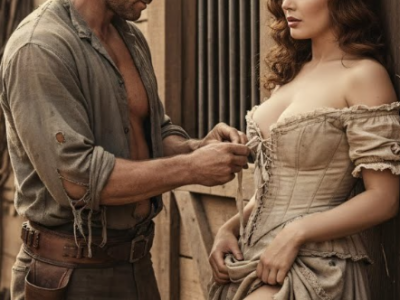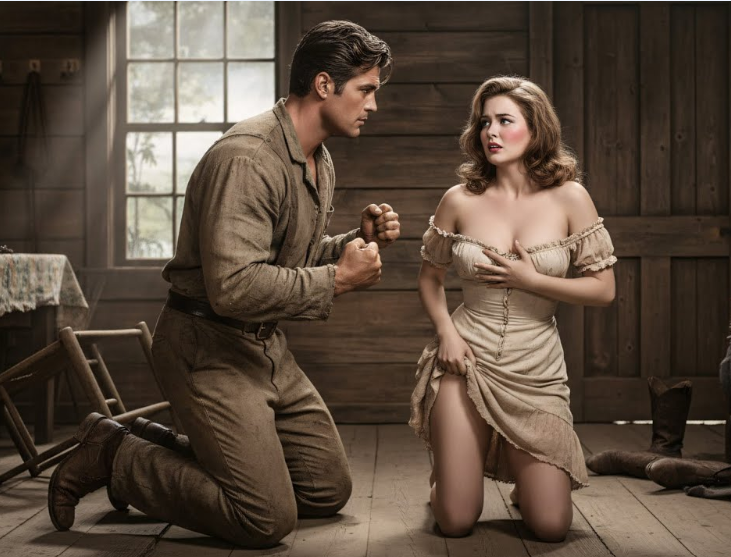
“Don’t Kiss Me There,” She Pleaded, Cowboy Said, “Then Tell Me Where I Should Start”
“Don’t Kiss Me There,” She Pleaded, Cowboy Said, “Then Tell Me Where I Should Start”
The wind in Iron Ridge did not blow so much as it scoured. It came down from the Big Horn Mountains with the weight of winter already heavy in its belly, stripping the paint from the clapboard storefronts and driving grit into the eyes of any man or beast foolish enough to face it head on.
It was late October of 1888, and the Wyoming territory was turning hard and gray, the sky pressing down like a bruised lid over the valley.
The town itself was little more than a scar on the landscape, a huddled collection of timber and false fronts clinging to the edge of the vast brown emptiness that stretched north toward Montana.
In summer, the main street was a choking river of dust that coated the back of the throat and turned spit to mud.
Now, with the frost settling in, the ruts in the road were frozen into ankle twisting ridges of iron hard earth, waiting for the snow that hung heavy in the clouds above the peaks.
Laya Greer kept her head down against the wind just as she kept it down against the world, she pushed open the back door of the laundry shop, a narrow, steam choked building that smelled perpetually of lie soap and wet wool.
The heat inside was a physical wall, moist and suffocating, but it was better than the biting cold of the alley.
Laya closed the door quickly, leaning her back against the rough wood for a moment to catch her breath.
She was 26 years old, though the lines around her eyes and the set of her mouth made her look older.
Her hair, a dark brown that might have been pretty if she ever let it see the sun, was pulled back severely, pinned tight enough to make her scalp ache.
She wore a dress of gray calico, faded from endless washings, with a high collar that buttoned right to the hollow of her throat and sleeves that came down to her wrists.
She did not wear the high collar for fashion. She wore it because the skin beneath it was a map of bad memories.
A lattice of pale raised scars that she would die before showing to a living soul.
There was a basket of shirts waiting on the table, stiff with dried mud and smelling of horse sweat.
Laya moved to the basin, [clears throat] her hands taking up the rhythm they knew best.
Soak, scrub, ring, repeat. Her knuckles were red and swollen. The skin cracked from the harsh soap, but she did not stop.
Work was the only armor she had. The bell above the front door jingled. A sharp, intrusive sound.
Laya stiffened. She did not look up immediately. She learned long ago that meeting a man’s eyes was often interpreted as an invitation.
And an invitation was the last thing she wanted to give. Mrs. Higgins, the banker’s wife, swept in, bringing a gust of cold air and the scent of expensive lavender water that failed to mask the smell of judgment.
I have brought Mr. Higgins’s Sunday shirts. Mrs. Higgins announced, dropping a bundle on the counter.
And mind you, get the starch right this time. The last batch was limp as a dish rag.
I will do my best. Ma’am, Laya said, her voice low and steady. Mrs. Higgins sniffed, her gaze traveling over Laya with a mixture of pity and distaste.
It was a look knew well. To the women of Iron Ridge, she was a creature of suspicion.
She had no husband, no family, and she had arrived in town two years ago with nothing but the clothes on her back and a bruise fading on her jaw.
They whispered that she had been a saloon girl in Cheyenne, or perhaps something worse in Deadwood.
They called her trash when they thought she could not hear. And sometimes when they knew she could, it is a wonder you stay on here.
Mrs. Higgins said, adjusting her gloves. A woman alone in a town like this. It is hardly decent.
I earn my keep. Mrs. Higgins, Laya said, keeping her eyes on the ledger. The woman made a noise in her throat.
A sharp click of the tongue. Just see that the colors are white. When the door closed, Laya let out a breath she had not realized she was holding.
She moved to the floorboard behind the counter, the one that was loose if you knew just where to pry.
She lifted it and checked the tin box hidden in the dirt beneath. It held $4.50, enough for another month of rent, if she ate sparingly.
She took a stale heel of bread from her pocket wrapped in a handkerchief and set it aside for later.
Tonight after dark, she would slip it to the widow Albbright, who lived in the shack next door and had not had a son to care for her since the fever took him three winters ago.
It was part of the routine. Survive the day. Hide [clears throat] the money. Help who you could.
Memorize the exits. Never let them corner you. Eli Graves rode into Iron Ridge 3 hours before sundown.
Looking like a man who had been carved out of the same dry wood as the fence posts lining the trail.
He was 45 years old, but his joints felt twice that. He sat at top a big ran geling that was as roadweary as he was.
His posture loose and easy in the saddle. The deceptively relaxed slump of a man who had spent 30 years watching the horizon for trouble.
His hat was pulled low, the brim stained with sweat and rain, shadowing a face that had seen too much sun and not enough kindness.
He was a tall man, lean and corded with muscle that had grown hard from work rather than show.
His hair was black, shot through with iron gray at the temples, and his skin was the color of deep copper, a testament to the Shosonyi mother he had barely known, and the white father who had left him nothing but a last name.
Eli shifted his weight, wincing as a sharp ache radiated from his left shoulder. An old bullet wound from a fight in Abalene.
5 years gone, still talked to him whenever the weather turned cold. It was talking loud today.
He looked at the town rising out of the dust. It looked like every other place he had passed through in the last decade, a livery, a general store, a church with a peeling steeple, and three saloons.
It was a place to stop, perhaps, a place to rest the horse, and maybe, just maybe, lay down the burden of being a stranger for a few months.
The wide sky above him, usually a comfort, felt heavy today. Out on the open range, the silence could be a church.
But lately, the cold night sleeping on the hard ground had started to hollow him out.
He was tired of waking up with his hand on his revolver. He was tired of the wind being his only conversation.
He wanted a roof. He wanted a fire he didn’t have to build himself. He wanted to belong to something other than the empty miles.
He rode past the first few buildings, his eyes scanning the street from habit. He noted the men loitering on the boardwalks, gauging their hands, their hips, the way they stood.
He saw the sheriff’s star glinting on a man leaning against a post, and he looked away.
Lawman and Eli rarely saw eye to eye. There were rumors that trailed Eli like dust.
In a saloon in Casper, men whispered that he had shot three men in a single dust up over a card game, dropping them before they cleared leather.
In Laram, they said he was a half breed tracker who had scalped a man for stealing his horse.
There was even a wanted poster with a face that looked somewhat like his, half burned and jagged, nailed to a wall in a town two days ride south.
It wasn’t him, but the resemblance was close enough to make him cautious. He pulled the ran up in front of the livery stable.
The hustler, a young boy with ears that stuck out like jug handles, trotted out, then slowed as he saw Eli’s face.
The boy’s eyes dipped to the scabbard on Eli’s saddle, then back to his dark skin.
“Two bits for the stall,” the boy said, his voice cracking. “Oats are extra.” Eli dismounted, his boots hitting the frozen mud with a heavy thud.
He fished a coin from his vest pocket and flipped it to the boy. “Give him a good rub down,” Eli said.
His voice was gravel rolling in a dry creek bed. “He has carried me a long way.”
He took his saddle bags, slung them over his good shoulder, and walked out onto the main street.
The wind hit him instantly, biting through his canvas coat. He needed a drink, and he needed a job.
In that order, he turned down a side street, looking for a path to the saloon that didn’t involve waiting through the main thoroughar’s crowd.
As he passed the mouth of an alley behind a sagging timber building, a flash of white caught his eye.
A woman stepped out of the back door of what looked to be a laundry.
She was carrying a wicker basket piled high with wet sheets. The wind caught the linen, snapping it violently, and for a moment she struggled with the weight of it.
Her boots slipping on the icy ground. A sudden gust whipped a lock of dark hair loose from her pins, lashing it across her face.
She jerked her head up, and her eyes met Eli’s. It was a brief moment, lasting no longer than a heartbeat.
But in that second, Eli saw something that stopped him in his tracks. He expected to see the usual dull exhaustion of a frontier woman, or [clears throat] perhaps the flirtatious glance of a girl looking for a cowboy with coin.
Instead, he saw a profound, terrified weariness. It was the look of a wild horse that had been roped and broken, but was still waiting for the chance to kick down the stall door.
Her eyes were dark and intelligent, and they assessed him as a threat instantly. She did not smile.
She tightened her grip on the basket, her knuckles whitening, and stepped back toward the safety of the door.
Eli tipped his hat, a reflex of manners he hadn’t lost. She did not acknowledge it.
She turned and vanished back into the steam and shadow of the laundry, the door clicking shut decisively behind her.
Eli stood there for a moment, the wind tearing at his coat. He felt a strange pang in his chest, an echo of recognition.
>> [clears throat] >> He knew what it was to look at the world and see only things that wanted to hurt you.
The hierarchy of Iron Ridge was simple. Silas Crowe owned the land, and therefore he owned the town.
Silas was a man built like a bull, thick-necked and red-faced, with a belly that strained the buttons of his waist coat.
He sat at the best table in the Golden Steer Saloon, nursing a whiskey that cost more than a cow hand made in a week.
He owned the Circle Sea Ranch, which swallowed up half the valley, and he had a hand in the bank, the freight line, and the sheriff’s office.
Beside him sat his son, Wade. Wade Crowe was 22, handsome in a soft, spoiled way, with a mouth that curled naturally into a sneer.
He was drunk, which was his natural state afternoon. And he was loud. I am telling you, P, Wade said, slamming his hand on the table.
That little piece of trash at the laundry thinks she is too good to answer a civil question.
I walked by there today and she locked the door in my face. She is running a business.
Wade, Silas grunted, not looking up from his cards. Leave the girl be. You have got plenty of willing women over at the Bluebird.
WDE’s face darkened. It ain’t about willing. It is about respect. She forgets who she is.
I heard she ran out on a debt in Cheyenne. I reckon she owes someone something.
Maybe she owes me. Sheriff Hooker, leaning against the bar, chuckled. Hooker was a thin man with a mustache that looked like it had been drawn on with charcoal.
He wore boots that shone with polish, likely paid for by Silus Crow’s generosity. Now wait, the sheriff said, “Don’t go making trouble that I have to clean up.
I don’t make trouble. Sheriff Wade grinned, his eyes glassy and cruel. I collect what is due.
Eli stood at the far end of the bar, nursing a cheap beer. He kept his head down, his hat brim shading his eyes, but he heard every word.
He knew men like Wade Crowe. He had seen a hundred of them in a hundred towns.
Boys who had never worked a day for their bread, who thought the world was a fruit ripe for the plucking, and who rotted from the inside out.
Eli felt the familiar itch in his palms, the urge to step in, to shut the boy’s mouth, but he forced his hand to stay on his beer glass.
He was not here to save anyone. He was here to survive the winter. He had $3 in his pocket and a bad shoulder.
He couldn’t afford a war with a cattle baron son. He finished his beer and turned to leave.
The taste of it sour in his mouth. Night fell like a hammer. The temperature plummeted, freezing the mud in the streets into jagged ruts.
The wind howled through the gaps in the buildings, a lonely, mournful sound that made men huddle closer to their fires.
Laya finished the last of the ironing by the light of a kerosene lamp. Her shoulders achd, and her eyes burned from the smoke and the strain.
She folded the last shirt, placed it on the stack, and blew out the lamp.
She wrapped her shawl tight around her shoulders and picked up the bucket of slop water from the day’s washing.
She needed to empty it in the alley before she could go home to her small room above the shop.
She unlocked the back door and stepped out into the biting dark. The alley was a tunnel of blackness.
The only light coming from the sliver of moon struggling through the clouds. She heaved the bucket, splashing the soapy water into the drainage ditch.
Well, now look what we have here. The voice came from the shadows, thick with drink and malice.
Laya froze, her heart hammering against her ribs like a trapped bird. She knew that voice.
Wade Crow stepped out from behind a stack of crates. He swayed slightly, a bottle dangling from one hand.
He was smiling, but it was a smile that didn’t reach his eyes. “Mr. Crow, Laya said, her voice trembling despite her best effort to keep it steady.
I am closing up. Please let me pass. Wade laughed. A low, wet sound. Closing up?
You are just getting started, darling. I told you earlier. We’ve got business. I have no business with you, Laya said, taking a step back toward the door.
Wade moved faster than a drunk man should. He lunged forward, grabbing her wrist. His grip was wet and hot, and Laya flinched violently, a gasp of pure terror escaping her throat.
“Don’t you walk away from me,” Wade snarled, yanking her toward him. “You think you are better than me.
You are nothing, just a used up little thing hiding in the steam. I know what you are.
Let me go,” Laya cried out, struggling. She twisted, trying to break his hold, but he was heavy and strong.
He shoved her back against the rough wood of the shop wall. Her head cracked against the timber, a dull thud that made stars burst in her vision.
She felt the fabric of her dress tear at the shoulder, the sound loud in the quiet alley.
“Please,” she begged, her voice cracking. “Please, just leave me be.” Wade pressed his forearm against her throat, pinning her.
His breath smelled of rot and whiskey. I will leave you be when I say so.
You owe me a little fun, I reckon. Laya squeezed her eyes shut, her body rigid with the old paralyzed terror she thought she had outrun.
She [clears throat] waited for the pain. She waited for the end. Instead, the weight was suddenly ripped away.
There was a sound of scuffling boots, a grunt of surprise, and then the sickening crunch of bone meeting wood.
Laya opened her eyes, gasping for air, her hand flying to her torn shoulder. The stranger from the alley, the cowboy with the sad eyes, had Wade Crow pinned against the opposite wall.
Eli had one hand wrapped around WDE’s throat and the other twisting WDE’s arm behind his back at an angle that made the younger man whimper.
Eli’s face was inches from WDE’s in the moonlight. Eli looked like a demon. His lips were pulled back from his teeth and his eyes were black pits of rage.
He wasn’t shouting. He was deadly, terrifyingly quiet. You touch her again, Eli whispered, his voice a rasp of steel, and I will break this arm like a dry twig.
Do you understand me? WDE sputtered, his face turning purple. Do you know who I am?
My father? I don’t care who your father is, Eli said, tightening his grip. I care that you are a coward assaulting a woman in the dark.
Now, not if you want to keep the arm. Wade nodded frantically, tears of pain squeezing out of his eyes.
Eli shoved him away. Wade stumbled, falling into the mud. He scrambled backward, clutching his arm, his bravado gone, replaced by the whining fear of a bully who has finally met a wolf.
“You are dead,” Wade hissed, scrambling to his feet. “You hear me, drifter? You are a dead man.
Get,” Eli said. One word, simple, final. Wade turned and ran, slipping and sliding in the frozen muck, disappearing toward the main street.
Eli stood there for a moment, his chest heaving, his hands balled into fists at his sides.
He took a long, jagged breath, trying to leash the violence that had surged up inside him.
It had felt too good. That was the danger. It had felt too good to hurt him.
He turned slowly to Laya. She was pressed against the wall, shaking so hard her teeth chattered.
She held her torn dress together with white- knuckled hands. “Ma’am,” Eli said softly, raising his hands, palms up.
“I ain’t going to hurt you.” Laya stared at him. She [clears throat] saw the blood on his knuckles where he had grazed the wall.
She saw the wildness still lingering in his eyes. She wanted to thank him, but the words stuck in her throat.
Fear was a habit she couldn’t break in a second. I am fine,” she whispered, though she clearly wasn’t.
“Just just go. Please don’t make a scene. I reckon the scene is made,” Eli said, boots crunched on the gravel at the end of the alley.
A lantern swung into view. “Sheriff Hooker, followed by two deputies, stroed toward them.” Wade must have found them fast.
“What is this?” Hooker demanded, holding the lantern up. He He attacked me. WDE’s voice came from behind the sheriff.
That half-breed animal. I was just talking to the lady and he jumped me. Eli didn’t move.
He looked at the sheriff then at Wade. The boy was forcing himself on her.
Eli said calmly. I stepped in. Hooker turned the light on Laya. She flinched away from the glare.
“Is that right?” “Miss Greer,” Hooker asked, his tone bored. Wde Crow was forcing himself.
Laya looked at Wade, who was smirking now, safe behind the badge. She looked at the sheriff, who clearly didn’t care.
She realized with a sinking heart that the truth didn’t matter here. If she accused Wade, Silus Crow would have her evicted by morning.
She would starve. “He there was a misunderstanding,” Laya whispered, looking at the ground. “It is over now.
Please. Hooker looked back at Eli, a nasty smile touching his lips. Seems the lady doesn’t want your help, stranger.
Eli looked at Laya. He saw the shame burning in her cheeks. He understood. She was surviving.
Hooker stepped close to Eli, hooking his thumbs in his belt. I’m going to let you walk away tonight, cowboy, because I am a generous man.
But you listen to me. Wade Crowe is the son of the man who owns this town.
You touch him again and I won’t be asking questions. I will just be digging a hole.
You understand? Eli met the sheriff’s eyes. He didn’t blink. I understand how things work here.
Sheriff, good. Now get out of my alley. Eli turned to look at Laya one last time.
She wouldn’t meet his gaze. He felt a heavy stone of disappointment in his gut.
Not at her, but at the world. It was always the same. He turned and walked away into the darkness, his spurs jingling softly, the wind snatching the sound away.
That night, Laya barred the door of her room with a heavy oak plank. She pulled the curtains tight.
She stripped off the torn dress, her fingers trembling so badly she ripped a button.
She stood naked in the center of the room, shivering in the cold air. She poured water from a pitcher into a tin basin.
The water was icy, skimmed with frost, but she didn’t heat it. She took a rough cloth and the bar of harsh yellow soap.
She began to scrub. She scrubbed the wrist where Wade had grabbed her. She scrubbed her shoulder where the dress had torn.
She scrubbed until the skin was raw and angry red. She wanted to scrub the feeling of his hand off her.
She wanted to scrub the memory of his breath out of her mind. Tears ran down her face, hot and silent.
She remembered the others, the men in Cheyenne, the men who had given her the scars on her back.
They were all the same. Hands, mouths, promises that turned into threats. She had thought she was safe here.
She had thought she was invisible. But she wasn’t. She was just prey that had forgotten to run.
And the cowboy Eli, the way he had looked at Wade, the violence in him, it terrified her.
But the way he had looked at her, sad, gentle, that terrified her more. Kindness was a trap.
She knew that kindness was just the bait they used before the steel jaws snapped shut.
Across town in the loft of the livery stable, Eli sat on a bail of hay.
The air smelled of dry grass and horses. He had a bottle of whiskey in his hand, but he hadn’t opened it.
He was staring at his own hands. They were large, scarred, capable of so much work and so much destruction.
He could still feel the snap of Wade’s arm under his grip. He could still feel the surge of adrenaline, the dark, familiar joy of hurting a man who deserved it.
He had spent 20 years trying to outride that part of himself, the part that was good at killing, the part that had earned him the rumors.
He had come here for peace. He had come here to fix fences and watch cows and sleep without a gun in his hand.
But he had been in town less than 6 hours, and he had already made an enemy of the most powerful family in the valley.
He leaned his head back against the rough wood of the barn wall and closed his eyes.
He saw Laya’s face, the terror in it, the way she had looked when the sheriff arrived.
Defeated, he should ride out. He should saddle the rone at first light and head for Montana.
There was nothing for him here but a shallow grave or a jail cell. But as the wind howled outside, rattling the barn doors, Eli knew he wasn’t going anywhere.
He had seen the way Wade looked at her. The boy wasn’t done. And if Eli left, there would be no one to stop the next time.
“Damn it,” Eli whispered to the dark. Morning broke cold and brittle. The sun was a pale, watery disc behind the clouds.
By the time the first pot of coffee was boiling at the general store, the story of the alley had already changed.
It traveled from mouth to ear, twisting with every telling. “Did you hear?” “Mrs.” Higgins whispered to the baker.
“That laundry woman, the Greer girl, caught in the alley with a drifter. I heard she was drunk.”
The baker replied, wiping flour from his hands, flashing her ankles at Wade Crow, trying to get him to pay her rent.
And that drifter, the blacksmith added, leaning in, a half breed pulled a knife on the sheriff, said he’d kill the whole Crow family.
Disgraceful. Mrs. Higgins sniffed. Just disgraceful. I told Mister Higgins we shouldn’t act kindly to her.
Trouble follows that sort. Laya walked down the street toward the shop. Her collar buttoned high, her head down.
She felt the eyes on her. She heard the whispers stop as she passed, then start up again, louder, sharper.
They were stripping her down, judging her, blaming her for the bruises she hid under her dress.
She didn’t look up. She unlocked the shop door and stepped inside. Across the street, Eli Graves stood on the boardwalk, leaning against a post.
He watched her go in. He heard the men laughing nearby, making jokes about what happened in the dark.
He pulled his hat brim down. The town had already decided who the villains were.
And for the first time in a long time, Eli didn’t care what they thought.
He just watched the door of the laundry shop and settled in to wait. The winter was going to be long, and the wind was only going to get colder.
Winter arrived in Wyoming, not with a whisper, but with the slam of a door.
By the second week of November, the ground had turned to iron. The mud in the streets of Iron Ridge, which had been a nuisance in October, was now a treacherous landscape of frozen ruts and jagged ridges that could snap a horse’s leg as easily as a dry twig.
The wind came down from the north, screaming off the peaks of the big horns, carrying crystals of ice that scoured the skin raw.
The mountains themselves, once distant purple sentinels, now loomed closer, white capped and jagged, looking like the teeth of a wolf waiting to snap the valley shut.
Travelers who had the means moved on, pushing south toward the railroad lines in Cheyenne or west toward the coast.
The drifters, the gamblers, and the summerhands vanished, leaving the town to those who had nowhere else to go.
Eli Graves was one of those left behind. His plans to ride for Montana had died with the first hard frost.
The mountain passes were already choked with snow, and his ran geling, while Sturdy was too old to push through 4 ft of powder on an empty belly.
Eli was stranded. His coin purse was light, holding barely enough for a week of grain for the horse and beans for himself.
He tried the Circle Sea first, purely out of necessity. He rode out to the main gate, where the sheer size of Silus Crow’s operation was a testament to the man’s greed.
Silus Crow himself was inspecting a line of new fencing near the road when Eli approached.
The cattle baron sat on a massive black stallion wrapped in a buffalo coat that made him look like a bear on horseback.
“I am looking for work.” “Mister Crow,” Eli said, keeping his voice flat. “I can ride, I can shoot, and I can fix anything made of wood or leather.”
“Crow looked down at him, his eyes narrowing as they took in the gray at Eli’s temples and the dark cast of his skin.
He spat a stream of tobacco juice onto the frozen ground. Missing Eli’s boot by an inch.
I have got enough hands, Crow said. And even if I was short, I don’t hire old men with mixed blood.
They tend to stir up trouble or steal. Eli felt the heat rise in his neck.
A slow burn that had nothing to do with the cold. I have never stolen a thing in my life.
Crow laughed. A harsh barking sound. That is what they all say. I heard about you in the alley with my boy.
You are lucky the sheriff didn’t run you out then. Right on, Drifter. Iron Ridge doesn’t need your kind.
Eli turned the ran without another word. There was no point in arguing with a man who owned the law.
He found work 2 days later, not with the rich, but with the desperate. Jonah Pike was a small rancher with a parcel of land nestled in the foothills.
Land that Silas Crow had been trying to buy or steal for 5 years. Jonah was a stringy man with worried eyes and hands calloused from doing the work of three men.
[clears throat] He looked Eli over in the dim light of the livery stable. “I can’t pay much,” Jonah said, rubbing the back of his neck.
“$20 a month and found, but the work is hard. I need a man up at the line cabin on the north ridge.
It is disputed land. Crow’s cows keep wandering onto it and my cows keep disappearing.
I can handle cattle, Eli said. It ain’t just the cattle, Jonah warned. It is the winter.
Once the snows come proper, you will be cut off. Might be weeks before I can get a wagon up there with supplies.
You will be alone with the wind and the wolves. Some men go crazy from the quiet.
Eli looked out the stable door at the gray sky. He thought of the whispers in town, the way the bartender served him last, the way the sheriff watched him.
Quiet sounds like a luxury. Mr. Pike, Eli said, “For Laya Greer, the winter brought a different kind of cold.
The incident in the alley had stained her. Iron Ridge was a town that thrived on boredom and judgment, and Laya was now the favorite subject of both.
The wives of the town, women who had previously ignored her, now went out of their way to cross the street when she approached.
Business at the laundry began to bleed away. First it was Mrs. Higgins, then the banker’s wife, then the reverend’s daughter.
They stopped sending their linens, paring the gossip that Laya was a woman of loose morals who tried to trap men in alleys.
They say she lured Wade Crowe out there. A woman whispered loud enough for Laya to hear in the general store, trying to get money out of him.
Trash, another muttered. Laya kept her head down, buying her sack of flour with hands that trembled only slightly.
She did not fight back. She knew that fighting only gave them more ammunition. Her landlord, a nervous little man named Mr.
Clancy, knocked on her door 3 days after the snow started. He refused to meet her eyes.
I’m afraid the rent is going up. Miss Greer,” he mumbled, staring at his boots.
“Going up?” Laya asked, her hand gripping the doorframe. “Mr. Clancy, we have an agreement.
$2 a month. Wood is expensive,” he stammered. “And well, Mr. Crow, he owns the mortgage on this building now.
He says the risk of tenants with questionable reputations requires a higher fee, $3 starting now.
Laya felt the blood drain from her face. $3 was everything she had. It meant no meat, no lamp oil, and barely enough coal to keep the stove from freezing.
I will have it, she said, her voice hollow. She took in extra work. She mended horse blankets for the livery.
Heavy, filthy work that made her fingers bleed. She stayed up until the candles burned down to wax puddles, stitching tears in rough canvas coats for the miners passing through.
She grew thinner, her eyes dark hollows in her pale face, and through it all.
Wade Crow was a spectre. He didn’t attack her again, not physically, but he was there.
He lingered at the mouth of the alley when she took out the ashes. He sat on the porch of the saloon across the street, watching her shop window.
When she walked past, he would make low, wet sounds, kissing the air or whisper things that made her skin crawl.
He hadn’t forgotten. He was just waiting for her to break. The bell above the laundry door jingled on a Tuesday afternoon.
Laya looked up from a pile of mending, her needle poised like a weapon. It was Eli.
He looked different than he had in the alley. He was wearing a heavy sheep-skin coat and his hat was pulled low against the glare of the snow.
He held a flannel shirt in his hand, crumpled and torn at the sleeve. Laya stood up slowly.
She hadn’t spoken to him since that night. She had seen him around town, a dark shadow moving through the gray light, but she had kept her distance.
“I I have a tear,” Eli said, his voice rough. Snagged it on a nail at the livery.
“Can you fix it?” Laya looked at the shirt, then at his face. He looked tired.
The lines around his eyes were etched deep. “I can fix it,” she said. “It will cost 10 cents.”
Eli nodded and placed the shirt on the counter. He didn’t leave. He stood there filling the small steam choked room with his presents.
He smelled of cold air, tobacco, and pine. You are staying then? Laya asked, surprising herself.
She usually never asked customers questions. Found work, Eli said. Riding fence for Jonah Pike.
Leaving tomorrow for the high country. Laya smoothed the fabric of the shirt. That is lonely work.
I am suited for it, Eli said. He watched her hands. They were red and chapped, moving with a quick, nervous efficiency.
He noticed the shadows under her eyes. The way her collar bones pressed against the thin fabric of her dress.
They are making it hard for you, he said softly. Laya’s hands faltered for a second, then resumed their stitching.
I don’t know what you mean. The town, Eli said. Crow. I hear things. People talk.
Laya said, keeping her eyes on the needle. It is what they do. It ain’t right.
Eli said, “You didn’t do nothing wrong that night.” Laya stopped sewing. She looked up at him, her eyes fierce and wet.
It doesn’t matter what is right. It matters who owns the story, and I don’t own anything.
Eli looked at her, really looked at her, and the mask of the stoic cowboy slipped for a fraction of a second.
I know that feeling, he said, being the villain in everyone else’s book. Laya hesitated.
I have seen worse nights than that, alley,” she whispered, almost to herself. Eli nodded slowly.
“So have I, ma’am. So have I.” The silence that stretched between them wasn’t empty.
It was heavy with the things they weren’t saying. It was a recognition of shared scars.
When the shirt was done, Eli paid her. He placed two dimes on the counter, double the price.
“That is too much,” Laya said. It is for a rush job, Eli said. He hesitated at the door.
I’m walking toward the boarding house. It is on your way home. It is getting dark.
Laya looked at the window. The sun was gone, and the street was a tunnel of purple shadows.
Wade usually waited until true dark, but she never knew. “I can walk myself,” she said, her habit of defense rising up.
Eli nodded. I know you can, but I am going that way anyhow. He stepped outside and waited.
Laya hesitated, then blew out the lamp and locked the door. They walked down the frozen street.
Eli didn’t walk beside her. He walked five paces behind on the street side of the boardwalk.
He didn’t try to talk to her. He didn’t try to take her arm. He just placed his body between her and the dark for the first time in months.
The knot of fear in Laya’s chest loosened just a fraction. She could hear his boots crunching in the snow behind her.
It was a steady, heavy sound, a sound that said, “I’m here. Watch the front.
I’ve got the back.” When she reached her door, she turned to look at him.
He touched the brim of his hat. “Good night, Miss Greer.” “Good night, Eli,” she said softly.
Two days later, trouble struck the Pike Ranch. Jonah came into town in a panic, his wagon skidding on the ice.
His wife Martha had taken a fever. She was burning up, delirious, and the town doctor was drunk in the back of the Golden Steer and refused to ride out in the cold.
Someone told Jonah that Laya knew healing. It was true in the life she tried to forget.
The women had looked after each other because no one else would. Laya knew how to break a fever, how to make puses from willow bark, how to stitch a wound.
Jonah pleaded with her in the shop. She is dying. Miss Greer, please. I have no one else.
Laya didn’t hesitate. She couldn’t turn away from suffering. She packed a small bag with herbs and clean linens and climbed into Jonah’s wagon.
The ride out was brutal. The wind had teeth. The landscape was a vast, indifferent ocean of brown grass and white drifts.
Laya huddled in her shawl, realizing for the first time just how small Iron Ridge was, and how deadly the world outside it could be.
She spent two days at the Pike Ranch. She cooled Martha’s forehead with snow water, fed her broth drop by drop, and sat up through the long nights listening to the coyotes yip in the hills.
By the third morning, the fever broke. Martha was weak, but she would live. Jonah was weeping with gratitude.
He tried to pay Laya, but she refused. “Just get me back to town,” she said.
“I can’t lose a day of work.” Jonah couldn’t leave his wife, so he sent his hired hand, a boy named Toby, to drive the wagon.
Toby was 18, pimply, and terrified of the weather. The sky was the color of a bruised plum when they set out.
“We need to make haste,” Toby said, flicking the rains. “It smells like snow.” It didn’t just snow.
The sky collapsed. They were 5 mi out of town when the storm hit. It wasn’t a gradual fall.
It was a white curtain dropping over the world. The wind roared like a freight train, driving the snow horizontally.
In minutes, the road was gone. The landmarks were erased. Toby panicked. I can’t see the trail.
He shouted over the wind. Keep the horses steady. Laya screamed back, pulling her shawl over her face.
But Toby yanked the rains, trying to turn them toward a grove of trees that wasn’t there.
The horses blinded and spooked, veered off the hardpacked earth and into the deep drifts of the open range.
The wagon lurched, the wheels grinding in the soft powder. They were lost. The cold descended instantly, a physical weight that pressed the air from their lungs.
Laya huddled in the back of the wagon, her teeth chattering so hard her jaw achd.
She knew what this was. This was how people died. They would freeze here and the snow would bury them until spring.
Suddenly, a shape emerged from the white wall. A horseman. He was a dark smudge against the blinding snow, riding hard.
The rider cut across their path, waving his hat. Whoa. The voice was torn away by the wind, but the tone was commanding.
It was Eli. He rode up alongside the wagon. His horse chest deep in a drift.
His face was wrapped in a scarf, his eyes narrowed to slits. “You are going in circles,” Eli shouted.
“We are trying to get to town,” Toby yelled back, crying now. “You will never make it,” Eli roared.
“The pass is blocked. The drips are 5 ft deep and rising. You will die out here.”
Laya pulled herself up, grabbing the side of the wagon. Eli. He looked at her, his eyes widening slightly.
He hadn’t known she was there. Lla, we have to get you out of this wind.
Where? She screamed. My cabin. Eli pointed toward the treeine that was barely visible up the slope.
It is a mile up. It is the only shelter. Toby didn’t argue. He followed the dark flank of Eli’s ran as if it were a lighthouse.
The mile took an hour. The horses struggled, their breath pluming in the air. The wind tried to push them off the mountain.
Laya’s hands were numb. Her feet blocks of ice. She stopped shivering, which she knew was a bad sign.
Finally, a shape loomed out of the gray. A low rough huneed structure of logs chinkedked with mud.
The line cabin. Eli dismounted, sinking to his knees in the snow. He forced the door open against the drift and waved them in.
Get her inside, he yelled to Toby. Toby helped Laya down. Her legs collapsed under her, frozen and useless.
Eli caught her. He scooped her up, his arms strong and hard, and carried her into the cabin.
He kicked the door shut, cutting off the scream of the wind. The silence inside was sudden and ringing.
The cabin was freezing, darker than the storm outside. It smelled of wood smoke and old dust.
It was tiny. One room, a stone fireplace, a table, and a single narrow bunk built into the wall.
Eli set Laya down on the bunk. She curled into a ball, shaking violently as the warmth of the room, relative as it was, began to wake her nerves.
Toby stumbled in with the bed rolls from the wagon. I I got to see to the horses.
He chattered. There is a leanto round back. Go, Eli said. Bring the blankets. When they were alone, Eli moved to the fireplace, his hands, stiff with cold, fumbled with a match.
He struck it, the flare of light illuminating his face. He looked grim. He got the fire going, feeding it dry kindling until the flames caught and roared.
Then he turned to Laya. “You are freezing,” he said. “We need to get you warm.”
Laya stared at him. Her mind was fracturing. The walls of the cabin felt like they were closing in.
The door was shut. The window was a square of white nothingness. She was trapped.
She was trapped in a small room with a man. The memory hit her like a physical blow.
The smell of cheap tobacco. The sound of a lock turning. The feeling of being cornered.
“No,” she whispered, scooting back against the rough log wall. “No.” Eli froze. He saw the look in her eyes, the same look from the alley, but amplified by the trauma of the cold.
She wasn’t seeing him. She was seeing every man who had ever heard her. He held up his hands, palms open.
I’m just going to put more wood on the fire. Laya, that is all. He moved slowly, narrating his actions in a low, steady voice.
I am walking to the wood pile. I am picking up a log. I am putting it on the grate.
I am stepping back. Laya watched him, her chest heaving. The logic of survival was waring with the logic of trauma.
She knew he had saved her. She knew she needed warmth. But her body was screaming, “Run!”
Toby burst back in, bringing a blast of cold air. “The horses are tied.” “It is It is bad out there.
You can’t see your hand in front of your face.” “We are snowed in,” Eli said flatly.
“For how long?” Toby asked. “Days,” Eli said. Maybe a week. Laya let out a small choked sound.
Eli looked at her. He took the heavy buffalo robe from his own bed roll.
“Miss Greer,” he said formally. “I am going to give you this robe. I want you to wrap it around yourself.
I’m going to sit over here by the door.” “Toby can take the floor by the fire.”
He didn’t come closer. He tossed the robe onto the foot of the bed. Laya grabbed it, pulling it around her like a shield.
She buried her face in the fur, smelling the animal scent, trying to ground herself.
Nightfell, though it was hard to tell through the storm. The cabin grew dark, save for the orange glow of the hearth.
The wind outside changed its pitch, deepening into a guttural roar that shook the roofboards.
They ate hardac and dried beef from Eli’s supplies, washing it down with melted snow water.
Conversation was sparse. Toby fell asleep quickly, exhausted, snoring softly on the floor near the hearth.
That left Eli and Laya awake. The cold crept back in as the fire settled.
The cabin’s walls were thin, and the heat dissipated fast. Eli sat on a crate near the door, his coat buttoned to his chin.
He was shivering. “Layla could see the tremors running through his shoulders.” “You will freeze over there,” Laya said.
Her voice was brittle. I have slept in worse, Eli said, his teeth chattering slightly.
You should you should come closer to the fire, she said. Eli looked at her.
The bed was next to the hearth. To be near the fire meant being near her.
I am fine, he lied. Laya looked at the single narrow bunk. Then she looked at the floor.
The stone floor was radiating cold. It is going to be 20 below tonight,” Eli said, looking at the frost forming on the inside of the window pane.
He stood up and moved his bed roll. He didn’t come to the bed. He laid his blanket on the floor parallel to the bunk, but with 3 ft of distance between them.
“I will sleep here,” he said. On the floor, you keep the bed. Laya watched him lie down.
He turned his back to her, facing the door. He curled up, pulling his coat collar over his ears.
Laya lay back on the thin mattress. She was rigid. Every muscle in her body was coiled tight.
She listened to the wind. It sounded like a living thing, clawing at the logs, trying to get in.
[clears throat] She looked at Eli’s dark shape on the floor. He was breathing slowly, evenly, though she knew he couldn’t be asleep yet.
She was trapped in a box in the middle of nowhere with a man who could snap her neck with one hand, a man with a gun on his belt and a violent past.
But he had walked behind her to keep her safe. He had ridden into the storm to find them.
He had given her the bed. She pulled the buffalo robe tighter. She closed her eyes, but she didn’t sleep.
She listened to his breathing, counting the inhalations, wondering if the monster outside the door was worse than the fear inside her heart.
And wondering with a terrifying spark of hope if he might be the one man in the world who wouldn’t make her regret staying.
The snow piled up against the door, sealing them in. The world was gone. There was only the fire, the cold, and the long waiting dark.
The dawn did not come as a sunrise, but as a slow gray lightning of the frost that coated the single window pane.
The silence was absolute. The howling wind that had battered the cabin for hours had ceased, replaced by a stillness so heavy it felt like pressure against the eardrums.
Eli Graves woke first. He was curled on the stone floor near the door, wrapped in his bed roll and his heavy canvas coat, but the cold had seeped through every layer.
His left shoulder, the one with the old bullet wound, throbbed with a dull, sickening ache that made his teeth clench.
He lay still for a moment, watching his breath plume in the air above him.
It rose in thick white clouds, lingering before dissipating. He pushed himself up, his joints popping, and looked toward the bunk.
Laya was a mound of buffalo fur, motionless, save for the rhythmic rise and fall of the hide.
Toby, the young ranch hand, was asleep on the Hearthston, huddled so close to the dying embers that his boot leather was smoking slightly.
Eli moved to the door and lifted the latch. He pushed. The wood groaned, but did not budge.
He put his shoulder into it and shoved harder. It gave an inch, revealing a wall of packed white.
“We are dug in.” Eli whispered to himself. He grabbed the shovel standing in the corner and spent the next 20 minutes clearing enough space just to crack the door open.
When he finally squeezed through the gap, the sight that greeted him stopped him cold.
The world was gone. The valley, the trail, the horizon, all of it had been erased.
In its place was a blinding, undulating ocean of white. The snow had drifted halfway up the cabin walls.
The pines were bent double under the weight, looking like hunched old men. The sky was a low, oppressive ceiling of granite gray, promising more to fall.
Eli stood there, the cold biting at his exposed face, and did the mental arithmetic of survival.
They had a half sack of beans, a tin of coffee, some hard tac, and the dried beef in his saddle bags.
They had the wood in the leanto, but if the temperature dropped again, that wood would burn fast.
He went back inside, stomping the snow from his boots. The noise woke Laya. She sat up abruptly, clutching the buffalo robe to her chest, her eyes wide and disoriented.
For a second, she didn’t know where she was. She saw the rough logs, the stone fireplace, the strange man standing by the door.
Panic flared in her eyes. A sharp hunted look. “It is morning,” Eli said softly, keeping his hands where she could see them.
“The storm is settled, but we are snowed in.” Laya blinked. The memory of the wagon and the blizzard rushing back.
She looked at the door, then at Eli. “How bad is it?” She asked, her voice raspy from sleep and dry air.
Eli didn’t lie to her. “It is deep. We won’t be moving anywhere today. Maybe not for a few days.”
Laya swung her legs over the edge of the bed. She was still wearing her dress and boots, having slept fully clothed for warmth.
She shivered violently as the cold air hit her. “We have to work,” Eli said.
“Staying warm is going to take effort. The reality of their situation stripped away the social graces of the town.
There was no room for modesty or hesitation. Survival was a chore that required all hands.
They fell into a rhythm born of necessity. Toby, young and terrified, was tasked with digging a path to the lean-to where the horses were sheltered.
Eli and Laya took on the wood. The wood pile in the leanto was frozen solid.
The logs cemented together by ice. They had to pry them apart with a crowbar before they could be split.
Laya insisted on helping. I am not an invalid. Eli, she said when he tried to tell her to stay inside.
I can swing an axe. She proved it. She followed him out into the biting air, her breath coming in short, sharp gasps.
The altitude made her lungs burn as if she were inhaling glass. The cold stung her cheeks until they turned a raw, angry red.
But she didn’t stop. Eli watched her out of the corner of his eye as he split kindling.
She wielded the hatchet with a grim determination, bringing it down on the pine knots with a force that surprised him.
She wasn’t doing it for exercise. She was attacking the wood. She was fighting the cold, the trap of the cabin, the fear that was constantly simmering just behind her eyes.
They worked in short bursts, 10 minutes outside, then rushing back in to warm their hands over the fire until the feeling returned with a painful sting.
By noon, they had a stack of wood, but they were exhausted. They boiled snow in a pot for water, the taste flat and metallic.
They ate beans warmed in the tin, counting every spoonful. “It is going to get colder tonight,” Eli said, looking at the window.
“The clouds are thinning. That means the heat will lift right off the earth. Laya looked at the fire.
It was small, kept low to conserve fuel. The cabin was already drafty. She wrapped her shawl tighter around herself.
How cold? She asked. Cold enough to kill a horse if it isn’t blanketed, Eli said.
Cold enough to freeze water inside a cup. Night fell with a terrifying speed. One moment the light was gray, the next it was gone, swallowed by the mountains.
The temperature plummeted just as Eli had predicted. The cold was a physical presence in the room, a heavy weight that pressed against the walls.
The frost on the window pane grew thick, fern-like patterns spreading across the glass. They sat around the fire, huddled in their coats.
Toby was already asleep, exhausted by the digging, curled up on the hearthstone where the heat was strongest.
Eli sat by the door again on his bed roll. He was shaking. It started as a tremor in his hands, then spread to his shoulders.
His jaw was clenched tight to keep his teeth from chattering. The old wound in his shoulder was screaming, the cold settling into the bone like a rusted nail.
Laya watched him from the bed. She could see the tremors. She could see the way his skin had turned a pale wax and gray.
“You are freezing,” she said. “I am fine,” Eli managed to say, though his voice shook.
“You are not,” Laya said. She sat up, pulling the buffalo robe around her shoulders.
“You are shaking so hard you are going to rattle the walls.” Eli tried to chuckle, but it came out as a gasp.
Just a cold night. Laya looked at the fire, then at the frozen expanse of the floor where Eli lay.
The draft from under the door was a steady stream of ice. He wouldn’t survive the night down there, not in his condition.
She looked at the narrow bunk. It was barely 3 ft wide. “Get in the bed,” she said.
Eli stopped shaking for a second, surprised into stillness. “Ma’am.” She didn’t look at him.
She stared at the fire. It is simple arithmetic, Eli. If you stay on the floor, you will freeze.
If you freeze, who is going to chop the wood tomorrow? I can’t do it alone.
I can’t I can’t take your bed, Eli said. It is not taking. It is sharing.
Eli sat up slowly. He looked at the bed, then at her. He knew what she was asking.
He also knew what it cost her. He had seen the way she flinched when Wade grabbed her.
He had seen the terror in her eyes when he carried her in. For a woman like her, sharing a bed wasn’t intimacy.
It was a cage. We can lie like rocks in a creek, Eli said softly.
Just close enough not to freeze. I won’t turn toward you. Laya hesitated. Her body tightened at the thought.
The memory of men, their weight, their smell, their grabbing hands washed over her. But then she looked at Eli.
He was huddled in his coat, his face drawn with pain, and his [clears throat] eyes were lowered, giving her the dignity of choice.
“If you touch me,” she whispered, her voice trembling. “I will scream.” “I won’t touch you unless you ask,” Eli said.
“I promise you that.” Laya nodded, a sharp jerk of her chin. “All right.” Eli stood up, his legs stiff.
He moved to the bed. He didn’t take off his coat or his boots. He lay down on the very edge of the mattress, his back to her, facing the wall.
He made himself as small as a man of his size could be. Laya lay down behind him.
She kept the buffalo robe between them, a furry barrier. She faced the room, her back to his back.
They lay there in the dark, the fire light casting long, dancing shadows on the logs.
The silence was thick. Laya could feel the heat radiating from him. Even through the layers of clothing, it was a solid, steady warmth.
She was rigid, her muscles locked, waiting for him to move, waiting for the shift in weight, the hand reaching out, but he didn’t move.
He lay as still as the logs in the wall. Slowly, the warmth began to do its work.
The shivering in Eli’s frame stopped. Laya’s own feet, which had been numb for hours, began to tingle.
They were two islands of trauma in a sea of cold, connected only by the desperate need to see the morning.
Laya listened to his breathing. It was slow and shallow. “Good night, Eli,” she whispered.
So low she wasn’t sure he heard. There was a long pause. “Good night, Laya.”
The storm lasted for 4 days. Time blurred into a cycle of waking, chopping, eating, and sleeping.
The cabin became a universe unto itself. The outside world, Silus Crowe, the sheriff, the judgment of the town, felt like a dream they had woken up from.
The proximity forced a change in them. You cannot live in a single room with another person for days without the edges of your defenses wearing down.
They learned the rhythm of each other’s movements. Eli learned that Laya hummed when she was melting snow, a tuneless, nervous sound.
Laya learned that Eli rubbed his left shoulder when he thought she wasn’t looking. The sleeping arrangement evolved.
The second night, the buffalo robe barrier was discarded because it was too bulky. They lay back to back, their coats touching.
On the third night in the deepest part of the dark, Laya shifted in her sleep, her shoulder pressed against his.
She didn’t pull away. The contact was electric. A sudden awareness of another living body that wasn’t trying to hurt her.
It was just there, solid, anchored. Eli lay awake, feeling the pressure of her shoulder blade against his spine.
He wanted to turn. He wanted to wrap his arm around her, not for anything carnal, but just to hold her against the cold.
The desire was a physical ache in his chest, sharper than the bullet wound. But he held his promise.
He stayed still, guarding her sleep like a sentry. The fourth day was the hardest.
The wood pile was getting low, and they had to trek further into the trees to find fallen branches.
The snow was thigh deep. Laya trudged behind Eli, carrying bundles of pine limbs. Her boots were soaked through.
Her skirts were heavy with ice. By the time they got back to the cabin, Laya was finished.
Her legs were trembling so hard she could barely stand. She dropped the wood by the hearth and collapsed onto the bench at the table.
She reached down to untie her boots. Her fingers were white and clumsy, devoid of feeling.
She pulled at the wet laces, but they were frozen into knots. She tugged and clawed, but her hands wouldn’t obey.
Frustration, hot and sudden, welled up in her throat. It wasn’t just the boots. It was the cold.
It was the fear. It was the exhaustion of always fighting, always surviving. A sob escaped her.
A harsh, ugly sound. She hit her leg with her fist. Damn it. She choked out.
Damn it. Eli was there in an instant. He didn’t rush her. He knelt slowly in front of her, lowering himself to the floor.
Let me help, he said quietly. He reached out. I can do it. Laya snapped, pulling her foot back.
Your hands are frozen, Laya, Eli said. His voice was calm, a steady anchor in a rising panic.
Let me get the knots, he reached for her boot again. He narrated his movements just as he had the first night.
I’m going to touch the lace, he said. I am not touching you, just the leather.
Laya froze, her breath catching in her throat. She watched his hands. They were large, scarred, and rough.
But they moved with a surprising delicacy. He worked the frozen knot loose with patience.
He slid the first boot off. Then he reached for the second. Once both boots were off.
He saw her socks. They were soaked. “We need to get the blood back in your feet,” Eli said.
He reached out and took her foot in his hands. He began to rub, applying friction to the sole, trying to warm the skin through the wool.
The sensation of his hands on her, firm, manipulating her flesh, sent a jolt of pure terror through Laya.
It wasn’t the context of the cabin. It was the memory of a hand grabbing her ankle in the dark.
It was the memory of being held down. The panic hijacked her brain. “No!” She screamed.
She jerked her leg back violently, kicking out. Her foot caught Eli in the chest, knocking him back.
She scrambled backward on the bench, pulling her knees up to her chest, her eyes wide and unseeing.
“Don’t touch me there,” she cried, her voice cracking. “Don’t you touch me!” Eli froze.
He sat back on his heels, his hands raised in the air, palms open. He didn’t look angry.
He didn’t look hurt. He went very still, making himself non-threatening. “I’m sorry,” he said.
His voice was low, devoid of any aggression. I am sorry, Laya. I should have asked.
Laya was gasping for air, tears streaming down her face. She was shaking, her body remembering pain that wasn’t happening.
I am not him, Eli said softly. Look at me. I am Eli. I am not him.
Laya blinked, the tears blurring her vision. She saw Eli. She saw the gray in his hair, the concern in his dark eyes.
The monster faded, leaving only a man kneeling on the floor of a cabin in the middle of nowhere.
She buried her face in her knees and began to weep. It was a deep, wrenching sobbing that shook her whole frame.
Eli didn’t move to comfort her. He knew that any touch now would be fire.
He stayed where he was, giving her space, witnessing her pain without trying to fix it.
I won’t do anything you don’t say to do, Eli said when her sobs began to subside.
You tell me where it hurts. You tell me how to help or I will do nothing.
It is your call always. Laya wiped her face with her sleeve. She looked at him, huddled on the floor.
I’m sorry, she whispered. I I didn’t mean to kick you. You have got a strong kick.
Eli offered a small tentative smile. I reckon I deserved it for moving too fast.
You didn’t. Laya sniffed. It is just me. It is just my head. It is not just your head.
Eli said seriously. It is your history. And history is heavy to carry. Later that night, the wind picked up again, slamming against the cabin walls like a fist.
They were in the bed. Laya lay facing the room, watching the fire die down.
She felt guilty. Eli had been nothing but kind, and she had treated him like an attacker.
She rolled over. Eli was awake, staring at the log wall. “Eli,” she whispered. He shifted, turning his head slightly so she could see his profile in the dim orange light.
“Yeah, I didn’t mean what I said about not touching me. I mean, I did, but not because of you.”
“I know,” Eli said. Laya moved her hand under the covers. She felt the warmth of him.
I am all scars. Eli, she whispered. The words felt like stones falling from her mouth under these clothes inside my head.
I am just ruins. Eli turned fully then. He lay on his side, facing her.
His face was inches from hers. She could smell the wood smoke in his hair.
You ain’t ruins, he said fiercely. Ruins don’t fight this hard. Ruins don’t chop wood in a blizzard.
You are a fortress. Laya, you are just a fortress that has taken some cannon fire.
Laya looked at his mouth. She looked at the scar on his own chin. She saw the way he was looking at her.
It wasn’t with pity. It wasn’t with the hungry greed she was used to seeing in men’s eyes.
It was with a profound aching reverence. He raised his hand slowly. He gave her time to pull away.
When she didn’t, he reached out and brushed a stray lock of hair from her cheek.
His fingers were rough, calloused sandpaper, but his touch was light as a moth’s wing.
He leaned in. The movement was unmistakable. He was going to kiss her. Panic flared in Laya’s chest again.
Not the terror of the afternoon, but a reflex, a flinch. “Don’t kiss me there,” she whispered, pulling her head back slightly.
Eli stopped immediately. He didn’t push. He didn’t sigh with frustration. He held his position, his breath trembling slightly against her skin.
“Then tell me where I should start,” he said. The question hung in the air between them.
It was a surrender. He was handing her the map and asking her to draw the borders.
Laya looked at him. She searched his face for any sign of deception. She found none.
She brought her hand up, her fingers trembling. She reached out and took his wrist.
His pulse was hammering under her fingertips. She guided his hand. She moved it away from her mouth, away from her neck, away from the places that held the memories of choking and silencing.
She placed his palm against her temple, just at the hairline. Here she breathed. Eli closed his eyes.
He leaned forward, moving with agonizing slowness. He pressed his lips to her temple. It wasn’t a kiss of passion.
It was a benediction. It was warm and dry and firm. He held it there for a long moment, breathing her in, treating [clears throat] that small patch of skin like it was holy ground.
Laya let out a breath she felt like she had been holding for years. She closed her eyes and leaned into the pressure of his mouth.
Safe. The days that followed were different. The storm still raged outside, but inside the air had changed.
The tension of survival remained, but the fear between them had evaporated, replaced by a fragile, tentative curiosity.
They talked in the long evenings while the fire crackled. They peeled back the layers of their lives.
Laya told him about her stepfather, a man with gambling debts, who had looked at her one day when she was 16 and realized she was the only asset he had left.
She told him about being sold, about the brothel in Cheyenne, about the way she had learned to leave her body when the door locked.
“I learned to be a ghost,” she said, staring into the flames. “If I wasn’t there, they couldn’t really touch me.”
Eli listened, his jaw working, his eyes dark with a helpless anger. He didn’t offer platitudes.
He didn’t tell her it was okay. He just listened. Then he told her about the gun.
He told her about being a hired hand in the range wars down in New Mexico.
He told her about the men he had killed, some who needed killing, and some who just happened to be on the other side of a pay dispute.
“I got blood on my hands that won’t wash off,” Eli said, looking at his palms.
“I thought if I came up here to the cold, maybe it would freeze the memories, but they keep warm.”
“Lila, ghosts keep warm.” “We are a pair, aren’t we?” Laya said softly. A [clears throat] ghost and a killer.
Maybe, Eli said. Or maybe just two people trying to find a way to be something else.
The cabin became a sanctuary. The howling of the wolves on the distant ridges was a reminder of the danger.
But it felt far away. Inside there was the smell of coffee, the warmth of the fire, and the growing realization that they fit together.
They touched more now. A hand on a shoulder when passing the table, knees bumping under the blankets.
It wasn’t urgent. It was reassuring. It was Laya learning that a man’s touch could be a question, not a command.
It was Eli learning that he could be gentle, that his hands were made for more than just holding a colt.
On the seventh morning, silence woke them. The wind was gone. Laya sat up and looked at the window.
It wasn’t gray anymore. It was a brilliant, blinding blue. The storm broke. She whispered.
They got dressed quickly and shoved the door open. The sight was staggering. The world had been remade in white.
The mountains stood sharp and clear against the azure sky, glittering like diamond dust. The snow was smooth and unbroken.
A perfect pristine blanket covering the scars of the land. It was beautiful. It was the most beautiful thing Laya had ever seen.
But as she stood there squinting against the glare, the dread settled back into her stomach like a stone.
The road was clear or it would be soon the pass would open. They could go back.
She looked at Eli. He was standing beside her, looking down toward the valley, toward the smudge of smoke that marked Iron Ridge.
He wasn’t smiling. His face was hard, his eyes wary. They are still down there, Eli said quietly.
Crow, the sheriff, the whispers. Laya wrapped her arms around herself. Sudden cold seeping into her bones despite the sun.
I know, she said. Eli turned to her. He reached out and took her hand, his gloved fingers interlacing with hers.
He squeezed tight. We ain’t the same people who came up this mountain. Lla. No, she said, squeezing back.
We aren’t. But as they looked down at the world waiting for them, Laya knew that the peace of the cabin was over.
The sanctuary was dissolving with the snow. The real fight, the fight for her name, for his life, for the small, fragile thing growing between them, was just beginning.
The rescue party from the pike ranch did not arrive with fanfare, but with the grinding struggle of men and beasts fighting the earth itself.
It took them 3 days to break the trail up the mountain. Their horses chest deep in the drifts.
The men alternating with shovels to clear the path. When they finally crested the ridge and the cabin came into view, half buried in white.
There was no cheering. There was only the grim satisfaction of survival. Jonah Pike rode at the front, his face wrapped in a wool scarf, his eyes shadowed with worry.
When Eli opened the door, blinking against the sudden intrusion of the outside world, Jonah did not smile.
He looked at Eli and then passed him to where Laya stood by the hearth.
Alive but pale. Thank God, Jonah breathed, his voice rough. We thought the mountain had swallowed you whole.
We made do, Eli said, stepping out to grip Jonah’s hand. We had wood and we had shelter.
It is good you are alive, Jonah said. But he did not let go of Eli’s hand.
His grip was tight, urgent, but you need to know what is waiting for you down there.
Eli felt the cold knot tighten in his stomach. The one that had loosened during the week of silence.
What is it? It has been 3 weeks. Eli, Jonah said heavily. And in this town, silence is just a blank page for folks to write their own stories on.
They are saying she ran off with you. They are saying you took her or that she is kept by you.
Laya stepped into the doorway, wrapping her shawl tight. She heard the words. They hung in the crisp air like smoke.
Kept, she asked, the word tasting like ash. Jonah looked at her, removing his hat out of respect.
Though his eyes were sad. Silus Crow has been talking. Miss Greer, and when Crow talks, the town listens.
He says you lured his boy into that alley, trapped him, and then ran off with this drifter to hide from your debts.
He says, “Eli here is a kidnapper.” Eli looked at the pristine snow, the blue sky, the piece they had carved out of the ice.
“It was already melting. We should get moving,” Eli said, his voice flat. “If there is a fire, we best go face it.”
The ride down the mountain was a descent into hell, layer by layer. At the summit, the world was still pure.
The snow was diamond bright, the air thin and clean. But as the elevation dropped, the snow turned to gray slush, churned up by the hooves of the rescue party.
The trail became a treacherous slide of mud and ice. The pines gave way to the brown, scrubby foothills, and the air grew heavy with the smell of wet earth and coal smoke.
Laya rode in the wagon, wrapped in blankets, but she felt naked. Every mile closer to town felt like a layer of skin being peeled away.
Up in the cabin, she had been Laya. She had been a woman who chopped wood, who laughed at a story, who felt safe.
Now, with every turn of the wheel, she was becoming the woman the town wanted her to be again.
The victim, the [ __ ] the scar. Eli rode alongside the wagon on his own.
He kept his eyes scanning the ridge lines, his hand resting near the butt of his revolver.
The peace of the last few days was gone, replaced by the old familiar tension of a hunted animal.
He watched Laya out of the corner of his eye. She sat rigid, staring straight ahead, her face a mask.
He wanted to tell her it would be all right. But Eli Graves had given up on lying to himself 20 years ago.
They hit the outskirts of Iron Ridge just as the sun was beginning to fail.
The main street was a quagmire of half-rozen mud. As the wagon clattered onto the thoroughfare, the town seemed to stop.
A woman sweeping her boardwalk froze. Her broom held like a weapon. Two men loading a feed wagon stopped and stared, leaning close to whisper.
Laya kept her chin up, but she felt the weight of their eyes. It was a physical pressure.
She saw Mrs. Higgins standing outside the merkantile. The banker’s wife didn’t look away. She stared with a cold, hard curiosity, then reached down and pulled her young daughter behind her skirts, shielding the child from the sight of the fallen woman.
That gesture cut deeper than any knife. Eli saw it, too, a muscle feathered in his jaw.
He nudged his horse closer to the wagon, putting [clears throat] his body between Laya and the street.
“Keep moving,” he told the driver low. “Don’t stop for nothing. They are looking at us like we are a sideshow, Laya whispered, her voice trembling.
Let them look, Eli said, though his own heart was hammering against his ribs. They don’t know the truth.
The truth doesn’t matter, Laya said, echoing the words she had spoken weeks ago. Only the story matters.
The story, as it turned out, was worse than Jonah had described. Silus Crow had not been idle.
He had spun a tale that played perfectly into the prejudices of Iron Ridge in the saloons in the barberh shop.
The narrative was set. Laya Greer was a devious temptress who had tried to blackmail Wade Crowe.
And when that failed, she had fled with a violent half-breed gunman who was likely holding her to avoid the law.
It was a brilliant lie. It made Wade the victim, Laya the villain, and Eli the monster.
It gave the sheriff a reason to look the other way, and it gave the town permission to hate.
Laya tried to return to her life. She unlocked the laundry the morning after their return.
The air inside was stale and cold. When she went to wipe down the front window, she stopped, the rag falling from her hand.
Scrawled across the glass and a mixture of grease and ash were words. [ __ ] Thief!
Trash! Laya stood on the boardwalk, the wind whipping her skirts, and stared at the words.
People walked by. No one stopped to help. No one offered a bucket of water.
They glanced at the graffiti and then at her, their eyes sliding away with a mixture of embarrassment and satisfaction.
She cleaned it off, her arm aching from the scrubbing, her eyes burning with unshed tears.
2 hours later, she opened the back door to empty a basin. Lying on the stoop was a chicken.
Its neck had been rung, its head twisted at an unnatural angle. A piece of paper was nailed to the doorframe above it.
Get gone. Laya backed away, her hand flying to her mouth. The violence of it, the casual cruelty shook her to her core.
It wasn’t just a prank. It was a promise. Eli found Wade Crowe in the Golden Steer that evening.
The [clears throat] saloon went quiet as Eli walked in. The piano player stopped mid-tune.
Men at the poker tables held their cards still. Eli ignored them. He walked straight to the bar where Wade was holding court, a glass of whiskey in his hand.
Wade looked older, harder, his face puffy from drink and entitlement. When he saw Eli, a sneer curled his lip.
Well, look who drifted back down from the mountain. Wade announced loudly. The squam man himself.
Did you get tired of playing house graves? Or did you run out of money to pay her?
Eli stopped 3 ft from him. He didn’t draw his gun. He stood with his hands loose at his sides, his stillness more threatening than any shout.
You are going to leave her alone. Wade, Eli said quietly. You and your friends.
No more messages on her door. No more dead animals. Wade laughed, looking around the room for support.
The men chuckled nervously. I don’t know what you are talking about, Wade said. But it seems to me the lady attracts trouble naturally.
Maybe it is because of what she is. She is a laress, Eli said. And a decent woman, Wade slammed his glass down.
She is a [ __ ] he shouted, the veneer of humor vanishing. She is a used up piece of property that thinks she can walk around decent folks like she belongs here.
Eli took a step forward. You watch your mouth. Or what? Wade sneered. You will shoot me.
Go ahead. Sheriff is right outside. But before you do, you might want to see this.
Wade reached into his coat pocket. He pulled out a folded yellowed piece of paper.
He waved it in the air like a flag. You know what this is? Drifter?
Wade asked. This is a bill of sale from a house in Cheyenne. Dated 4 years ago.
It lists the assets transferred from one owner to another. Chairs, beds, linens, and one girl.
Laya Greer. Price paid $40. The room was deadly silent. Wade tossed the paper onto the bar.
It landed with a soft slap. She cost $40. Graves. Wade hissed. That is less than a good saddle.
You are fighting over a piece of merchandise. She was property then, and as far as the law is concerned, she is just a runaway investment now.
Eli felt a roaring in his ears, a red tide rising behind his eyes. He wanted to kill him.
He wanted to draw his cult and put a bullet right between Wade Crow’s eyes, but he saw the trap.
If he drew, he died. And if he died, Laya was alone. He looked at the paper, he didn’t pick it up.
He looked at Wade with a cold, terrifying disgust. A piece of paper don’t make a person a thing, Eli said.
It just shows what kind of men you come from. Men who buy flesh because they ain’t got the soul to earn love.
Wade flushed purple. Get out, he spat before I have you dragged out. Eli turned his back on him.
It was the ultimate insult. He walked out of the saloon, the silence following him all the way to the doors.
Laya heard about the scene in the saloon before Eli even reached her shop. Bad news in Iron Ridge traveled faster than the wind.
When Eli arrived, she was sitting at her table, her hands gripping the edge so hard her knuckles were white.
She looked at him, her eyes dark holes in her pale face. “Is it true?”
She whispered. “Does he have the paper?” Eli took off his hat, turning it in his hands.
He couldn’t lie to her. He has a paper. Lla. Laya let out a sound that was half laugh, half sobb.
It was a terrible broken noise. $40, she said. That is what I was worth.
I remember the day. I remember standing in the parlor while they haggled over the price of the curtains and me.
She stood up, pacing the small room, hugging herself. I thought I could outrun it.
She said. I thought if I came far enough north, if I scrubbed enough floors, if I kept my head down, I thought I could wash the ink off my name.
But you can’t, can you? It is branded on me. Laya, Eli said, stepping toward her.
That paper means nothing. It means everything, she cried, spinning on him. It means I am not a person here.
Eli, I am a loose end. I am a scandal. And now, now you are dragged into it.
I walked into it, Eli said firmly. I chose to walk into it. And look what it is doing to you, she pointed at the window.
They hate you because of me. They call you names because of me. Wade will kill you.
Eli or the sheriff will hang you because of me. I ain’t afraid of Wade Crow.
Well, I am, Laya shouted. I am afraid for you. She took a breath, steadying herself.
Her face hardened. The mask of the survivor slipping back into place. You need to stay away from me.
Eli, what? Eli blinked, stunned. You heard me. Don’t come here anymore. Don’t walk me home.
Go back to the ranch. Finish your winter work and ride on. I ain’t leaving you, Eli said, his voice dropping to a growl.
You have to, Laya insisted. Can’t you see? As long as you are here, they have a target.
If you leave, maybe maybe they will get bored. Maybe they will leave me be.
They won’t, Eli said. And you know it. Please, Eli, she begged, her voice breaking.
I can’t have your blood on my conscience, too. I have enough ghosts. Please, just go.
Eli looked at her. He saw the terror in her eyes. Not for herself, but for him.
She was trying to save him the only way she knew how, by pushing him away.
He put his hat back on. I will go, he said, for tonight. But I ain’t leaving town and I ain’t leaving you.
He walked out, leaving her alone in the room that felt suddenly too big and too cold.
The next day, the trap tightened. A stranger rode into town on the noon stage.
He was a man out of place in Iron Ridge. He wore a tailored suit of dark wool, a silk vest, and a bowler hat.
His boots were not made for mud. They were made for carpets. He had the slick, oily demeanor of a man who made his living off the misery of others.
His name was Mr. Harlon. He went straight to the sheriff’s office, then to the Circle Sea.
By afternoon, he [clears throat] was drinking tea in the parlor of the hotel with Silus Crow sitting opposite him.
Laya saw him from her shop window. She didn’t know his name, but she knew his type.
She had seen men like him in Cheyenne, men who kept the books, men who enforced the contracts.
A chill that had nothing to do with winter went down her spine. Mister Harland didn’t come to the shop.
He didn’t need to. He let the rumors do the work. By evening, word was out that he was a representative of the establishment in Cheyenne, and he had come to collect stolen property.
He claimed Laya had run away owing a substantial debt, hundreds of dollars, and that she was technically still under contract.
It was a lie, mostly. Laya had worked off her debt. But in a town owned by Crow, with a judge who drank with the cattle barons, the truth was flexible.
The plan was elegant and cruel. They wouldn’t just run her out of town. They would use the law to shackle her.
They would declare her a runaway, a debtor, and force her back into the life she had escaped.
And if Eli tried to stop them, he would be interfering with a lawful retrieval.
He would be a criminal. Laya realized her strategy of silence was dead. Keeping her head down was no longer survival.
It was surrender. Eli came to the laundry after dark. He didn’t knock. He slipped in through the back door, bolting it behind him.
Laya was packing a bag. Her hands were shaking. You heard? Eli asked. Laya nodded, not looking up.
The man in the suit? Harlon? I know him. He He kept the ledger. He adds interest to interest until you can never pay.
He is here to take me back. We are leaving, Eli said. Laya stopped packing.
What? Tonight, Eli said. I have got the ran and I bought a packorse. We can ride west over the pass toward Idaho.
There are mining camps there, Silver City. No one knows us there. Laya looked at him.
The temptation washed over her like a warm wave. To leave, to just ride away from the shame, the mud, the eyes, to be with him in the high country again.
But then the doubt crept in. “If I run,” Laya said slowly. “It proves them right.
It keeps you free,” Eli countered. It makes me a fugitive. Eli, if I run, I’m admitting I owe the debt.
I’m admitting I am what they say I am. And you? You would be aiding a criminal.
They would hunt us. Let them hunt, Eli said fiercely. I have been hunted before.
I can lose them in the bad lands. And then what? We spend our lives looking over our shoulders, sleeping with one eye open.
That isn’t a life, Eli. That is just a longer way of dying. So what is the choice?
Eli stepped closer, his voice rising. “You stay here. You let Harlland drag you back to Cheyenne.
You let Wade Crow win.” “I don’t know,” Lla cried, throwing a shirt into her bag.
“I don’t know,” she turned away, pressing her hands to her face. Eli grabbed her shoulders.
“He spun her around.” “Look at me,” he commanded. Laya looked up. His face was hard, desperate.
I am not going to let them take you, he said. I will burn this whole damn town to the ground before I let them put you in a wagon.
Why? Laya whispered. Why do you care so much? I am just I am just trouble.
Because, Eli said, his voice cracking. Because up in that cabin, that was the first time in 20 years I felt like I wasn’t just taking up space waiting to die.
Because you make me want to be a good man. Lla. Laya stared at him.
[clears throat] The admission hung in the air, raw and terrifying. She reached up and touched his face.
Her fingers traced the line of his jaw. Eli. She breathed. She didn’t think. She didn’t plan.
She just needed. She rose on her toes and pulled his face down to hers.
The kiss wasn’t gentle. It wasn’t the tentative, holy touch of the cabin. It was a collision.
It was hunger and desperation and fear all wrapped into one. Laya kissed him with a fierceness that startled them both.
Her hands gripping the lapels of his coat as if he were the only solid thing in a dissolving world.
Eli made a low sound in his throat and wrapped his arms around her, pulling her crushed against him.
He kissed her back with all the pentup longing of the winter, his mouth moving over hers, claiming her, promising her.
For a moment, the shop, the town, and the danger ceased to exist. There was only the heat of their bodies and the taste of salt and desire.
They broke apart, gasping for air, foreheads [snorts] resting against each other. “We go west,” Eli whispered.
“We go tonight,” Laya nodded against his chest. “Okay, okay, we go. Meet me at the livery in an hour,” Eli said, pulling back.
“I need to get the supplies. Don’t go out the front. Stay hidden. I will, she said.
He kissed her one last time hard and quick and slipped out the back door.
Laya finished packing her bag. Her heart was pounding a frantic rhythm. She was terrified, but for the first time, she felt a spark of something else.
Hope. She blew out the lamp. She put on her heavy coat. She took one last look at the shop, at the piles of other people’s dirty laundry she had spent years cleaning.
“Goodbye,” she whispered. She opened the back door and stepped into the alley. It was pitch black.
The wind was howling again, masking the sounds of the night. She took two steps toward the side street that led to the livery.
A hand clamped over her mouth. Laya tried to scream, but the sound was smothered by leather and grit.
An arm wrapped around her waist, lifting her off her feet. She kicked, thrashing wildly, dropping her bag.
She heard a low chuckle. “Not Wade, hold her. Got her!” A voice grunted. She was dragged backward into the deep shadows.
She saw the outline of a wagon waiting at the mouth of the alley. “Two men, rough clothes, hired muscle.”
She bit the hand over her mouth, tasting blood. The man cursed but didn’t let go.
He slammed her against the side of the wagon, knocking the wind out of her.
“Easy now.” “Girly,” the man hissed, “Mister, Harlon is waiting.” They shoved a rag into her mouth and tied it tight.
They bound her wrists with a rough rope. They threw her into the bed of the wagon like a sack of grain and threw a heavy, stinking canvas tarp over her.
Laya lay in the dark, struggling to breathe, tears burning her eyes. She felt the wagon lurch into motion.
Above her, in the window of the boarding house next door, the widow Albbright peered out through the curtains.
She saw the struggle. She saw the men. She saw Laya vanish under the tarp.
But the widow was old, and she was afraid. She had seen what happened to people who crossed the crows.
She let the curtain fall back into place and blew out her candle, telling herself she had seen nothing.
Eli waited at the livery. One hour passed, then two. The horses were saddled, their breath misting in the cold air.
Eli paced the straw strewn floor, checking his pocket watch every minute. She wouldn’t change her mind.
He told himself, “Not after that kiss. Not after the look in her eyes.” Something was wrong.
He mounted the ran and rode to the laundry shop, keeping to the shadows. The back door was standing open, banging softly in the wind.
Eli’s heart stopped. He dismounted while the horse was still moving and ran inside. Lla.
Silence. The shop was empty. The fire in the stove was dead. He ran back out to the alley.
He scanned the ground in the dirt, illuminated by the faint moonlight. Lay her carpet bag.
It was open. Clothes spilled out into the mud. Eli dropped to his knees. He saw the scuff marks of a struggle.
He saw the deep indentations of wagon wheels. And there, glinting in the dirt, was a single pin.
It was one of her sewing pins, a long steel needle with a glass head.
It was bent almost double, as if stepped on. And on the white glass head, there was a smear of dark crimson blood.
Eli picked up the pin. He held it in his palm. It was so small, so fragile.
She hadn’t run. She hadn’t left him. She was stolen. A cold, terrible calm settled over Eli Graves.
The anxiety, the hesitation, the desire to be a good man. It all evaporated in its place.
The old door in his soul swung wide open. The door he had kept locked for 20 years.
The man who stood up from the mud wasn’t the fence mener. He wasn’t the lover.
He was the man from the rumors. He was the man who had shot three men in a dustup.
He was the predator. He walked back to his horse. He checked the load in his colt.
Six rounds. He checked the Winchester in the scabbard. 12 rounds. He looked at the tracks leading out of town.
“I am coming,” he whispered to the wind. “And this time he wasn’t asking for permission.
He [clears throat] was going to burn their world down to the bedrock.” Eli Graves did not ride out of Iron Ridge alone, though his instincts screamed at him to do so.
A single rider moved faster, but a single rider died faster, too. He needed guns, and he needed men who had no love for the law of Silus Crowe.
He rode first to the shanties by the railroad tracks, where the Chinese laborers lived in tents of canvas and scrap wood.
The wind rattled the loose boards, whistling through the gaps. These men had laid the steel that connected the territory to the world.
Yet they were treated like ghosts, unpaid for months by crows foremen, and beaten if they complained.
Eli swung down from his horse in front of a fire where a group of men sat warming their hands.
They looked up, their faces guarded, eyes flat and hard. I am looking for a sing, Eli said.
A man stood up. He was short but broad with a braid down his back and hands that looked like they could crush stone.
“I am a Singh.” “They took a woman,” Eli said, skipping the pleasantries. “Crows men and a slaver named Harlon.
They took Lyla Greer.” A Singh looked at the fire, then back at Eli, the washerwoman.
She mended my coat last winter. She did not charge me when I had no coin.
“She is in trouble,” Eli said. I’m going to get her back. I need men who can shoot and who aren’t afraid of Crow.
Ah, Singh spit into the fire. Crow owes us three months of wages. He pays us with whips.
If you go to bleed him, we will go. Two other men stood up, reaching for old Henry rifles leaning against a crate.
Eli nodded. Get your horses. Next. He rode to the edge of the treeine near the creek where a solitary tepee stood.
It belonged to Red Hawk, a Lakota trader who moved furs between the tribes in the town.
He was a quiet man existing in the margins, watching the white men destroy themselves with whiskey and greed.
Red Hawk came out as Eli approached a Winchester cradled in his arm. I know why you are here, the Lakota said.
I saw the wagon leave. I saw the men. Will you ride? Eli asked. Red Hawk looked toward the town.
That woman gave my daughter medicine when the doctor would not open his door to us.
She has a good heart. A good heart is rare in this country. He whistled for his pony.
Finally, Eli stopped at the Pike Ranch. Jonah was awake, sitting on his porch with a shotgun across his knees, staring into the dark.
When he saw Eli and the others, he stood up. I figured you would come.
Jonah said, “You don’t have to do this, Jonah.” Eli said, “You have a wife recovering.
You have land to lose. If they can take her, they can take anyone.” Jonah said, jamming his head onto his head, “And I am tired of living with my head down.”
[clears throat] Silus Crow has pushed this valley long enough. “It is time someone pushed back.”
The group rode out under the cover of a moonless sky. It was a strange company, a white rancher, a mixed blood gunman, a Lakota trader, and three Chinese railroad workers, united only by their exclusion from the world Silus Crow had built.
They found the tracks quickly, the heavy wagon, laden with supplies, and a captive had cut deep ruts into the softening earth.
The trail led south toward the borderlands, where the law was just a rumor. The country turned rough.
They rode through ravines choked with brush and crossed rivers swollen with the recent melt.
The mud was thick, sucking at the hor’s hooves, slowing their pace. As they rode, the silence of the high country prompted confessions.
“You handle that colt like you were born with it,” Jonah said to Eli as they watered the horses at a muddy creek.
“I wasn’t born with it,” Eli said, staring at the brown water. “I learned it.
I heard stories. Jonah pressed about a man with your name in New Mexico. A man who worked for the cattle syndicates.
They said he killed for money. Eli looked up. His eyes were tired. It was me.
I was young. I was hungry. And I was angry at a world that looked at my face and saw a mongrel.
A man offered me $10 to scare a squatter off a claim. Next time it was 20 to stop a rustler.
Then it was 50 to kill a man who knew too much. The Chinese workers were listening.
Red Hawk watched him impassively. “I ain’t proud of it,” Eli said quietly. “I have got blood on my hands that no amount of snow can wash off.
I thought I could leave it behind. I thought I could just be a man who fixes fences.”
“Why go for her then?” Jonah asked. “Why risk dying for a woman you have known two months?”
Eli looked south toward where the tracks disappeared into the dark. Because she looked at me and didn’t see the killer, Eli said.
She saw the man I wanted to be, and I reckon I want to prove her right.
Just once. I want this gun to keep something alive instead of putting it in the ground.
Red Hawk nodded once. A shield is heavier than a spear, my friend. But it is worth carrying.
They mounted up and rode on. The sky was turning the color of a bruise.
Heavy purple clouds stacking up against the mountains. Another storm was coming. The place Harlon called a rest house was a scar on the landscape.
It sat in a box canyon near the territorial line, a sprawling, ugly structure of raw timber and stone.
It was a way station for misery, a place where women were broken and rebranded before being shipped to the mining camps in the south or the brothel in San Francisco.
Laya sat in a small room with a barred window. The air smelled of mildew and despair.
She was not tied, but the door was locked and a man with a shotgun sat on a stool in the hall.
The door opened and Harlon stepped in. He looked impeccable, his suit unrinkled, holding a sheath of papers.
He smiled, a thin, tight expression that didn’t reach his eyes. “We need to finalize the paperwork, my dear,” Harlon said, placing the documents on the small table.
I am not your dear, Laya said. She was sitting on the edge of the cot, her hands clasped to stop them from shaking.
Harlon sighed as if dealing with a petulant child. You are making this difficult. You have a debt.
The establishment in Cheyenne has added interest, plus the cost of retrieval, plus the transport fees.
You owe $600. I owe nothing. Laya said, “I worked off every cent. I have the receipts.”
Harlon waved a hand dismissively. Those receipts are for Llaya Greer, but you are not Llaya Greer anymore.
He tapped the paper. Here you are listed as Rose. It is a good name.
Soft. Men like soft names. You are a contracted worker under the name of Rose, bound for the Silver Creek camp.
My name is Laya, she said, her voice trembling but clear. Harlon leaned down, his face close to hers.
He smelled of bay rum and rot. Your name is what the ledger says it is.
You are an asset. You are inventory. And until you accept that, things will be very unpleasant for you.
He straightened up and walked to the door. Think about it, Rose. The wagons leave in 2 days.
You can go quietly or you can go in chains. It makes no difference to the profit margin.
The lock clicked shut behind him. Laya stared at the door. She felt the old familiar darkness creeping in, the urge to dissociate, to float away and let them do what they wanted with the shell of her body.
It was how she had survived before. But then she thought of the cabin. She thought of the fire light.
She thought of Eli’s lips on her temple, treating her like holy ground. “No,” she whispered.
She stood up. She wasn’t Rose. She wasn’t Inventory. She was Laya Greer and she had chopped wood in a blizzard.
She went to the window. The bars were iron set deep in the wood, but the wood of the sill was rotten from the damp.
She waited. Night fell, bringing the storm with it. Thunder rolled through the canyon, shaking [clears throat] the floorboards.
Rain began to lash against the roof. A deafening drum beat. Laya waited until the guard in the hall started snoring.
She had seen a serving girl leave a tray of food earlier. On the tray was a knife, dull, meant for butter, but it was steel.
She picked it up. She went to the window and began to dig at the rotting wood around the bottom of the bars.
It was slow, agonizing work. Splinters tore at her fingers. The knife slipped and gouged her palm, but she didn’t stop.
She dug until her fingers were raw, and the wood gave way. One bar came loose, then a second.
The gap was narrow, barely wide enough for a child. But Laya was thin from the winter.
She squeezed through, the rough iron, scraping the skin off her ribs. She fell into the mud outside, gasping in the cold rain.
She didn’t look back. She ran. She ran toward the hills, slipping and sliding in the churned earth.
The mud sucked at her boots, trying to hold her. The rain blinded her. She heard a shout from the house.
A lantern flared. She’s gone. Someone yelled. Laya scrambled up a muddy slope, clawing at roots and rocks.
She could hear dogs barking. She could hear the heavy thud of horses hooves. She made it to the crest of a ridge, her lungs burning, her heart hammering against her ribs like a trapped bird.
A figure loomed out of the dark. Gotcha. A large hand grabbed her coat. Laya spun, screaming, and slashed out with the butter knife.
The man yelled in surprise, clutching his forearm. “You little [ __ ] You cut me!
It was one of the guards!” He backhanded her, a heavy blow that sent her tumbling down the slope.
She rolled through the mud, hitting rocks and brush, until she landed in a heap at the bottom of a ravine.
She lay there, stunned, the taste of copper in her mouth. Pain radiated from her cheekbone.
The guard slid down after her. He grabbed her by the hair, dragging her up.
“Mister Harlon is going to take this out of your hide.” He growled. Laya looked at him.
She was covered in mud, bleeding, and caught. The despair washed over her. A black tide.
It was the old life. It was always going to be the old life. “I am not Rose,” she spat at him, blood mixing with the rain on her face.
The guard laughed and shoved her forward. “Move!” Eli and his men were on the ridge when the lantern light flared in the yard below.
They heard the shout. They saw the chaos. “She is trying to run,” Jonah said, pointing.
Eli pulled his Winchester from the scabbard. “We go now.” They spurred their horses down the slippery trail.
“They didn’t ride quietly. They rode like an avalanche. They hit the yard just as the guard was dragging Laya back toward the house.
Harlon was on the porch shouting orders. Three other gunmen were running from the stables.
Eli raised his rifle and fired. The shot cracked like a whip over the thunder.
The lantern on the porch shattered, plunging Haron into darkness. Take cover, Harlon screamed. The yard erupted.
It was not a clean fight. It was a brawl in the mud and the rain.
Gunshots flashed in the dark. Brief explosions of light that revealed terrified horses and shouting men.
The Chinese workers armed with the old Henry rifles flanked the house, firing at the windows.
Red Hawk stayed high on his horse, firing with a deadly precision that kept the guards pinned down behind the water trough.
Eli rode straight for the guard holding Laya. “Let her go!” Eli roared. The guard released Laya and raised his pistol.
Eli didn’t slow down. He trampled the man. The ran’s heavy shoulder knocking him into the mud.
“Lila!” Eli shouted, raining the horse in. “Eli,” she was scrambling up, waving her arms.
“Get to the stables,” Eli yelled. A shot rang out from the house. Red Hawk grunted, his horse rearing.
A second shot kicked up mud near his pony’s hooves. Eli saw the muzzle flash from an upper window.
He wheeled his horse, putting himself between the shooter and the Lakota trader. A bullet slammed into Eli’s shoulder.
The good one. The impact nearly knocked him from the saddle. It felt like being hit with a sledgehammer.
His arm went numb, the rifle slipping from his fingers. Eli Jonah screamed from the gate.
I am fine. Eli lied. Gritting his teeth against the white hot pain. He drew his colt with his left hand, his off hand.
Cover me. He kicked the ran toward the house. He couldn’t leave Laya in the open, and he couldn’t leave the shooter in the window.
He rode up the steps of the porch, the horse’s hooves thundering on the wood.
He fired three shots through the front door, blowing the lock apart. He kicked the door open and rode the horse right into the foyer.
The house was chaos. Men were shouting. Glass was breaking. Eli slid from the saddle, his knees buckling as he hit the floor.
He ignored the blood soaking his coat. Laya ran in behind him, breathless and wildeyed.
She saw the blood on his shoulder. You are hit. It is nothing. Eli gasped.
We have to finish this. He saw a shadow move at the top of the stairs.
He fired. The bullet splintering the banister. Where is Haron? Eli yelled. I don’t know, Laya cried.
He was on the porch. The back door burst open. Jonah and A Singh rushed in, dragging a wounded railroad worker between them.
We have got the yard, Jonah shouted. But they are regrouping in the bunk house.
Laya looked around. This was the place of her nightmares. Now filled with smoke and noise.
But amidst the terror, she felt a strange cold clarity. She saw a shotgun lying on the floor, dropped by a fleeing guard.
She picked it up. It was heavy, smelling of oil and steel. Check the rooms.
Eli ordered Jonah. Make sure no one else is locked up. Eli turned to Laya.
We are getting out of here now. He grabbed her arm gently this time and pulled her toward the door.
They stepped out onto the porch. The rain was coming down in sheets. Stop right there.
The voice came from the shadows near the corner of the house. Harlon stepped out.
He was wet, his suit ruined, his face a mask of fury. He held a revolver leveled at Laya’s chest.
“You have caused me a great deal of expense.” “Mr. Graves,” Harlon said calmly. “Let her go, “Harlen,” Eli wheezed, his gun hand wavering.
“It is over. It is not over until the contract is fulfilled,” Harlon sneered. “Or until the asset is written off,” he cocked the hammer.
“I am going to kill you, Graves. And then I’m going to take Rose south in a box if I have to.”
He shifted his aim toward Eli. “No!” Laya screamed. Haron fired. Eli didn’t think. He didn’t calculate.
He just moved. He stepped in front of Laya, twisting his body. The bullet hit him in the chest.
Low on the right side. The sound of the impact was a wet thud. Eli jerked back, the air rushing out of his lungs.
He collapsed, falling heavily onto the wet planks of the porch. “Eli,” Lla shrieked. Harlon smiled.
Aiming the gun at Laya again. Now, my dear, he never finished the sentence. Laya didn’t freeze.
She didn’t beg. She raised the shotgun. She didn’t know how to aim it properly.
She didn’t know if it was loaded with birdshot or buckshot. She just knew that the man on the ground was dying for her, and she would not let it be in vain.
She pulled the trigger. The boom was deafening. The recoil slammed into her shoulder, bruising the bone.
The shot caught Haron in the leg and hip. He screamed a high thin sound and spun around, crashing into the railing.
He fell over the side into the mud below, writhing in agony. Laya dropped the gun.
She fell to her knees beside Eli. Eli, Eli, look at me. Eli was lying on his back, the rain washing the blood from his face as fast as it welled up.
His breath was coming in shallow, bubbling rasps. His eyes were unfocused. Laya,” he whispered.
“I am here,” she sobbed, pressing her hands over the wound in his chest, trying to stem the flow.
“I am here, oh God, please don’t die. You can’t die.” Jonah ran out onto the porch.
He saw Haron moaning in the mud below and Eli on the deck. “Bring the wagon!”
Jonah shouted to the others. “Bring the wagon now!” Laya leaned over Eli, her tears mixing with the rain on his cheeks.
“Why did you do it?” She cried. “I’m not worth it. I am not worth this.”
Eli’s hand moved. It was weak, trembling. He reached up and touched her face, his thumb brushing away a smear of mud.
“You are.” He wheezed, coughing blood. “You are the first thing I ever thought was worth saving.”
Laya froze. The words cut through her panic. Through the noise of the storm, through the years of shame.
You should have run, Eli whispered. But I am glad I found you. Don’t you say goodbye, Laya said fiercely, gripping his hand.
Don’t you dare say goodbye, Eli Graves. You promised me. You promised we would go west.
I want you to live free, Eli said, his eyes drifting shut. Don’t let him put you in a book.
You write your own. His hand went slack, falling to the wet wood. No. Laya screamed, shaking him.
No. Jonah was there lifting Eli’s shoulders. We have got a pulse. It is weak, but he is alive.
Help me lift him. Ah. Sing and Redhawk ran up together. They lifted Eli’s heavy, limp body.
They carried him through the rain to the wagon. Laya didn’t let go of his hand.
She walked beside them, her dress heavy with mud, her shoulder throbbing from the shotgun kick.
They laid him in the bed of the wagon on a pile of blankets. Jonah climbed into the driver’s seat.
“We need to ride hard,” Jonah said. “There is a doctor in the next county.
It is a long hall.” Laya climbed into the back. She sat in the blood and the straw.
She took Eli’s head into her lap. The storm began to break as they pulled out of the yard.
The thunder rolled away to the east, grumbling like a defeated beast. Dawn began to gray the eastern sky.
It was a cold, harsh light. The clouds shredded, revealing strips of pale steel. Laya looked down at Eli.
He was so pale, his breathing so shallow she had to put her hand on his chest to feel it.
She looked at his face, the lines of age, the scar on his chin, the gray at his temples, the face of a killer who had chosen to be a shield.
She leaned down and whispered into his ear. “You hear me, Eli? You hear me?
You hold on. You hold on because I am not going to let you go.”
She pressed her hand over his cold fingers, intertwining them. “I am Laya Greer,” she whispered to the dawn.
And I have a right to be here. And I have a right to love you.
So you stay. You stay. And you let me love you. The wagon rattled and bounced over the rudded track, heading north, away from the prison of the border, toward the uncertain hope of home.
Laya didn’t look back. She only looked at the man in her arms and the small, stubborn flame of life that she was determined to fan into a fire.
The return to Iron Ridge was not the parade of shame. Silus Crow had orchestrated weeks before.
This time it was a procession of grim defiance. The wagon rattled down the main street as the sun climbed toward its zenith, turning the mud to a slurry that shone like polished steel.
In the back of the wagon lays, unconscious and pale as a sheet of parchment.
His chest rose and fell with a terrifying shallowess. Beside him sat Laya Greer. Her face stre with dried mud and blood.
Her hand resting protectively on his shoulder. But it was the others who drew the town’s eyes.
Jonah Pike drove the team, his jaw set like granite. Behind him rode Red Hawk on his pony, a Winchester across his saddle, and the three Chinese railroad workers, a sing among them, carrying their Henry rifles openly, and tied to the back of the wagon, stumbling and limping, was Mr.
Harlon. The man who had been the terror of Laya’s nightmares was now just a muddy, broken figure in a ruined suit.
His wrists bound with rawhide. The sheriff stepped out onto the boardwalk, his hand dropping to his gun.
He was flanked by two deputies. Silus Crowe emerged from the bank, his face purpling with rage as he took in the scene.
What is the meaning of this? Crow bellowed. You bring an outlaw gang into my town.
We bring the truth, Jonah shouted back, pulling the horses to a halt. And we bring a kidnapper.
Sheriff Crow pointed a shaking finger at the wagon. Arrest them. That man Graves, he is a murderer.
He shot a businessman. The sheriff hesitated. He looked at Red Hawk’s stony face. He looked at the Chinese workers who did not lower their rifles.
He looked at the crowd gathering, miners, shopkeepers, wives who were watching with a breathless intensity.
He kidnapped me. Laya’s voice rang out. It was not a whisper. It was a clear, sharp sound that cut through the murmurss.
Crow sneered. You are a hysterical woman, tangled up in your own lies. He didn’t kidnap me, Laya said, standing up in the wagon bed, her legs trembling but holding her weight.
This man, Mr. Harlon, took me. He took me on Crow’s orders. And Eli Graves took two bullets to bring me back.
“Liar!” Crow shouted. “I saw it.” “Ah!” Sing stepped forward, his voice heavily accented, but loud.
“I saw them drag her. I saw this man shoot. I saw it, too,” Red Hawk added.
His voice deep. “The spirit saw it, and now you see it.” The weight of the witnesses was a physical thing.
“In the past, Crow could sweep one voice under the rug. He could crush a single laress or a drifter, but he could not crush a rancher, a traitor, and the railroad men all at once.
Not with the whole town watching. The sheriff looked at Crow, then at the crowd.
He saw the shift in the wind. Self-preservation. The only law he truly followed. Kicked in.
“Get the dock,” the sheriff muttered to a deputy. “And put Harland in a cell.
We will sort this out.” Crow stared at the sheriff. Betrayed. This isn’t over. He hissed.
Jonah flicked the res. Get out of the way. Silus. We have a dying man to tend to.
The spare room at the Pike Ranch became Eli’s entire world. The doctor, a sober and serious man from the next county who happened to be in town, had managed to dig the bullet out of Eli’s chest.
It had missed the lung by a fraction of an inch, lodging against a rib.
The shoulder wound was messy but cleanable. “He is strong as an ox,” the doctor had said, wiping his hands on a rag.
But he has lost a lot of blood. The fever will come. If he survives the next three nights, he might live.
Laya did not leave the room. Jonah’s wife, Martha, brought in a cot for her, but Laya barely used it.
She sat in a hardback chair by the bed, listening to the rasp of Eli’s breathing.
The fever did come. It raged like a wildfire in his blood. Eli thrashed and moaned, lost in the dark corridors of his memory.
He called out names Laya didn’t know, men he had killed, friends he had lost.
He apologized to people who were long dead. Laya became his anchor. She bathed his forehead with cool water from the creek.
She trickled broth between his cracked lips. But it was the changing of the bandages that shifted something inside her.
In the past, the sight of a man’s bare skin had been a trigger for panic.
It meant violence. It meant being used. But as she unbuttoned Eli’s bloodstiffened shirt, peeling the fabric away from his heated skin, she felt no fear.
She saw the map of his life written on his body. There was the puckered scar on his shoulder from Abalene.
There was a long, thin white line across his ribs from a knife fight in his youth.
And now, the fresh, angry wounds he had taken for her. She washed him with a sponge, her touch gentle and reverent.
She wasn’t washing an enemy or a customer. She was washing the man who had stood between her and the dark.
She traced the line of his collarbone with her thumb, marveling at the strength that lay dormant beneath the skin.
One night, the fever broke. Laya was dozing in the chair, her head resting on the mattress near his hand.
She felt a movement. She jerked awake. Eli’s eyes were open. They were dark, clear, and focused on her.
“Hey,” he rasped. His voice was like grinding stones, but it was the sweetest sound she had ever heard.
“Eli,” she breathed, leaning forward. “You are back. I reckon I am, he whispered. I heard you calling me.
Laya smiled, tears spilling over her lashes. I told you not to leave. I told you I wasn’t done with you.
Eli looked at her hand resting on his. He turned his palm up slowly, intertwining his fingers with hers.
He squeezed, weak, but steady. You are a hard woman to say no to. Laya Greer.
Their smile in that dim, lamplit room was not a flash of joy. It was quiet.
It was the smile of two soldiers meeting in the trench after the shelling has stopped.
Realizing they are both still breathing, it was intimate in a way that made the air feel charged and heavy.
As Eli regained his strength, Laya made a decision. She stood in front of the mirror in the Pike’s guest room.
She smoothed down her dress, a clean one Martha had lent her. She buttoned the collar high out of habit, then stopped.
She undid the top button, then the second. It wasn’t much, just a glimpse of her throat, but it felt like shouting.
She rode into town with Jonah. She didn’t go to the back alley. She walked through the front door of the general store.
The shop went silent. Mrs. Higgins was there holding a bolt of calico. Laya walked to the counter.
I need 10 lb of flour, Laya said clearly. And a tin of coffee. And I will not be paying extra for the privilege of being stared at.
The shopkeeper blinked. No, ma’am. [clears throat] Of course not. Laya turned to face the room.
She looked Mrs. Higgins in the eye. My name is Laya Greer. She said to the room, I was sold when I was 16 to pay a gambling debt.
I was used by men who thought money gave them the right to own people.
Silus Crowe and Mr. Harlon tried to make me into a thing again, but I am not a thing.
I am a woman and I am staying. Mrs. Higgins opened her mouth, then closed it.
She looked at Laya, really looked at her and saw not a scandal, but a human being standing tall in the wreckage of her life.
Mrs. Higgins nodded a stiff jerky motion. The coffee is fresh today. Miss Greer. It was a small crack in the dam, but water was flowing through.
The legal reckoning arrived 2 weeks later. A circuit judge, Judge Callaway, wrote in from Laramie.
He was a man with a face like a dried apple and a reputation for impatience with nonsense.
He set up court in the church, the only building large enough to hold the crowd.
Silas Crowe arrived with a team of lawyers he had telegraphed for. He wore his finest suit, trying to project the image of the benevolent cattle king, but the evidence was not on his side.
Jonah Pike testified about the threats to his land. Red Hawk testified through a translator about the men Crow had hired to intimidate the tribes.
And then the sheriff’s deputy, sensing the sinking ship, produced the ledger Harlon had been carrying.
The ledger was damning. It listed payments from Crow to Harland for retrieval services. It listed bribes to the sheriff.
It listed the names of women, Laya [clears throat] included, with dollar amounts next to them.
When Laya took the stand, the church was so quiet you could hear the dust settle.
She told her story. She didn’t weep. She didn’t tremble. She spoke with the cold, hard clarity of a survivor.
She told them about the price tag of $40. She told them about the rest house.
She told them about Eli. He is not a kidnapper. She told the judge, “He is the only man in this territory who ever asked my permission before he touched me.”
Crow tried to bluster. He stood up red-faced, shouting about slander and ungrateful trash. Judge Callaway banged his gavvel.
“Sit down, Mr. Crow, or I will have you shackled.” The ruling when it came was not a complete victory.
Justice in the West rarely was, but it was enough. Haron was sentenced to 20 years in the territorial prison for kidnapping and extortion.
The sheriff was stripped of his badge and ordered to stand trial for corruption, and Silas Crowe was fined heavily and placed under investigation by the federal marshals for his dealings with the railroad labor.
It wasn’t prison for Crow. Not yet. But his power was broken. The myth of his invincibility was shattered.
He walked out of the church alone. The crowd parting to let him pass. Not out of respect, but out of revulsion.
The town began to change. It wasn’t a sudden revolution, but a slow thaw. People stopped crossing the street to avoid Laya.
A minor tipped his hat to her. The baker put an extra roll in her sack and winked.
One morning, Laya found a loaf of fresh bread on the porch of the Pike Ranch wrapped in a cloth.
There was a note in shaky handwriting for the lady and her man. It was signed, “Widow Albbright.”
Eli was well enough to sit on the porch now. He watched Laya read the note.
“Her man,” Eli [clears throat] mused, a small smile touching his lips. “That sounds like a heavy title.
It is a title you earned, Laya said, sitting beside him. Eli looked at his hands.
I still see the way they look at me. Lla, I am still the half breed who shot up a house.
They look at you with fear. Yes, Laya said, but also with respect, and some.
Some with gratitude. You broke the monster’s back, Eli. I didn’t do it alone, he said, looking at her.
Silus Crow was not a man to accept defeat. He was a wounded animal. And wounded animals are most dangerous when they are cornered.
It happened on a night when the wind was dry and fierce, stripping the moisture from the air.
Laya and Eli were asleep in the guest room. Eli in the bed. Laya on the cot, though she often fell asleep holding his hand across the gap.
They were woken by a shout from outside. Fire. Fire in the barn. It was Jonah.
Eli was up in an instant. Adrenaline overriding his pain. He grabbed his trousers and his boots.
Eli, “No!” Laya cried, grabbing his arm. “You are not healed. The horses are in there,” Eli shouted, and the wind is blowing toward the house.
He ran out, shirtless, the bandages stark white against his skin. Laya grabbed a bucket and followed.
The barn was a torch. Flames licked up the dry timber walls, roaring into the night sky.
The heat was physical, a wall that pushed them back. Jonah was already there trying to beat the flames back with a wet blanket.
Get the stock. Eli roared. He wrapped his shirt around his face and ran into the burning structure.
Eli. Laya screamed. She didn’t wait. She grabbed a shovel and ran to the side of the barn, throwing dirt on the flames, trying to create a break.
Inside, the smoke was blinding. The horses were screaming, kicking at their stalls. Eli moved through the inferno, his chest burning with every breath.
He threw open the stall doors, slapping the horse’s rumps to drive them out one by one.
They bolted into the night, sparks flying from their mans. Eli stumbled out, coughing, his skin smeared with soot.
He collapsed on the grass, gasping. Laya was there, pouring water over his head. You idiot.
You stubborn idiot. Look, Jonah pointed. A figure was running from the back of the barn, carrying a kerosene can.
It was Silus Crowe. He had come to finish what he started, to burn them out, to destroy the evidence and the witnesses in one go.
Crow saw them. He saw that the house hadn’t caught. He saw Eli alive and standing.
Crow panicked. He scrambled toward his horse, tied near the paddic fence. “Stop him!” Jonah yelled, raising his shotgun.
But he didn’t need to shoot. The horses Eli had released were in a frenzy.
Spooked by the fire and the smell of smoke. The herd stampeded around the side of the barn.
Crow was directly in their path. He turned, raising his hands, screaming something lost to the roar of the fire.
The lead stallion, a massive bay, slammed into him. Crow went down. The rest of the herd followed, a thunder of hooves churning the earth.
When the horses passed, Silus Crow did not get up. The fire eventually burned itself out, leaving only the skeleton of the barn black against the stars.
The house was saved. They found Crow’s body in the mud. He was crushed, broken by the very panic he had tried to induce.
It was a grim, silent end to a man who had been a king. With Crow dead and the sheriff fled to avoid trial.
The dark cloud over Iron Ridge lifted. It didn’t become a paradise, but the fear was gone.
The deputies were replaced by a marshall appointed by the territory. A man who tipped his hat to Singh and Redhawk.
3 weeks after the fire, Jonah Pike walked Eli and Laya up a ridge behind his property.
He pointed down into a narrow valley. It was rough land. The soil was thin and stony.
Scrub pines clung to the slopes. A cold, fast stream cut through the middle. “It ain’t much,” Jonah said.
“It is hard land, but it has good water, and it is secluded.” Eli looked at the land.
He saw the work it would take, the rocks to clear, the cabin to build.
“Why are you showing us this?” Eli asked. “Because you saved my life,” Jonah said.
“And my wives and my horses. I am deeding this parcel to you both of you.
Jonah, Eli started his throat tight. Don’t argue with me, Jonah said, clapping him on the good shoulder.
A man needs a place to stop running. He left them there on the ridge.
Eli and Laya stood in silence, the wind tugging at their clothes. “It is a lot of rocks,” Laya said, a smile playing on her lips.
“It is,” Eli agreed. It will break our backs, but it is ours. It is ours.
They built the cabin slowly. They lived in a tent while Eli healed and Laya worked.
It was hard labor, the kind that leaves you too tired to dream, which was a mercy.
One evening in late spring, the cabin was half finished, the roof was on, and the hearth was built.
They sat on the floor in front of the first fire they had lit in their own home.
Outside, the wolves were howling, a lonely sound that used to terrify Laya. Now, it just sounded like the world singing.
They drank coffee from tin cups. Laya looked at Eli. The fire light danced on his face, softening the lines of his scars.
“Do you think we will ever be normal?” She asked. Eli looked into the flames.
“No, I don’t think so. I think I will always reach for a gun when a twig snaps.
I think you will always watch the exits. Laya nodded. The nightmares still come. Sometimes I wake up and I can smell the lie soap from the laundry.
I can feel the hands. We ain’t fixed. Lla, Eli said gently. We are cracked vessels.
Laya set her cup down. She turned to him. She reached up to her collar.
The high button that she always kept fastened. Even now her fingers trembled. Eli watched her, his eyes dark and patient.
She undid the button. Then [clears throat] the next, she pulled the fabric open. For the first time, she revealed the scars on her neck and collarbone.
Faint white lines, old burns, the map of her suffering. She didn’t look away. She let him see her.
I’m not hiding anymore. She whispered, “Not from you.” Eli didn’t flinch. He didn’t look away in horror.
His gaze was soft, filled with a profound ache of love. You are beautiful, he said.
You asked me once where to start, Laya said, her voice shaking. Back in the snow.
I remember. Eli said. Laya took his hand. His palm was rough, warm, and safe.
She guided it. She placed it over the scars on her neck. Then she moved it down over her heart.
“Start here,” she whispered. “Start everywhere.” Eli leaned in. He kissed her. It wasn’t the desperate kiss of the escape.
It was slow. It was deliberate. It was a question and an answer all at once.
He kissed the scar on her neck. He kissed the pulse at her throat. He kissed her mouth with a tenderness that shattered the last of her defenses.
In the firelight amidst the smell of pine and new wood, they didn’t erase their pasts.
They simply held them together, finding that the weight was lighter when carried by two.
Morning came with a clarity that stung the eyes. The sun crested the Big Horn Mountains, [clears throat] spilling gold over the rough, stony valley.
The frost on the scrub pines glittered. The door of the cabin opened. Eli and Laya stepped out.
They stood on the porch of their half-built home, looking out at the land that was theirs.
It was difficult land. It would require sweat and blood and years of toil, but it was free.
Eli reached down and took Laya’s hand, her fingers scarred from the needle and the lie, interlaced with his scarred from the gun and the rope.
“Ready to get to work?” Eli asked, squeezing her hand. Laya took a deep breath of the cold clean air.
She looked at the horizon where [clears throat] the world stretched out endless and open.
“I am ready,” she said. They stepped off the porch together, walking into the light.
Two broken things that had found a way to make a hole. “Thank you for listening to this story of Laya and Eli.
It has been a journey through the ice and the fire of the American West, exploring how love can grow even in the harshest soil.
I would love to hear from you. Please comment below and tell me where you are listening from in the world.
If you enjoyed this story, please subscribe to From Wild West for more tales of the frontier.
Share your thoughts on the ending and what you think the future holds for Eli and Laya in the comments.
Thank you for your time and until next time, keep your fires burning.